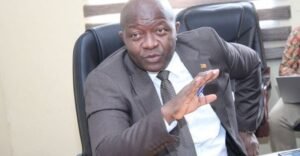
As Liberia meanders through thick and thine to land ambitious developments so longed, doing so only rests on making rule of law formidable foundation, according to Finance and Development Planning Minister Augustine Kpehe Ngafuan, warning Liberia “will get nowhere” on development if the rule of law is not made the foundation of governance, warning that weak courts and insecure property rights will undermine even the best economic policies.
He spoke at the weekend as keynote speaker during the graduation of 64 magistrates from the Professional Magistrate Training Program at the James A. A. Pierre Judicial Institute.
The program is seen as the country’s flagship initiative intended to strengthen lower courts and expand access to justice in all 15 counties.
He acknowledged the significance of rule of law in democratic governance, without which he believes “our entire economic foundation is on sinking sand.”
Ngafuan framed the judiciary as central to President Joseph Nyuma Boakai’s ARREST Agenda for Inclusive Development, stating “We can design the most brilliant economic policies and attract the world’s leading investors, but if the rule of law is weak, property rights are insecure, and justice is delayed or compromised, our entire economic foundation rests on sinking sand.”
The Finance Minister described the judiciary as “the final anchor of public trust,” stressing that both domestic and foreign investors need confidence that contracts will be enforced, disputes resolved fairly, and property rights protected before they commit capital.
Citing data from international institutions, Ngafuan said countries with stronger judicial systems attract higher levels of foreign direct investment and that efficient courts improve business competitiveness and economic resilience.
A defining point of Ngafuan’s address was Liberia’s growing financial ownership of judicial reform.
For more than a decade, the Professional Magistrate Training Program, now 16 years old, relied heavily on partners including Germany, GIZ, Sweden through UNDP, and the U.S. through USAID.
“Today, however, more than 90 percent of the Professional Magistrate Training Program is financed directly through the Government of Liberia’s judiciary budget,” Ngafuan said. “This demonstrates that Liberia is prepared to finance its own institutional development, secure its own peace, and invest directly in the capacity of its public servants.”
He revealed that funding for the Judiciary has risen from US$18.5 million in 2023 to US$33.3 million in the 2026 National Budget — an increase of about 80 percent in three years. According to him, the expanded budget is funding construction and rehabilitation of courts nationwide, improved operations of magisterial and circuit courts, digitization of court records and proceedings, logistics for judges, magistrates and public defenders and expansion of access to justice in rural communities.
Ngarfuan also bragged about government’s restoration of remuneration for Supreme Court Justices and subordinate court judges to pre-harmonization levels, with salary adjustments for magistrates and other judicial workers under its multi-year public sector reform.
“Our destination has not yet been reached,” Ngafuan acknowledged. “Sustained domestic revenue growth and prudent public expenditure management will be essential to financing future salary improvements.”
He urged 64 new magistrates who are expected to deploy to magisterial courts nationwide, with priority for underserved counties where judicial personnel remain scarce to lead with integrity.
“A sharp lawyer or magistrate with integrity is a blessing to society. A sharp lawyer without integrity becomes a menace,” he said, warning them to resist pressure from “politicians, business interests, relatives and influential individuals seeking to manipulate judicial decisions.”
“The authority you carry is not your personal property. It belongs to the Republic of Liberia,” he cautioned. “A magistrate may command a courtroom, but every magistrate remains a servant of the Constitution, the laws of Liberia and the ethical standards of the Judiciary.”
The Minister told them to “listen more than they speak, analyze evidence rather than rumors, and exercise judicial authority with restraint and impartiality.”
Ngafuan used the occasion to commend the Chief Justice and the Judiciary for a new strategic plan aimed at a “fair, independent and accountable judicial system.”
He pledged that the Ministry of Finance will continue mobilizing domestic and international resources to support priorities including reducing case backlogs and modernizing courts.
“While significant progress has been made during the Boakai administration’s first two-and-a-half years, additional reforms remain necessary,” he said. “There are still miles to travel. But the Judiciary President Boakai inherited in January 2024 is not the Judiciary we see today.”
Government officials say strengthening judicial independence is critical not only for democracy but also for economic growth and consolidating peace nearly two decades after Liberia’s civil war.
“We’ll get nowhere, if the rule of law is not where we start,” Ngafuan concluded.
The ceremony drew members of the Supreme Court Bench, diplomats, development partners and senior government officials.
About The Author