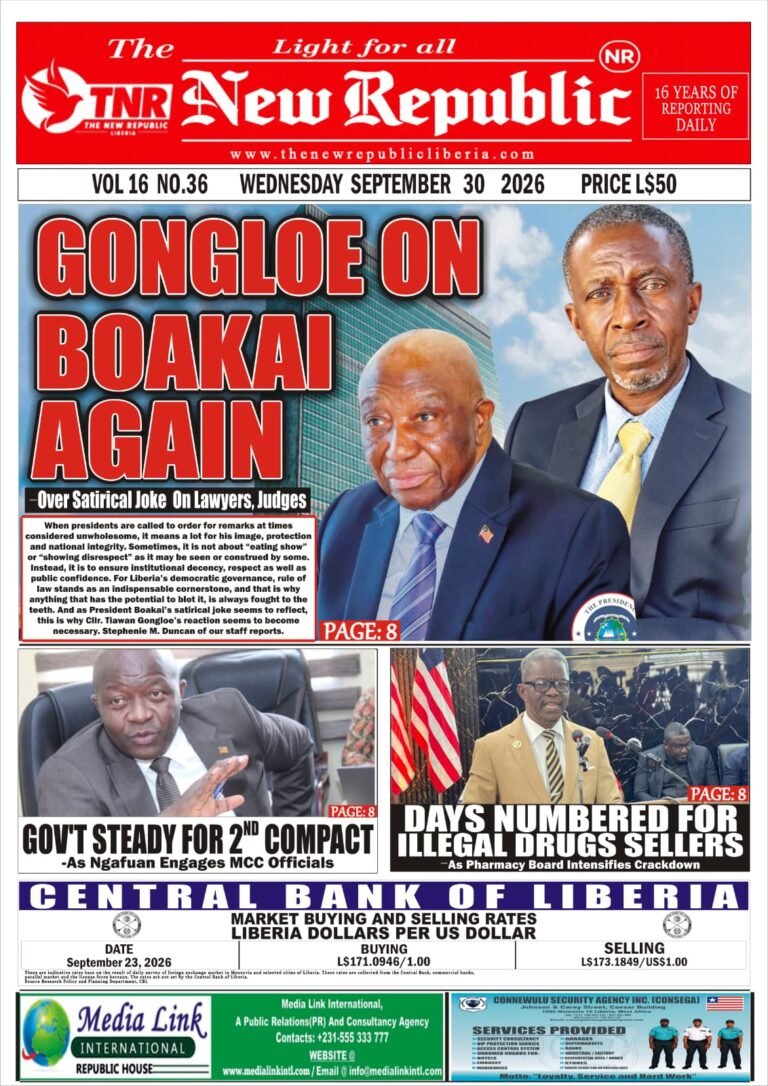

Monrovia-The Liberian government remains steady in its quest to secure a second development compact from the United States Millennium Challenge Corporation (MCC), as discussions entered a crucial stage between Finance and Development Planning Minister Augustine Kpehe Ngafuan and senior MCC officials in Washington.
The meeting, held on Monday, focused on progress toward Liberia’s proposed Second Compact and the formal transition into the Joint Design Phase — the stage where Liberia’s Compact Development Team (LCDT) and MCC will work jointly to refine investment proposals, set implementation arrangements, and agree on policy and institutional reforms required for a final deal.
Minister Ngafuan reaffirmed the Boakai administration’s commitment to fast-track the process and assured MCC that the Government of Liberia will provide full political and technical support to move the compact through all remaining stages.
He was joined by MCC Acting Deputy Vice President for Africa, Alicia Robinson-Morgan, Acting Managing Director for Africa, Carrie Monahan, MCC Country Director for Liberia, Kevin George, and LCDT National Coordinator, Alieu Fuad Nyei, among other officials.
A major focus of the discussion was Liberia’s electricity sector, particularly the urgent need to create stronger policy and regulatory conditions that can attract private investment in power generation and distribution.
Electricity remains Liberia’s biggest constraint to growth. World Bank data shows that only 34.9 percent of Liberia’s population had access to electricity in 2024, up from 32.5 percent in 2023. While this shows progress, Liberia still ranks among countries with the lowest access rates in the world.
The gap is starkest between urban and rural Liberia. Urban access has crossed 50 percent, while rural access remains below 10 percent.
The Liberia Electricity Corporation (LEC) customer base has grown rapidly — from 142,947 customers in 2021 to 282,505 in 2023 — while off-grid solar programs have also expanded, but demand still far outstrips supply.
According to the World Bank, reliable and affordable electricity is critical to unlocking Liberia’s agriculture, services, and mining sectors, creating jobs and improving competitiveness. This is crucial for a country with an estimated 5.73 million people and a GDP of about $5.25 billion in 2025, growing at about 5 percent.
Minister Ngafuan stressed that the next phase of Liberia’s power development cannot rely on public money alone. Government, he said, wants to put in place reforms that will encourage private investors to come into power generation and distribution, while strengthening LEC’s financial and operational sustainability.
Liberia’s push for a second compact builds on the success of the first MCC Compact, a five-year $256.7 million program that closed on January 20, 2021.
MCC reported that 92.1 percent of that compact was disbursed. The largest share of $209 million went to the Energy Project, while about $20 million went to the Roads Project.
The flagship investment was the rehabilitation of the Mount Coffee Hydropower Plant — Liberia’s main hydropower facility destroyed during the civil war. MCC contributed $151.5 million, alongside $212 million from three European partners, to restore the plant to its full 88 megawatts capacity in 2018.
According to MCC, the rehabilitation helped LEC provide more reliable and affordable power to over 76,000 homes and businesses — a threefold increase compared to 2015.
According to the Liberian Government’s account of the meeting, MCC Acting Deputy Vice President Alicia Robinson-Morgan commended Liberia for the pace of its compact development process and expressed optimism about the next milestones.
She indicated that the Joint Design Phase could be completed by May 2027, after which the proposed compact would be presented to the MCC Board for consideration in September 2027.
Subject to all required processes and approvals, she said MCC would welcome a Liberian delegation to Washington in December 2027 for the official signing of the Second Compact.
Those dates remain proposed targets, not final actions, as the compact will still have to go through full technical, economic, and policy reviews and board approval.
Robinson-Morgan also praised the work of the Liberia Compact Development Team led by National Coordinator Alieu Fuad Nyei for advancing the process.
For the Boakai administration, securing a second compact would be a major development win, potentially unlocking hundreds of millions of dollars in grants for energy and other growth sectors.
But for millions of Liberians who still live without reliable electricity, the true test will be whether the proposed investments and reforms translate into real power in their homes, lower tariffs for businesses, and expanded private investment that creates jobs.
For now, government says it will maintain momentum through the Joint Design Phase to ensure Liberia meets all conditions for a 2027 signing.
About The Author