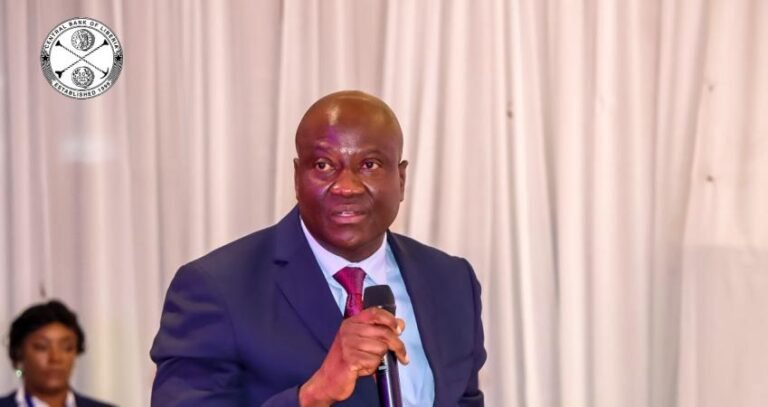

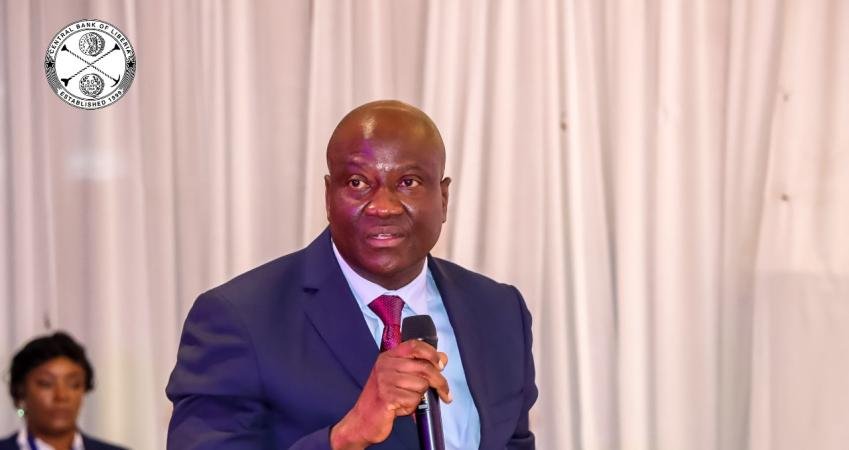
Monrovia-The Executive Governor of the Central Bank of Liberia (CBL), Henry F. Saamoi, has declared that Africa’s next frontier of financial inclusion is no longer about opening more bank accounts, but about connecting the systems that already exist.
Delivering his keynote address at the MojaCom 32 Conference in Ghana, Governor Saamoi told a gathering of central bank governors, regulators, and global payment leaders that Liberia’s experience proves that world-class, interoperable payment infrastructure can be built on open-source technology without prohibitively expensive proprietary systems.
“Financial inclusion is no longer primarily constrained by access and affordability. It is increasingly constrained by connectivity,” Saamoi said.
“Across Africa, millions of citizens today possess bank accounts, mobile wallets, and digital identities. Yet many still face barriers when attempting to move money across institutions, networks, and platforms. In many respects, we have successfully digitized financial services without fully connecting them.”
He added that “The next chapter of financial inclusion is therefore not simply about bringing more people into the financial system. It is about bringing the financial system together.”
The high-level conference brought together Deputy Governors and representatives of central banks and regulatory authorities, the CEO and representatives of the Mojaloop Foundation, representatives of the Gates and AfricaNenda Foundations, the CEO of GHIPSS and the Bank of Ghana, development partners, and leaders of financial institutions.
Governor Saamoi used the platform to outline Liberia’s payment system modernization journey, a journey he said did not begin with technology, but with a vision.
He disclosed that in 2025, Liberia achieved two significant milestones, including the launch of the Pan-African Payment and Settlement System (PAPSS) in Liberia, strengthening Liberia’s connection to Africa’s emerging continental payments ecosystem and supporting the African Continental Free Trade Area (AfCFTA).
He also named the launch of the Inclusive Instant Payment System (IIPS), enabling real-time interoperability between Liberia’s two largest mobile money providers, Lonestar Cell MTN Mobile Money and Orange Money Liberia.
He stressed that these were not merely technology deployments, but strategic investments in national infrastructure.
“We wanted Liberians to be able to transact across providers without having to worry about which network the recipient uses. We wanted government payments to become faster, more transparent, and more efficient.”
According to him, “We wanted businesses to have better tools to participate in a digital economy. And, ultimately, we wanted to create the foundation for a more connected and inclusive financial system.”
Giving hard numbers to back Liberia’s progress, the CBL Executive Governor reported that results have been encouraging.
In 2025 alone, he disclosed mobile money transactions in Liberia reached approximately “L$585 billion and US$6.9 billion” in value.
At the same time, Liberia’s systemically important payment systems processed approximately “230,367 transactions valued at approximately US$8.5 billion” for the same period.
Most notably, since its launch in “December 2025”, Liberia’s Inclusive Instant Payment System, powered by Mojaloop’s open-source infrastructure and implemented in collaboration with the Mojaloop Foundation, ThitsaWorks, and the AfricaNenda Foundation, has processed more than 5.3 million transactions as of August 31, 2026.
Of these, Governor Saamoi said about 4.2 million transactions, valued at L$4.1 billion, were conducted in Liberian dollars, while 1.1 million transactions, valued at US$22.2 million, were conducted in United States dollars.
He said “These figures demonstrate a growing demand for faster, more convenient, and more interconnected financial services, but more importantly, they demonstrate that the future of finance in Africa is increasingly becoming digital.”
A central theme of Governor Saamoi’s address was Liberia’s decision to adopt the “Mojaloop open-source solution” as digital public infrastructure.
He explained that for developing economies like Liberia, the Mojaloop model is transformational because it lowers barriers to innovation, promotes competition, encourages interoperability, and allows countries to build solutions that respond to their own realities rather than replicating expensive models developed elsewhere.
“For Liberia, adopting the Mojaloop Open-Source Solution was not merely a technology decision. It was a strategic choice to support financial inclusion through digital public infrastructure,” he said.
“It demonstrates that world-class payment infrastructure can be built using open, scalable, and inclusive digital public infrastructure that does not necessarily require prohibitively expensive proprietary solutions.”
Governor Saamoi offered four key lessons from Liberia’s journey that may be useful for fellow central banks, saying “Digital transformation requires vision, commitment, and sustained engagement from policymakers and regulators. Without leadership, interoperability remains an aspiration, but with leadership, it becomes reality.”
According to him, collaboration matters more than technology, adding “Technology challenges can be solved, but institutional fragmentation is far more difficult. Banks, mobile money operators, switches, regulators, and government institutions must see themselves as partners.”
He also said interoperability should be viewed as national infrastructure.
“Just as roads connect communities and telecommunications networks connect people, payment systems connect economic opportunity. When institutions operate in silos, customers bear the cost,” the CBL Governor said.
“The success of a payment system should not be measured solely by transaction volumes. It should be measured by whether more people gain access to financial services, whether small businesses transact more efficiently, and whether citizens participate more actively in the formal economy.”
He also emphasized country ownership, noting that while development partners, technology providers, and international organizations have important roles, the vision, priorities, and ownership must come from the country itself.
“We did not seek to replicate another country’s payment system. We sought to develop infrastructure that responds to Liberia’s own circumstances, policy priorities, market structure, and development objectives.”
Looking beyond Liberia, Governor Saamoi tied instant interoperable payments directly to the success of the African Continental Free Trade Area (AfCFTA).
“The future of African integration will depend not only on how efficiently goods move across borders, but also on how efficiently money moves across borders. Trade cannot flourish if payments remain slow, costly, and fragmented.”
“Through initiatives such as PAPSS and through continued collaboration among African central banks, we have an opportunity to create a future where payments across Africa are faster, cheaper, safer, and more accessible.”
Governor Saamoi said”Liberia’s experience is not ultimately a story about technology. It is a story about inclusion. It is a story about partnership. It is a story about connecting people to opportunity.”
“The future of African financial inclusion will not be determined by the number of institutions we create. It will be determined by how effectively those institutions connect,” he said. “Africa does not need to wait for the future of payments. Africa can build it.”
Governor Saamoi thanked the Mojaloop Foundation, the Gates Foundation, the AfricaNenda Foundation, the Republic of Liberia and host Republic of Ghana, and Africa for the success of the gathering.
About The Author