
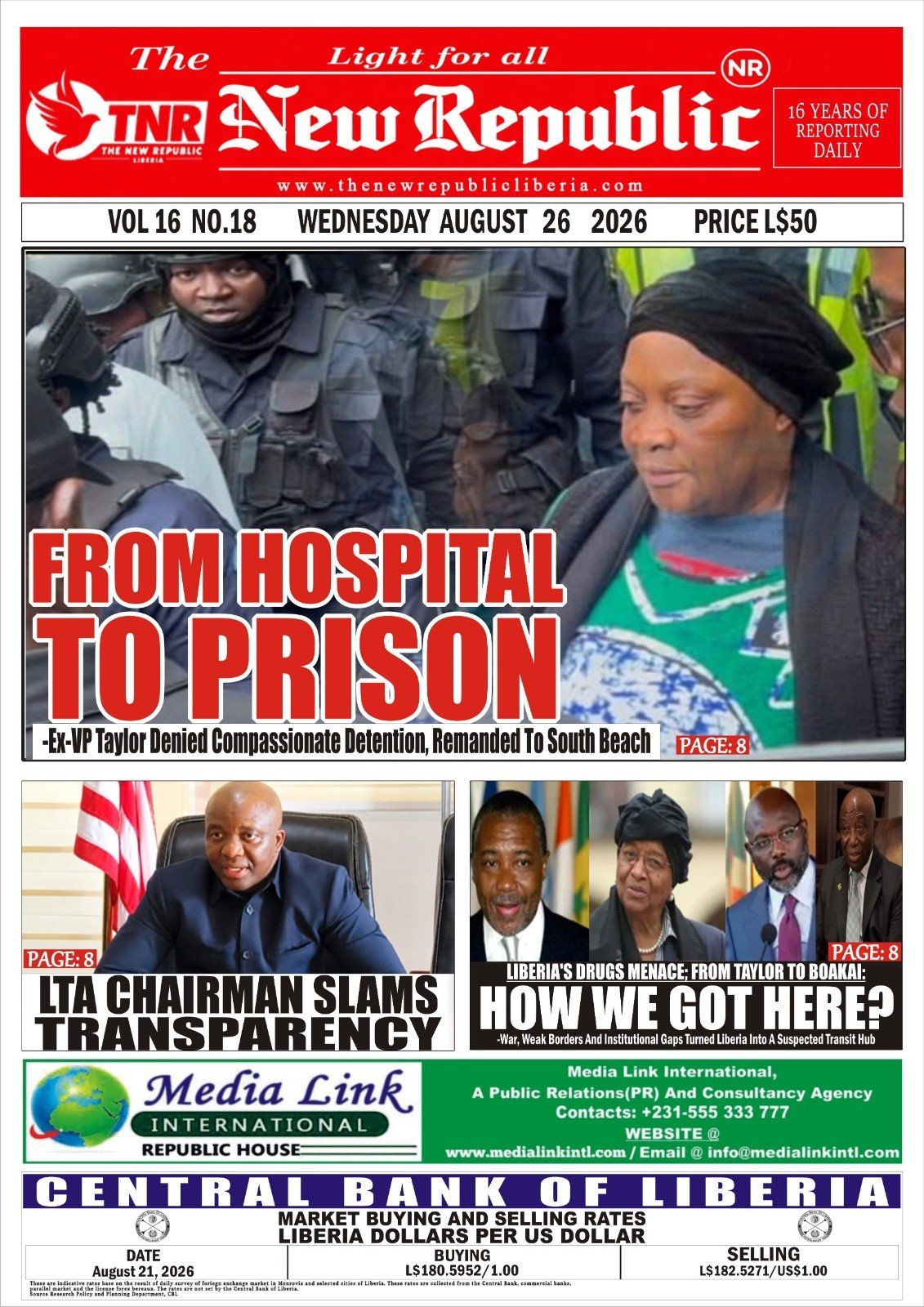
MONROVIA–From warlord bush encampments in the 1990s to a $317 million cocaine burn in 2026, Liberia’s relationship with narcotics has evolved from a weapon of war into what security analysts now describe as a regional transit crisis.
As the Government of Liberia pursues high-profile arrests, including the recent detention and charging of former Vice President Jewel Howard Taylor, civil society groups and international observers are asking as to how did Liberia become one of Africa’s most talked-about drug-prone nations.
Those familiar with Liberia’s drugs history trace the crisis to the 1990-2003 civil war launched by former President Charles Ghankay Taylor against the regime of then President Samuel Kanyon Doe.
Taylor and his National Patriotic Front of Liberia (NPFL) forcibly recruited and conscripted thousands of young people and allegedly drugged them to fight for his socalled ‘revolution.’
It is during that period, experts argued, the country collapsed into becoming a drug-destination and its youths becoming abusers and users. Thousands of young people, according to different accounts, succumbed to drug-related deaths, while many others became wayward, and turned into hardcore criminals.

According to Liberian United Youth for Community Safety and Development, LUYCSD, a Nimba-based NGO at the time, drugs were used by warlords “as a means of luring fighters into bravery and cannibalism.”
In a detailed report, the organization reckoned that children as young as 12 were conscripted and routinely drugged to fight for various factions. LUYCSD estimates that approximately 38% of Liberia’s current youth population, now aged 12 to 46, were drugged to participate in that unconventional warfare.
The organization warned that without rehabilitation, the legacy has “generational and future ramifications.”
“It is unimaginable that a legislative enactment emanating from a country still grappling with the aftermath of a gruesome civil war would ignore public health and push only criminalization,” LUYCSD wrote in a 2022 statement to the UNODC.
After 2003, drugs barons allegedly took advantage of Liberia’s weak border structures and poverty-stricken, under-paid security personnel to flood the country.
Between 2005 and 2020, Liberia was listed among West African states where over 90kg of cocaine was seized, with total regional seizures hitting 2,500kg, according to WACD 2014 data cited by LUYCSD.
The group notes that figure only reflects what entered state dragnets. LUYCSD’s 2011-2013 survey of over 600 people in ghettos across 15 counties found that most used drug, Cannabis, followed closely by “Italian White” locally called cocoa.
It recorded that 30% users were between 25-29 years, 21% were 30-34 years, while 55% said relatives no longer trust them, 22% said family consider them rogues, and 17% said they were rejected.
According to the report, only 2% were formally employed. Most wanted vocational training, jobs, or money to start business.
The survey also identified hotspots in Nimba’s Ganta and Gompa, Bong’s Gbarnga, Margibi’s Kakata, and Montserrado’s Congo Town, Chocolate City, New Kru Town, Clara Town, Duala, Red Light and West Point.
LUYCSD concluded that low education, lack of rehabilitation for ex-combatants, and police harassment without treatment options have entrenched abuse.
As it means of mitigating the drug crisis and providing reprieved opportunities to addicted youthful citizens, President Ellen Johnson Sirleaf, in 2014, signed the Liberia Controlled Drugs and Substances Act and the Act establishing the Liberia Drug Enforcement Agency.
But not everyone was satisfied with some of thing conditions therein. For example, LUYCSD and other CSOs argued at the time that the laws focused too heavily on punitive measures against low-quantity users, with little distinction between users, small dealers, and high-level traffickers.
They also flagged the absence of human rights protections in enforcement. Critics argued that the approach ignored lessons from a post-conflict country where addiction is tied to trauma. “Drug use should be seen primarily as a public health issue,” LUYCSD recommended to UNODC.
However, it is alleged that the country descended further into the abyss of drug prolifieration during the six-year term of the Coalition for Democratic Change (CDC) administration during which different kinds of narcotic substances reportedly flooded the society.
Tramadol, Kush were two leading narcotic substances linked to the Weah government of being responsible for – a claim the government denied repeatedly up to the time it left power.
It is believed in many political quarters that the government’s poor handling of the drugs crisis under its watch largely contributed to its 2023 elections loss to the Unity Party.
But former George Weah recently defended his government’s strong fight against drugs and other forms of substance abuse in the country, predominantly amongst the youthful population.
Those who worked closely with the government on drugs-related issues said the Weah government took actions to curtail infiltration and proliferation of drugs. They also made reference to the creation of recreation and rehabilitation centers.
Recall how authorities in October 2022 seized some $100 million worth of cocaine, with help from the United States’ international narcotics agency.
Then Justice Minister Musa Dean at the time told reporters the national Drug Enforcement Agency, with help from the Bureau of International Narcotics and Law Enforcement Affairs of the United States, had made the seizure Saturday in Topoe village, a western suburb of the capital Monrovia.
The operation led “to the seizure of $100 million worth of pure cocaine”, he said.
During the seizure, a Guinea-Bissau national and a Lebanese suspect were arrested, he added.
The drug agency could not confirm reports shared on social media that the drug had been stored in frozen fish containers. It said the investigation was ongoing.
Drug enforcement agency chief Marcus Zehyoue said “a full-scale investigation” was underway along with a search for accomplices who escaped capture.
The US embassy in Liberia congratulated the Liberian authorities on the drug haul, saying in a statement that it was the result of swift joint action.
“The success of this operation is the direct result of excellent communication between law enforcement agencies around the world, including Brazil, the United States, and Liberia, among others.” it added.
However, under President Joseph Nyuma Boakai who came to power on the promise to fight the drug menace Liberia suffered is facing challenges just as his predecessors, as authorities have acknowledged Liberia’s role as a transit node.
In the first year of the Boakai administration, a new substance – Zombie – surfaced and caused stirs nationwide among young people, causing sores on their feet.
Security sources and media reports point to vulnerable geography; unsupervised coastlines and the Freeport of Monrovia and RIA being used for Europe-bound shipments.
There is also the issue of institutional compromise. Allegations that traffickers recruited inside border, intelligence, and drug agencies are prevalent.
Few security officers across the Liberia National Police, National Security Agency, Liberia Drug Enforcement Agency are arrested, charged and detained at the Monrovia Central Prison for their alleged connections and facilitation of movements of drugs.
Another important factor has to with high-level complicity. Investigations into multi-million-dollar hauls moved with official vehicles and port clearances.
But the most prominent case came in August 2026 with the arrest of former Vice President Jewel Howard Taylor, who was charged under the 2023 Controlled Drug Act, Penal Law, and Anti-Money Laundering Law for alleged involvement in a transnational narcotics network.
Three foreign nationals were also charged in absentia. Madam Taylor was later hospitalized at Gomex Hospital for high blood pressure and asthma, postponing her court appearance.
The Boakai administration says it is reforming security, including dismissing compromised chiefs at airports and in police and national security.
In 2026 authorities also publicly burned a $317 million cocaine haul, sending what officials called “a blunt warning to Europe-bound traffickers.”
Experts note that while cartels like Mexico’s Sinaloa, Colombia’s former Medellin, and others dominate production, West Africa has become attractive because of weak enforcement and geographic location.
Experts say Liberia’s porous borders fit that pattern, recalling how the LUYCSD in its report urged UNODC and donors to fund rehabilitation and reintegration, not just arrests.
Their recommendations include medical and counseling services in ghettos, vocational training and jobs for users aged 12-36, women empowerment and child-rearing programs to prevent the next generation and distinction in law between users and traffickers, with heavier punishment for traffickers.
“We are pleading to UNODC to connect LUYCSD with friendly donors to support our work up to 2030,” said Board Chairman J. Kofa Tolbert and CEO Fred C. Johnson.
From Taylor’s war-era conscription to Ellen’s law-making, Weah’s enforcement gaps, and now Boakai’s crackdown and political prosecutions, Liberia’s drug story mirrors its state-building challenges.
The government insists that “No office is too high, no political connection is too powerful,” while civil society actors insist that “without treatment, jobs, and border reform, arrests alone won’t break the cycle.”
As one LUYCSD respondent put it: “They raid us before Christmas and July 26, put us in cell without explanation. We need school, not just jail.”
With an active investigation, an imprisoned ex-VP, and millions in drugs being intercepted, Liberia’s next chapter will likely be decided not just in courtrooms, but in clinics, schools, and at its borders.
About The Author