

By Cllr. Jimmy Saah Bombo
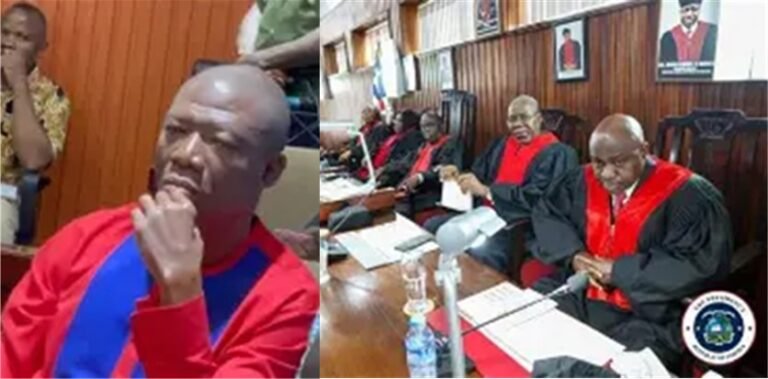
MONROVIA– At the formal opening of the October Term of the Honorable Supreme Court of Liberia, His Honor Chief Justice Yamie Quiqui Gbeisay advanced a bold recommendation: the abolition of trial by jury. The Chief Justice reasoned that pervasive jury tampering has eroded the integrity of jury proceedings, rendering them ineffective in the administration of justice. His pronouncement has ignited widespread debate among lawyers, politicians, advocates, and the general public.
Constitutional Foundation of Jury Trials
The right to trial by jury is enshrined in the 1986 Constitution of Liberia. Article 20(a) guarantees that no person shall be deprived of life, liberty, or property except through due process of law, and specifically provides for trial by jury in cases not arising in courts of record, courts martial, or impeachment proceedings. Article 21(h) further affirms the accused’s right to a speedy, public, and impartial trial by a jury of peers, unless expressly waived.
The framers of the Constitution, mindful of Liberia’s political and social realities, sought to safeguard individual rights by ensuring that decisions affecting liberty and property would not rest solely in the hands of a single judge. Their intent was to promote transparency and fairness by entrusting verdicts to a collective body of citizens.
The Practical Challenges of Jury Trials in Liberia
Despite this noble intent, the jury system in Liberia has become deeply problematic. Jurors, often lacking legal or professional training, are tasked with adjudicating complex matters such as commercial disputes or medical malpractice claims. The Judiciary Law, Chapter 18, subsection 18.2, sets minimal qualifications—merely the ability to read, write, and understand English. This standard fails to equip jurors to grasp intricate legal and factual issues, resulting in verdicts that are frequently divorced from the evidence presented.
Moreover, jury verdicts are susceptible to corruption and bias, often influenced by financial inducements or political affiliations. Unlike judges, jurors are not required to provide reasons for their decisions, leaving verdicts opaque and difficult to challenge on appeal. Judges, wary of public perception, are reluctant to overturn flawed jury verdicts, further undermining confidence in the system.
Comparative Perspectives
Liberia is not alone in practicing jury trials. However, many jurisdictions restrict jury proceedings to serious criminal offenses and, in some cases, employ hybrid systems combining laypersons with legal professionals. Such models mitigate the risks inherent in entrusting complex legal determinations solely to lay jurors. Liberia, alongside the United States, remains one of the few countries to maintain a broad jury system dominated by laypersons.
Systemic Inefficiencies
The statutory framework governing jury trials compounds the problem. Criminal Procedure Law section 19.1 and Civil Procedure Law section 22.2 mandate that only one jury panel may sit at a time. Consequently, courts often hear only a handful of cases per term, leaving scores of matters unresolved for years. Property disputes, in particular, languish for decades, depriving litigants of timely justice and eroding public trust in the judiciary.
The Case for Reform
Opponents of abolishing jury trials argue that judges, like jurors, may be susceptible to bribery. While this concern is valid, judicial decisions are subject to appellate review and must be accompanied by reasoned opinions—mechanisms that provide transparency and accountability absent in jury verdicts.
The suggestion of adopting a hybrid jury system merits consideration but would require significant structural reforms, including the establishment of specialized courts. Until such reforms are feasible, the current jury system remains untenable.
Conclusion
As Liberia strives to uphold the constitutional mandate of speedy and transparent justice, it is imperative to confront the realities of our jury system. The inefficiencies, corruption, and lack of competence among jurors have stripped the process of its intended purpose. In light of these challenges, the recommendation of the Chief Justice to abolish trial by jury deserves serious support. Reforming our judicial system in this manner would advance the cause of justice and restore public confidence in the rule of law.
About The Author