
By Jamesetta D. Williams
Monrovia-The Liberian government said it is in a prepared state of readiness to resume the United Nations Security Council presidency in December, two months from now, as it has outlined a series of diplomatic engagements, infrastructure projects and policy reforms.
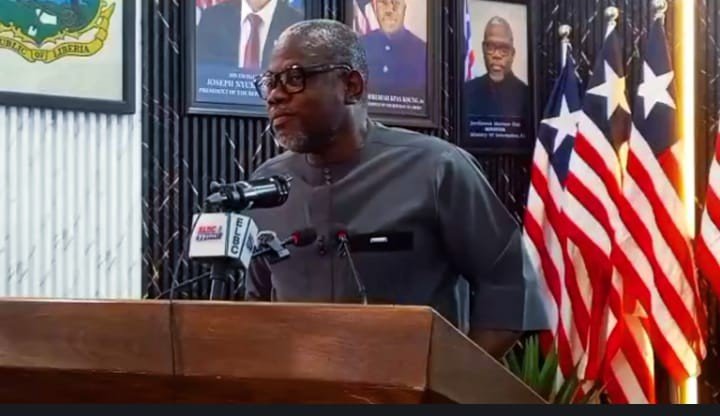
Information Minister Jerolinmek M. Piah made the disclosure Tuesday at the Ministry of Information’s regular press briefing, where he highlighted ongoing government efforts in electricity generation, water supply, transportation, public works, mining, petroleum storage and telecommunications.
Minister Piah described Liberia’s upcoming leadership of the Security Council as a significant opportunity to demonstrate the country’s progress from a nation that previously received international peacekeeping support to one contributing directly to international peace and security.
He said the government is preparing a series of activities ahead of the December presidency, during which President Joseph Nyuma Boakai is expected to lead Liberia’s delegation to the United States and preside over Security Council deliberations.
According to the minister, the planned activities include a diplomatic briefing and reception, the unveiling of a national war memorial, a visit by a peace museum delegation, the launch of Liberia’s feminist foreign policy, a maritime seafarers’ event and a model United Nations Security Council debate.
He also announced plans for a presidential dinner at the Ministry of Foreign Affairs coupled with the launch of a compendium of Liberia’s peace agreements by President Boakai.
Piah said the proposed national war memorial is intended to honor those who lost their lives during Liberia’s civil conflicts. He noted that figures concerning the number of people killed during the wars vary, making it important for the country to establish a memorial that recognizes the victims.
The minister said the activities are intended to showcase Liberia’s transformation, strengthen diplomatic partnerships and highlight the country’s contribution to global peace and security.
On domestic development, Minister Piah highlighted progress under the government’s electricity expansion initiatives, particularly projects being implemented by the Rural and Renewable Energy Agency.
He said electricity infrastructure projects are advancing in several counties, including Lofa, Grand Bassa, Sinoe and other parts of the country.
In Lofa County, the agency has completed the commissioning of a one-megawatt power generation system, while testing and commissioning of approximately 350 kilometers of low- and medium-voltage distribution lines are nearing completion.
The project is expected to provide electricity to about 1,000 homes, businesses and public facilities.
The agency is also working to complete the installation of a solar photovoltaic system and a 15-megawatt-hour battery energy storage system to support power generation and distribution in the county.
In Buchanan, Grand Bassa County, the agency is developing the electricity distribution network and carrying out service connections to homes, businesses and public facilities. Approximately 12,000 connections are planned under the project.
In Greenville, Sinoe County, testing and commissioning of the power generation system, which includes solar photovoltaic modules, battery storage and a diesel generator, have been completed. Work is continuing on distribution lines and service connections.
Meanwhile, construction of a two-megawatt hydropower plant is expected to resume with the onset of the dry season, providing an additional source of electricity for the area.
In Barclayville, Grand Kru County, civil works have begun for a solar power generation and battery storage system, with more than 1,500 connections planned.
Piah also highlighted plans to expand electricity access to public health facilities and schools.
He said the government intends to solarize an additional 84 public health facilities across the country as part of efforts to ensure that no baby is born in darkness at a public health facility by 2030.
The government is also targeting 34 public schools, including high schools and some middle-level institutions, for solar electrification to improve teaching and learning conditions.
The minister also highlighted progress by the Liberia Water and Sewer Corporation (LWSC), particularly the completion of a 10-kilometer section of a 48-inch water transmission pipeline under the Liberia Urban Water Supply Project.
The project, supported by the World Bank, is intended to improve access to safe, reliable and sustainable drinking water in Monrovia.
Speaking at the commissioning ceremony, LWSC Managing Director Mohammed Ali said the project would improve the quality of life for residents and bring the country closer to ensuring that households have access to safe water.
The project also includes rehabilitation and expansion of Monrovia’s water distribution system, construction of a ground reservoir and replacement of sections of the main transmission pipeline supplying the city’s water treatment facilities.
According to the information presented, the project has already provided access to water for approximately 45,055 people and improved services for about 62,885 customers. It has also strengthened the operational efficiency of the LWSC and improved the capacity of the water treatment plant.
Outside Monrovia, the corporation is expanding solar-powered water supply systems in several communities.
Solar equipment has arrived in Bomi and Greenville to support the operation of water supply systems.
In Greenville, the project is expected to connect approximately 300 households, including health centers and schools. In Barclayville, another 350 households are expected to benefit from water connections.
The corporation has also begun constructing a water supply system in Compound Number Three, Grand Bassa County, which is expected to serve 120 households.
A similar project is underway in Totota, Bong County, where 120 households are expected to receive connections.
Construction is also expected to begin in Kpanyan, Grand Cape Mount County, to provide water connections to another 220 households.
The systems are expected to be powered by solar energy.
The LWSC is also conducting feasibility studies for possible water supply projects in Buchanan, Kakata, Fishtown and other communities.
On transportation, Piah addressed public discussions surrounding reports that the National Transit Authority (NTA) had introduced free transportation for students and senior citizens.
He said the NTA had clarified that the proposed policy had not yet been implemented.
The existing free transportation arrangements cover security officers in uniform, persons with disabilities, children under five years of age nationwide and individuals with proper identification who fall within the categories currently recognized by the authority.
However, the NTA is considering introducing free transportation for students and citizens aged 65 and above.
The minister said the public should rely on official communications from the authority for accurate information about transportation charges and any future changes to the policy.
The Ministry of Public Works has also introduced reforms aimed at improving procurement processes and strengthening the participation of Liberian-owned companies in national development projects.
Piah said the ministry recently held its second introspective quarterly dialogue, bringing together ministry officials, contractors and other stakeholders to review policies, procedures and processes relating to tendering, contracting and project implementation.
The meeting provided an opportunity for contractors to raise concerns, seek clarification and assess challenges affecting the implementation of public works projects.
According to the minister, Public Works Minister Roland Giddings emphasized the need for collaboration between the ministry and contractors to achieve development targets and improve service delivery.
Piah said the ministry has reduced the number of steps in its contracting process from 88 to 57, a move intended to address delays, including those affecting payments to contractors.
He also said the ministry has adopted measures to give Liberian-owned companies greater opportunities to participate in public infrastructure projects.
Under the reforms, certain road construction and rehabilitation projects within the ministry’s portfolio have been reserved for Liberian-owned companies.
The minister said the measures are intended to give local contractors a competitive advantage and ensure that they are not disadvantaged when competing with foreign companies.
He encouraged Liberian contractors to remain committed to delivering quality work while urging foreign companies operating in the country to continue supporting Liberia’s development.
The minister also announced the formal launch of a project to formalize artisanal and small-scale mining operations in Liberia and Sierra Leone.
The initiative is intended to strengthen regulatory oversight, improve miners’ livelihoods and increase national revenue from mineral resources.
The project is jointly undertaken by Liberia and Sierra Leone and is supported by the African Development Bank, with a total funding allocation of US$2 million. Liberia is expected to receive US$1 million for implementation.
The project will focus on strengthening regulatory institutions, formalizing artisanal and small-scale mining operations, and improving project coordination and management.
The initiative is expected to help improve oversight of mining activities while promoting more organized and accountable operations in the sector.
Piah also highlighted efforts by the Liberia Petroleum Refining Company (LPRC) to strengthen the country’s petroleum storage capacity.
He said President Boakai had recently broken ground for the construction of an additional 35-million-liter petroleum storage facility while dedicating an already completed facility.
According to the minister, the expansion is intended to improve Liberia’s ability to maintain adequate petroleum reserves and ensure a more reliable supply of fuel.
He explained that sufficient storage capacity is particularly important during international petroleum market disruptions, which can affect the availability and cost of fuel.
Piah referred to the impact of international tensions, including the conflict involving the United States and Iran, on petroleum markets, noting that countries with limited storage capacity are particularly vulnerable to supply challenges.
He praised the LPRC management team for its efforts to maintain the availability and affordability of petroleum products in Liberia despite external pressures.
The minister also commended political leader Musa Bility for publicly recognizing the government’s and LPRC’s efforts in managing the petroleum sector.
He said acknowledging positive developments were important, just as the government should be held accountable when problems arise.
Meanwhile, the Liberia Telecommunications Authority (LTA) has deployed two teams to assess telecommunications coverage gaps across the country’s western, central and southeastern regions.
Piah said the assessment would help identify communities and locations where telecommunications services remain weak or unavailable.
He noted that unreliable network coverage can prevent people from communicating during emergencies and limit access to essential services.
The assessment is expected to help the LTA work with telecommunications companies to identify possible solutions and improve coverage in underserved areas.
The minister described the exercise as an important step toward ensuring that more Liberians can access reliable telecommunications services regardless of their location.
In concluding his remarks, Piah announced that the ministers of Health and Public Works are expected to appear at the Ministry of Information’s press briefing on Thursday to provide updates on their respective sectors.
He said the Health Minister, Dr. Louise M. Kpoto, had agreed to brief the public on progress made in the health sector.
The minister also indicated that the government intends to provide more information on infrastructure development and other ongoing initiatives through the relevant sector leaders.
Piah said the briefings are part of efforts to keep the public informed about government programs, progress and challenges.
He added that Liberia’s preparations for the United Nations Security Council presidency would continue alongside domestic development initiatives, as the government seeks to strengthen the country’s international standing while improving services for its citizens.
About The Author