
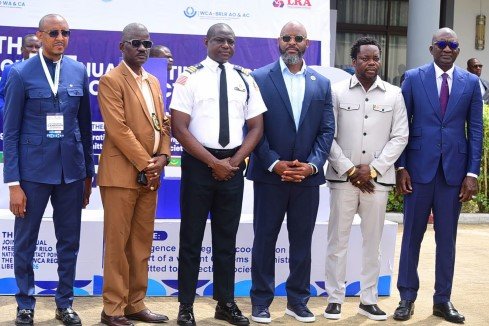
Monrovia-Liberia has joined other like-minded nations in combating cross-border crimes by hosting the 17th Joint Annual Meeting of National Contact Points of the World Customs Organization (WCO) Regional Intelligence Liaison Offices (RILO).
The gathering brought together more than 40 customs and intelligence officials from 17 countries across West and Central Africa to strengthen regional cooperation against smuggling and transnational crimes.
The weeklong meeting, hosted by the Liberia Revenue Authority (LRA) through its Customs Department, is being held at the Farmington Hotel in Margibi County under the theme, “Intelligence and Regional Cooperation in Support of a Vigilant Customs Administration Committed to Protecting Society.”
The gathering, the first of its kind to be hosted in Liberia, is intended to strengthen intelligence sharing, improve coordination of regional enforcement operations and deepen partnerships among customs administrations, security institutions and regulatory agencies.
Speaking at the opening ceremony on Monday, Amandu Tejan Sesay, Director General of RILO West Africa, described the meeting as an important platform for strengthening cooperation among customs administrations in the region.
He commended the LRA for hosting the gathering and emphasized that effective intelligence sharing remains critical to disrupting criminal networks and addressing illicit trade.
According to Sesay, seizures involving narcotics, counterfeit medicines and protected wildlife go beyond enforcement statistics, as they contribute directly to protecting communities and public safety.
“When intelligence is shared and connected across borders, we are able to identify trafficking routes, dismantle criminal networks, and target the individuals responsible for illicit trade,” he said.
He highlighted the role of National Contact Points in collecting, analyzing and disseminating intelligence to relevant authorities for enforcement action, urging participants to develop practical recommendations and establish clear mechanisms to ensure the implementation of decisions reached during the meeting.
Liberia’s Commissioner of Customs, Saa Saamoi, called for stronger regional intelligence-sharing mechanisms and coordinated border enforcement, warning that criminal organizations continue to exploit weaknesses in national security systems and delays in information exchange.
Saamoi noted that customs administrations face increasing pressure to improve revenue collection, facilitate legitimate trade and combat illicit activities amid expanding global trade, technological advancements, e-commerce and increasingly sophisticated criminal networks.
He identified cargo misdescription, undervaluation, origin fraud, document falsification, concealment of prohibited goods and diversion of transit cargo as some of the common forms of customs fraud confronting authorities.
The Commissioner stressed the need to balance trade facilitation with effective enforcement, particularly through improved risk assessment and the identification of high-risk consignments.
“We must make faster clearance decisions without compromising our controls. We must reduce unnecessary physical examinations while improving our ability to identify high-risk consignments,” Saamoi stated.
He further warned that intelligence cooperation must produce measurable operational results rather than focus solely on the volume of information exchanged.
“Intelligence collected but not analyzed has limited value. Intelligence analyzed but not shared in a timely manner loses its operational relevance,” he added.
Saamoi urged National Contact Points to strengthen their connections with national intelligence units, risk-management teams, frontline customs officers and regional counterparts, while encouraging greater use of the WCO Customs Enforcement Network (CEN) and CENcomm platforms.
“Our borders may separate our national jurisdictions, but they do not separate the criminal networks that exploit them,” he said.
Also speaking on behalf of the Vice-Chair of the WCO West and Central Africa Region, Ibrahim Njoya called on customs administrations to move away from reactive enforcement and adopt proactive, intelligence-driven approaches to identifying emerging threats and trafficking methods.
Njoya referenced recommendations from the 2025 RILO meeting in Bamako, Mali, which encouraged customs administrations to expand their use of Geospatial Intelligence (GEOINT), Open-Source Intelligence (OSINT), Artificial Intelligence (AI), and tracking and tracing technologies to improve intelligence gathering and enforcement.
He also commended the LRA for involving national security and law enforcement institutions in the meeting, describing inter-agency collaboration as essential to combating transnational criminal activities.
However, Njoya disclosed that only 17 of the region’s 24 customs administrations participated in the recent CRIFAX 11 regional operation, calling for broader participation in future joint operations.
He stressed that effective regional intelligence cooperation requires the active involvement of all member administrations.
Meanwhile, representing the Government of Liberia and the Joint Security apparatus, Prince B. Mulbah, Deputy Director General for Administration of the Liberia Drug Enforcement Agency (LDEA), called for a coordinated regional response to the growing threat posed by interconnected criminal networks.
Mulbah identified the trafficking of Kush and tramadol, illicit financial flows, arms smuggling, counterfeit pharmaceuticals and environmental crimes as major security concerns confronting countries across the region.
He emphasized that intelligence gathered by Customs authorities must be shared with other law enforcement institutions to strengthen investigations and facilitate coordinated enforcement operations.
“The sources of customs are the sources of the police. The sources of the police are the sources of the Drug Enforcement Agency. The sources of drug enforcement are the sources of our nations,” he said.
Mulbah also identified porous borders, limited forensic capabilities, delayed intelligence sharing and corruption as persistent challenges, emphasizing the importance of developing well-trained, disciplined and ethical security personnel.
The meeting has brought together representatives from 17 countries, including Benin, Burkina Faso, Cameroon, Cabo Verde, the Central African Republic, Chad, Côte d’Ivoire, Equatorial Guinea, Gabon, The Gambia, Ghana, Guinea, Guinea-Bissau and Liberia, among others.
The RILO network is part of the WCO’s global customs intelligence framework, providing member administrations with a platform for intelligence exchange, risk analysis, operational coordination and capacity building.
Participants are expected to review recommendations from the previous meeting in Bamako and examine issues relating to intelligence exchange, data quality, regional operations and the effective use of customs intelligence-sharing platforms.
The meeting is expected to conclude with recommendations aimed at strengthening regional intelligence networks, improving enforcement capabilities and enhancing collective efforts against cross-border criminal activities.
About The Author