
By Benjamin Q. Z. Johnson
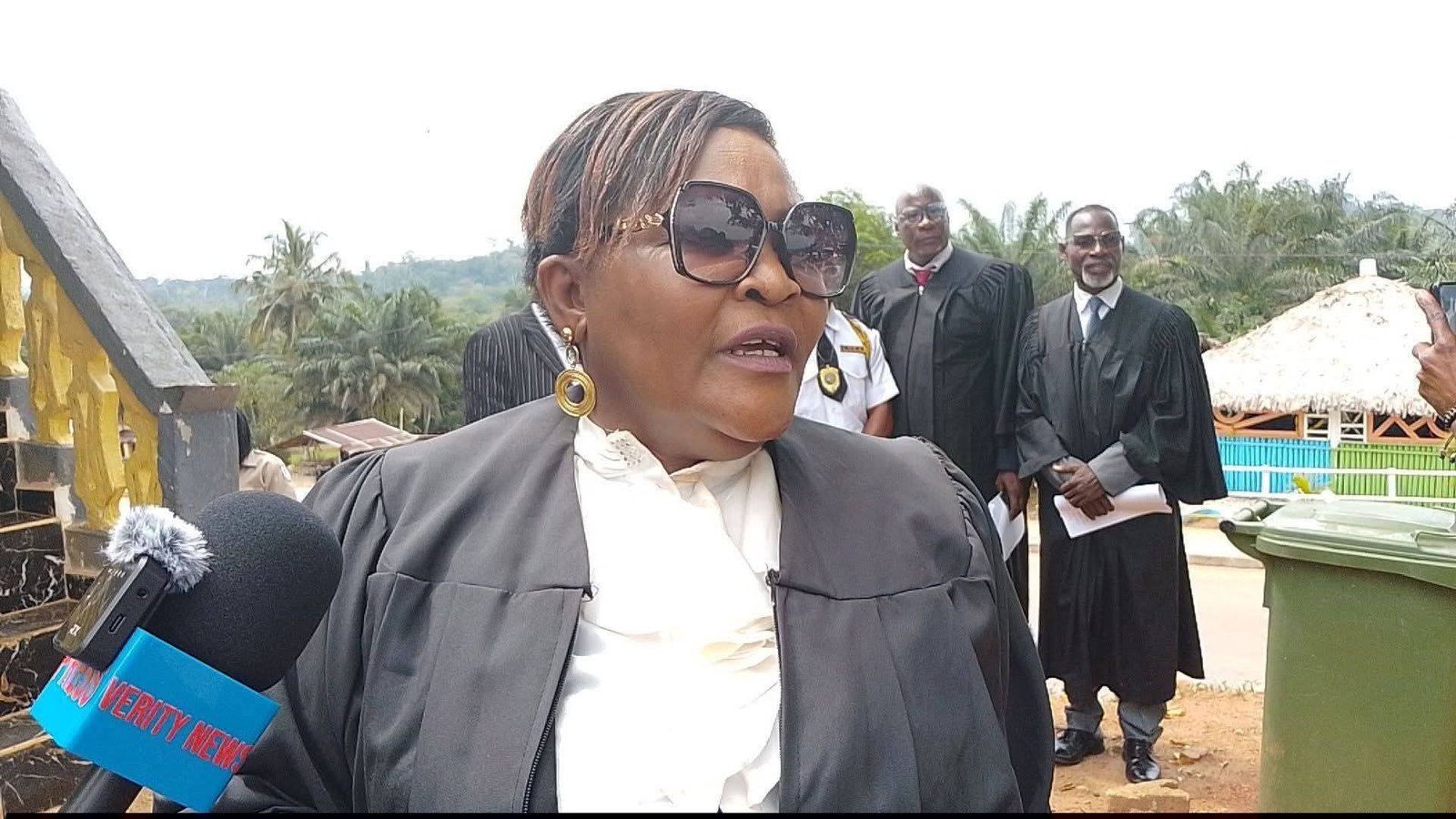
Monrovia-The President of the River Gee Bar Association, Cllr. Dennes Sokan, has sharply criticized the Judiciary of Liberia over the construction of a newly dedicated court facility in Fish Town, describing the structure as inadequate, uncomfortable, and poorly equipped to support the effective administration of justice.
Speaking on November 9, 2026, during the dedication ceremony and formal opening of the November AD Term of Court, Cllr. Sokan expressed strong dissatisfaction with the facility, arguing that it falls below the minimum standards expected of a Circuit Court.
The newly constructed building, located outside Fish Town, the county’s administrative capital, consists of a relatively small courtroom, three modestly sized offices, three bathrooms, and a front porch.
According to Cllr. Sokan, the facility lacks several essential components required for the smooth operation of a Circuit Court, including a dedicated room for jurors, offices for the County Attorney and Public Defender, a properly equipped court records room, and an office for the Sheriff.
She also raised concerns about excessive heat, poor ventilation, and limited working space, warning that the conditions could negatively affect judges, lawyers, jurors, court staff, and members of the public who depend on the justice system.
In unusually blunt remarks, the Bar Association President described the facility as a “complete trash,” questioning whether the structure adequately represents the dignity and importance of the justice system.
“This is complete trash. If I were the assigned judge for this November AD Term of Court, we would do business here because this does not represent River Gee County and its people. Even a magisterial court in Montserrado County is better than this,” she reportedly declared.
Cllr. Sokan further questioned what she perceived as unequal distribution of judicial infrastructure across Liberia, insisting that River Gee County deserves the same level of investment and institutional development as other counties benefiting from judicial construction projects.
“We Geepo votes cannot make a person win a presidency, but we all have the same right to these judicial complexes you are constructing in other counties, like Lofa, Maryland, and others,” she added.
Her remarks have brought renewed attention to concerns about regional development disparities and whether the national government is adequately prioritizing public institutions in less-developed counties.
The criticism also raises broader questions about the quality of public infrastructure being delivered to counties and whether temporary solutions are sufficient to meet the operational demands of the justice system.
Responding to the concerns, Supreme Court Associate Justice Yousuf D. Kaba, who led the Judiciary’s delegation to River Gee County, acknowledged the facility’s limitations but clarified that the building was designed as a temporary arrangement rather than the county’s permanent judicial complex.
Justice Kaba explained that the Judiciary initiated the construction of the facility to provide the 15th Judicial Circuit Court with its own operational space after the court had spent more than four years conducting proceedings in a privately owned rented building.
He disclosed that the Quick Impact Facility was constructed without a specific budgetary allocation, through an initiative of the Chief Justice aimed at addressing the court’s immediate accommodation challenges.
“There is no specific budget for this 15th Judicial Circuit Court Quick Impact Facility. But the Chief Justice saw the need to give the court its own shelter since it has been operating in a private building,” Justice Kaba explained.
He assured residents and members of the legal community that the Judiciary’s plans for a permanent judicial complex remain active, with construction expected to commence soon.
Justice Kaba emphasized that the dedication of the temporary facility should not be interpreted as the Judiciary abandoning its commitment to providing River Gee County with a modern judicial complex.
However, the assurance leaves residents and members of the legal community looking forward to a clear timeline for the proposed permanent facility, particularly given the concerns raised about the present building’s suitability for judicial operations.
Meanwhile, the November 9 ceremony featured two major judicial activities: the formal induction of newly appointed and confirmed Resident Circuit Judge, His Honour Nelson B. Chineh, and the dedication of the 15th Judicial Circuit Court Quick Impact Facility.
The occasion also marked the formal opening of the November AD Term of Court, bringing together judicial authorities, members of the legal community, and other stakeholders.
River Gee County, established in 2000 following its separation from Grand Gedeh County, is one of Liberia’s 15 political subdivisions, with Fish Town serving as its administrative capital.
As the Judiciary moves forward with its promise of a permanent judicial complex, the central question remains whether River Gee County will receive a facility that meets the standards required for the effective, dignified, and accessible administration of justice.
About The Author