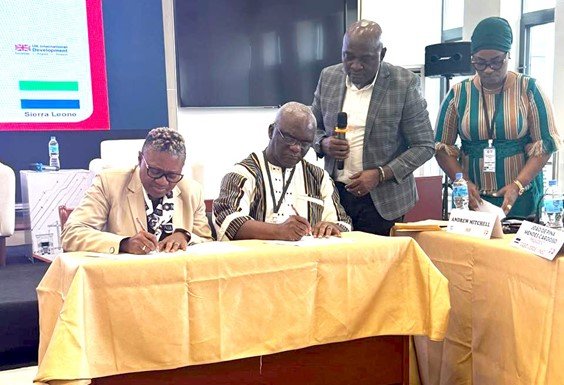
MONROVIA – The Liberia Revenue Authority (LRA) and Sierra Leone’s National Revenue Authority (NRA) have signed a major tax cooperation agreement aimed at strengthening cross-border tax compliance, enhancing information sharing, and combating tax evasion between the two neighboring countries.
The Memorandum of Understanding (MoU) on Simultaneous Tax Examinations was signed in Freetown by LRA Commissioner General James Dorbor Jallah and NRA Commissioner General Jeneba Bangura on the margins of the 13th IMF AFRITAC West 2 Steering Committee Meeting.
The agreement establishes a framework for coordinated tax examinations involving businesses and taxpayers operating in both Liberia and Sierra Leone, with the objective of improving tax compliance, strengthening audit effectiveness, and identifying revenue leakages linked to cross-border economic activities.
According to the terms of the agreement, both tax administrations will conduct simultaneous examinations of taxpayers whose operations, transactions, or financial interests have implications in both jurisdictions. The arrangement is designed to improve information exchange, support the detection of tax avoidance and evasion schemes, and strengthen domestic revenue mobilization efforts.
Authorities say the cooperation will focus on high-risk cross-border transactions, multinational business arrangements, transfer pricing concerns, illicit financial flows, unreported income, and other activities that may undermine government revenues.
The MoU is aligned with the ECOWAS Supplementary Act on Mutual Administrative Assistance in Tax Matters and provides mechanisms for joint risk assessments, coordinated audits, and the exchange of relevant taxpayer information while safeguarding confidentiality in accordance with national laws and regional legal frameworks.
Officials noted that the agreement will also help address complex international tax risks, including undeclared business activities and non-compliant tax arrangements, while promoting transparency and accountability among businesses operating across borders.
A key feature of the arrangement is its commitment to preventing double taxation and facilitating the timely resolution of cross-border tax disputes. Authorities believe this will contribute to a more predictable and business-friendly environment for investors and companies operating in both countries.
Speaking following the signing ceremony, Commissioner General James Dorbor Jallah described the agreement as a significant milestone in regional tax cooperation.
He emphasized that increasing economic integration within West Africa requires stronger collaboration among tax administrations to effectively manage cross-border tax risks, improve compliance, and protect government revenues.
For her part, Commissioner General Jeneba Bangura said the agreement demonstrates the shared commitment of Liberia and Sierra Leone to improving tax compliance and strengthening cooperation in addressing regional tax challenges.
She noted that closer collaboration between the two revenue authorities would help safeguard their tax bases, enhance domestic revenue generation, and support broader regional economic integration efforts.
The agreement further reinforces both countries’ commitment to implementing international best practices in tax administration and supporting ECOWAS initiatives aimed at combating tax evasion, illicit financial flows, and aggressive tax avoidance schemes.
The signing also positions Liberia among a growing number of African nations adopting coordinated approaches to managing cross-border tax risks and enhancing international tax cooperation.
The latest accord forms part of the LRA’s broader strategy to expand international partnerships. Earlier this month, the Authority signed three agreements with South Korea’s National Tax Service aimed at strengthening tax administration, promoting information exchange, and supporting modernization efforts within Liberia’s revenue system.
Under the leadership of Commissioner General Jallah, the LRA continues to pursue reforms and strategic partnerships intended to improve compliance, boost domestic revenue mobilization, and build a modern, intelligence-driven, and taxpayer-focused revenue administration capable of supporting Liberia’s development agenda.
About The Author