
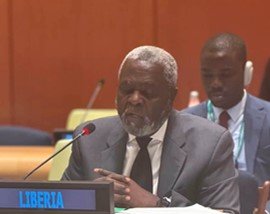
Monrovia-Liberia has reaffirmed its commitment to a world free of nuclear weapons while defending the right of countries to use nuclear technology for peaceful purposes.
Liberia’s Permanent Representative to the United Nations, Ambassador Lewis G. Brown II, made the position clear on September 29, 2026, during a United Nations high-level plenary meeting in New York.
Ambassador Brown called on nuclear-armed states to fulfill their disarmament obligations under the Treaty on the Non-Proliferation of Nuclear Weapons (NPT).
He also urged countries that remain outside the treaty to join the international agreement, stressing the importance of strengthening global efforts to prevent the spread and use of nuclear weapons.
Brown said international security should not be built around the threat of mutual destruction, emphasizing diplomacy, international law, verification and multilateral cooperation as key tools for addressing global security challenges.
Liberia’s position comes amid continued concerns over the size of the global nuclear arsenal.
The Stockholm International Peace Research Institute (SIPRI) estimates that the nine nuclear-armed states possessed approximately 12,187 nuclear warheads at the beginning of 2026.
More than 2,000 of those warheads were reportedly maintained on high operational alert.
Against this backdrop, Liberia emphasized the potentially devastating humanitarian consequences of any nuclear conflict.
Brown argued that the existence of nuclear weapons continues to pose serious risks to populations and that international efforts should focus on reducing those risks through cooperation and legally binding commitments.
He maintained that nuclear security should not depend on the possibility of mutual destruction but should instead be strengthened through international diplomacy and adherence to international law.
Liberia is calling on nuclear-armed countries to take concrete steps toward fulfilling their disarmament commitments under the NPT.
The treaty, which serves as a major international framework for preventing the spread of nuclear weapons, also recognizes the right of states to develop and use nuclear technology for peaceful purposes.
Brown therefore called for a balanced approach that advances nuclear disarmament and non-proliferation while allowing developing countries to benefit from peaceful nuclear science.
He urged the international community to move beyond long-standing commitments and take practical steps toward achieving meaningful progress on nuclear disarmament.
While advocating for nuclear disarmament, Liberia also stressed the importance of peaceful applications of nuclear technology.
The country supports international cooperation through the International Atomic Energy Agency (IAEA) and the responsible use of nuclear science for development.
According to Liberia’s position, nuclear technology can contribute to important areas including healthcare, agriculture, food security, scientific research and development.
In healthcare, nuclear science can support medical diagnosis and treatment, while in agriculture and food security, nuclear techniques can contribute to research and improved agricultural practices.
Liberia is therefore advocating for greater access to peaceful nuclear applications, particularly for developing countries seeking to use science and technology to address development challenges.
Liberia’s position reflects its call for the international community to pursue nuclear disarmament while ensuring that peaceful nuclear technology remains accessible to countries that use it responsibly.
Brown stressed the importance of international cooperation, verification mechanisms and adherence to existing treaties in addressing nuclear-related security concerns.
He also called for stronger multilateral efforts to ensure that commitments made under the NPT are translated into concrete actions.
Liberia said the international community must continue working toward a system where nuclear weapons are reduced and ultimately eliminated, while peaceful nuclear science remains available for legitimate development purposes.
The Liberian government’s position comes as global discussions continue over nuclear disarmament, non-proliferation and the future of international nuclear security.
About The Author