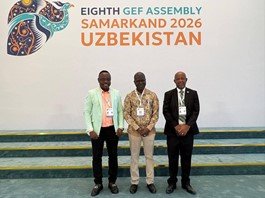
A high-level Liberian delegation is participating in the 8th Assembly of the Global Environment Facility (GEF) and the 71st GEF Council Meeting currently underway in Samarkand, Uzbekistan.
The global environmental gathering, which runs from May 30 to June 6, 2026, brings together representatives from 186 member countries to discuss key environmental priorities, financing strategies, and international cooperation on climate change, biodiversity loss, land degradation, and chemical and waste management.
The GEF Council Meeting, held from May 31 to June 3, focuses on policy direction, work programs, and funding decisions across the GEF system.
Liberia’s participation highlights its ongoing engagement in international environmental processes and its continued reliance on GEF support for national development priorities, including climate resilience, biodiversity conservation, coastal protection, and sustainable land management.
As part of the engagements, Liberia also took part in the West African Constituency Meeting, where member states coordinated shared priorities and positions ahead of Council deliberations.
The Liberian delegation is headed by Dr. Emmanuel K. Urey Yarkpawolo, Executive Director of the Environmental Protection Agency of Liberia and GEF Operational Focal Point.
He is accompanied by Mr. Benjamin Karmorh, Chief Technical Advisor, and Mr. Desmond Thompson, Alternative Operational Focal Point.
During discussions, Dr. Yarkpawolo expressed appreciation to the GEF for its continued support to Liberia and highlighted ongoing environmental projects in the country.
He disclosed that Liberia is currently implementing a US$10 million coastal defense project and has recently launched another US$10 million initiative covering agriculture, fisheries, tourism, and biodiversity-related interventions.
However, he raised concern over the GEF’s co-financing requirement, noting that the current 7:1 ratio places significant pressure on vulnerable countries.
Under this arrangement, beneficiary countries are expected to mobilize seven dollars in co-financing for every one dollar provided by the GEF.
He described this as challenging for least developed countries like Liberia, which continue to face fiscal constraints while addressing climate change impacts.
Dr. Yarkpawolo also emphasized the urgent threat posed by sea level rise and coastal erosion, warning that Liberia’s coastal communities remain highly vulnerable to environmental degradation.
He called for stronger consideration of these issues in future GEF programming.
The GEF reportedly acknowledged the concerns raised and indicated that the matter would be reviewed within ongoing policy discussions.
The Liberian delegation reaffirmed its commitment to strengthening cooperation with the GEF and ensuring that funded projects deliver tangible benefits to communities and national development goals.
It also emphasized the need for financing frameworks that reflect the realities of countries most affected by climate change.
The Council Meeting continues in Samarkand, with further discussions expected on financing priorities, strategic direction, and future support mechanisms under the GEF framework.
About The Author