The “You haul rope, rope hauls bush” scenario is being experienced by the people of Bong in the ongoing strike action being staged by health workers of Phebe Hospital in Suakoko, Bong County. As the situation continues unabated with no end in sight, people seeking medical attention to their health conditions are finding other alternatives at other health facilities. What is clear is that the C.B. Dunbar, the largest referral hospital in the county, is bearing the brunt with what authorities called “unprecedented influx of patients over the last days.” As Stephanie Duncan of our staff reports, the situation is said to have shed light on the difficulties and frailties in Liberia’s healthcare delivery regime, and could further explode beyond control.

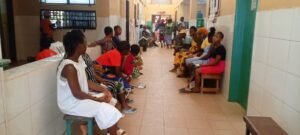

The ongoing strike action being staged by workers of the Phebe Hospital in Suakoko, Bong County is said to be gravely impacting other health facilities in the county, with C.B. Dunbar Hospital in Gbarnga reportedly bearing the brunt.
Hospital authorities have reported unprecedented influx of patients in the wake of the ongoing strike action by Phebe workers, forcing the facility to convert its conference hall into a temporary patient ward.
Enoch Morris, who is the Hospital Administrator, told reporters that the hospital has remained operational but has become overwhelmed by the influx of patients seeking medical care after services at Phebe Hospital were disrupted.
According to him, the hospital, which was originally built as a maternity facility before being upgraded to a comprehensive hospital in 2021, was never structurally expanded to match its increased responsibilities.
“We have been very overwhelmed with patient flow between yesterday and today,” Morris said, noting that the hospital’s existing infrastructure is struggling to accommodate the growing number of referrals.
The administrator disclosed that C.B. Dunbar Hospital has 102 functional beds, which are often fully occupied even during normal periods. He explained that the current situation has significantly worsened the already limited bed capacity.
To cope with the emergency, Morris said hospital management, in collaboration with the Bong County Health Team, is implementing temporary measures to increase patient space. These include converting the hospital’s conference hall into a general ward and reorganizing bed allocation by moving stable patients to alternative areas to free beds for critically ill cases.
He also emphasized the urgent need for the construction of the proposed new C.B. Dunbar Hospital along the Lofa Road, describing the project as essential to strengthening healthcare delivery in Bong County.
Morris noted that even under normal circumstances, both Phebe Hospital and C.B. Dunbar Hospital are insufficient to meet the healthcare demands of the county’s growing population. He said the ongoing disruption at Phebe has further exposed the need for expanded healthcare infrastructure.
While expressing confidence that normal operations at Phebe Hospital would eventually resume, Morris urged the government to expedite construction of the new referral hospital, saying it would significantly improve healthcare access and ease pressure on existing facilities.
The hospital administrator also revealed that construction of an annex at C.B. Dunbar Hospital is progressing and is expected to be completed later this year.
He said the additional structure will help reduce congestion but stressed that a larger, modern hospital remains necessary to meet the county’s long-term healthcare needs.
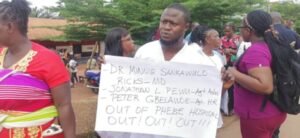
At the same time, dozens of protesting workers of Phebe Hospital on Monday marched to the Gbarnga Central Police Station and the Gbarnga Magisterial Court, demanding the release of three colleagues arrested in connection with the ongoing labor action at the hospital.
The detained workers are among leaders of the protest, which has disrupted services as employees press for improved working conditions and changes in the hospital’s leadership.
Speaking to reporters outside the Magisterial Court, President of the National Physician Assistant Association of Liberia, Theophilus Fayiah, condemned the arrests, describing them as an attempt to intimidate health workers rather than address their concerns.
Fayiah rejected allegations that protesters threatened to burn down Phebe Hospital if the government failed to meet their demands. He insisted the workers’ intention was only to peacefully withdraw their services until their grievances were addressed.
“We are not threatening anyone. We simply said we would stop offering our services because our concerns have not been addressed,” Fayiah said.
He stressed that the protest has remained peaceful, noting that workers intentionally stayed away from the hospital premises to avoid any confrontation or disruption.
According to Fayiah, healthcare workers have endured years of poor salaries, inadequate benefits and unfavorable working conditions, describing the environment at Phebe Hospital as “traumatic” for many employees. He accused authorities of attempting to criminalize the protest instead of engaging workers through dialogue.
Fayiah also alleged that police obtained statements from the detained workers without legal representation and challenged authorities to produce evidence supporting claims that protesters planned to burn the hospital.
“There is no crime. If anyone claims they threatened to burn the hospital, let them produce the evidence,” he said.
He called for the immediate release of the three detained workers and urged the government to resolve the dispute through dialogue rather than intimidation.
In a show of solidarity, Fayiah announced that the association had instructed healthcare workers at C.B. Dunbar Hospital to suspend work in support of their colleagues at Phebe Hospital.
“An injury to one is an injury to all,” he declared.
Addressing concerns over salaries, Fayiah said healthcare workers across Liberia continue to receive inconsistent pay. He claimed some physician assistants earn as little as US$95 a month, while others receive US$250 or US$400. He also alleged that some volunteers have worked for more than 15 years without being placed on the government payroll.
While acknowledging that low wages remain a major concern, Fayiah said the protest is also driven by poor management, strained labor relations and what workers see as a lack of respect from the hospital’s administration.
The protesters are demanding the immediate dismissal of Phebe Hospital’s Medical Director, Dr. Minnie Sankawulo-Ricks, along with the Human Resource Manager and his assistant, accusing the administration of poor labor practices and creating an unhealthy working environment.
The protest at Phebe Hospital remains ongoing as workers await the release of their detained colleagues and a response from the government to their demands.
About The Author