MONROVIA – The Press Union of Liberia (PUL) has joined growing calls for the immediate establishment and operationalization of Liberia’s Specialized National Anti-Corruption Court, describing the initiative as critical to strengthening democratic governance, accountability, and national development.
Speaking as a panelist at the National Anti-Corruption Policy Dialogue in Monrovia on Tuesday, PUL President Julius Kanubah urged all branches of government to prioritize the creation of the court, warning that further delays could undermine Liberia’s fight against corruption.
Kanubah called on President Joseph Nyuma Boakai, House Speaker Richard Koon, Senate Pro Tempore Nyonblee Karnga-Lawrence, the Chief Justice and Associate Justices of the Supreme Court, and other national leaders to ensure that establishing the specialized court becomes their collective legacy.
He argued that corruption has for decades hindered Liberia’s development by increasing poverty, weakening public institutions, eroding human security, and undermining the rule of law. He also reflected on the country’s history, noting that corruption contributed to public distrust, conflict, and political instability.
While acknowledging recent anti-corruption efforts by the Boakai administration, including the suspension, dismissal, and prosecution of some public officials, Kanubah maintained that progress has been slower than expected.
He cautioned that failure to establish and operationalize the court by December 2026 could allow political considerations ahead of the 2029 general elections to derail the process.
President Boakai in May 2026 submitted to the Legislature a bill seeking the establishment of the Specialized National Anti-Corruption Court following nationwide consultations coordinated by the Office for the Establishment of War and Economic Crimes Court (OWECC-L).
According to Kanubah, the proposed court would improve the prosecution of corruption-related cases, strengthen public confidence in government institutions, and safeguard public resources to support sustainable national development.
Referencing former President Ellen Johnson Sirleaf’s description of corruption as “a vampire,” the PUL President said the Specialized National Anti-Corruption Court should become Liberia’s “Anti-Corruption Vampire” by eliminating impunity and ensuring that justice prevails over exploitation.
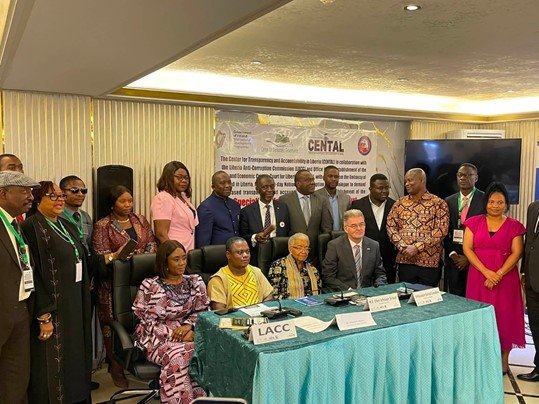
The National Anti-Corruption Policy Dialogue was organized by the Center for Transparency and Accountability in Liberia (CENTAL) in collaboration with the Liberia Anti-Corruption Commission (LACC) and the Office for the Establishment of War and Economic Crimes Court (OWECC-L), with support from the Embassy of Ireland.
Held at the Boulevard Palace Hotel in Sinkor, the dialogue brought together senior government officials, members of the judiciary, civil society representatives, diplomats, governance experts, and development partners to discuss strategies for strengthening Liberia’s anti-corruption framework.
Among those participating were former President Ellen Johnson Sirleaf, Ambassador Gerard Considine of the Embassy of Sweden, Dr. Jallah Barbu of OWECC-L, human rights lawyer Tiawan Gongloe, Alexandra Zoe of the Liberia Anti-Corruption Commission, Christian Mukosa of the United Nations Office for Human Rights, Lawrence Yealue of the National Civil Society Council of Liberia, Bendu Kpoto of the Association of Female Lawyers of Liberia, Matthew Kollie of the Governance Commission, and Lorpu Page of the Independent Information Commission.
About The Author