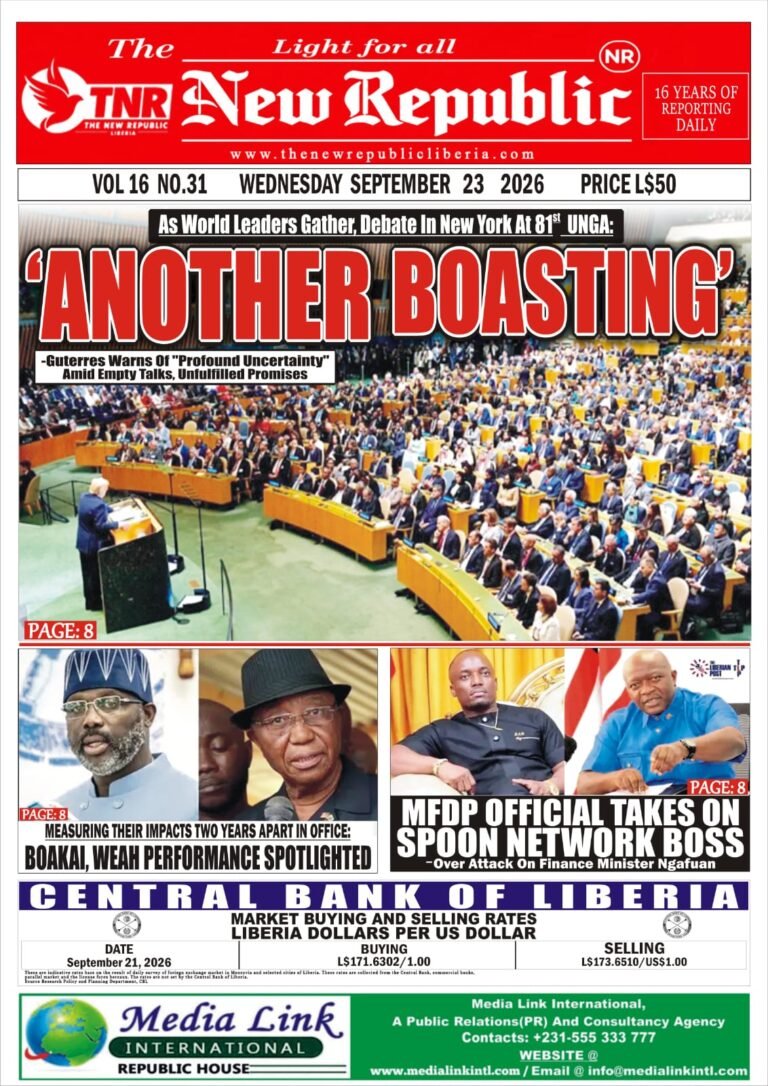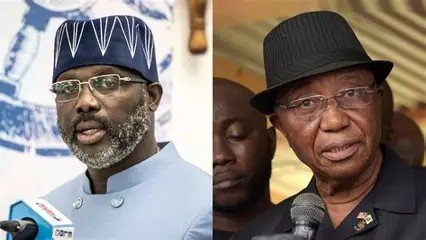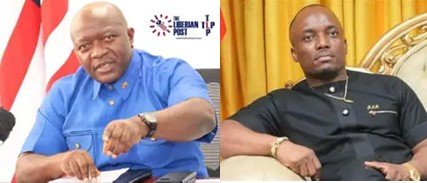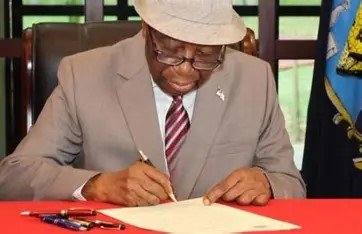
Monrovia-Fresh concerns are emerging about the oversize of President Joseph Boakai’s Government in light of questions surrounding the impact of the celebrated $1 billion revenue intake vis-a-vis disclosure that the amount is almost exhausted.
Analysts believe President Boakai has outstretched the size of his government with the creation of new structures, a situation blamed on the huge bill government has to foot.
The government currently operates with 19 core Cabinet ministries, including Foreign Affairs, Finance, State for Presidential Affairs, Justice, Defense, Local Government, Agriculture, Public Works, Health, Commerce, Information, Mines and Energy, Labor, Transport, Gender, Education, Posts and Telecommunications, Youth and Sports, and Minister of State Without Portfolio.
But beyond the Cabinet, the government has ballooned to over 104 ministries, agencies, commissions and special presidential structures, according to budget analysts. Besides structures already in existence, President initiated new establishments to meet other service delivery tasks in line with the administration agenda.
National Tourism Authority, Office Of Ombudsman, Office of war and economic crimes court, national illegal mining taskforce, yellow machines commission, and few others have been added to an already blotted national wage bill totaling millions of dollars.
Recall that transparency watchdog, Center for Accountability and Transparency in Liberia (CENTAL), in March of this year warned that Boakai is expanding the size and cost of government, citing the new management structure for the “yellow machines” road project which created additional boards, committees and minister-level appointments.
“It is cost-intensive to continue expanding the government when resources are meager,” CENTAL Executive Director Anderson Miamen said, urging the administration to strengthen existing institutions instead of creating new layers.
The criticism was amplified by former presidential candidate Dr. Clarence Moniba, who said the 2026 draft budget of US$1.2 billion is dominated by recurrent spending. Out of that amount, US$929.6 million is tied to recurrent expenditure alone, nearly US$200 million goes to goods and services across 104 institutions, while employee compensation totals US$329 million. 27b2
Moniba noted that the compensation is heavily skewed, 70 percent going to high-ranking ministers, deputies, commissioners, heads of agencies and advisers, while more than 60 percent of civil servants earn less than US$200 per month.
“So, when government operations consume so much of the national budget, the government is simply too big to succeed,” he argued.
His proposed a consolidated government to no more than 50 institutions, which he says would save nearly US$400 million annually.
He specifically recommends merging Mines and Energy, NOCAL, Forestry Development Authority and petroleum regulators into a single Ministry of Natural Resources, and transforming Agriculture into a Ministry of Food Security.
President Boakai, using executive orders,
Former President Ellen Johnson Sirleaf, who governed from 2006 to 2018, is remembered for a relatively leaner executive. Her administration maintained 18 line ministries and pursued a strategy of fiscal discipline in the post-war period, while keeping tight control at the Ministry of Finance.
Under Sirleaf, Liberia enacted the Public Financial Management Law, established the Liberia Revenue Authority, and negotiated debt relief that wiped out over US$4 billion in external debt.
Critics, however, said her government was overly centralized in Monrovia, slow on decentralization, and still burdened by a patronage system of superintendents and presidential appointees.
Supporters argue her small-government approach created fiscal space for infrastructure, paved roads from Monrovia to Gbarnga and Fish Town, while critics say it failed to create jobs and left rural Liberia behind.
However, governance experts say neither size alone guarantees development, arguing that large government can bring services closer to the people if agencies are functional, such as county service centers, extension workers, and regulatory bodies.
They said if it is built to accommodate political allies, it becomes a wage-bill trap where most of the $1 billion revenue is “eaten” by salaries, vehicles, fuel and sitting fees.
“A small government saves money but can be weak, unable to enforce regulations, monitor concessions, or deliver agriculture support to Lofa, Bong and Nimba,” one expert told this paper.
“The balance is not about number of ministries. It is about efficiency, productivity and outcomes,” a governance analyst said, and wondered it the Ministry of Agriculture have tractors and extension officers, or just ministers and deputies in Monrovia.
For President Boakai, who campaigned on “Rescue Mission” and reducing waste, the optics are challenging.
Prior to ascending to power, the president and the Unity Party criticized what they called “wasteful undertakings” of the former George Weah administration.
They specifically referenced the use of private jet by the then president on foreign trips, but few months into office, he resorted to doing the same thing, citing security and unhindered travel arrangements.
Huge presidential delegation is another issue many pointed out as having financial burden on the country.
President Boakai delegation of 23 officials to Japan last year, including 12 cabinet ministers, drew criticism from human rights lawyer Tiawan Gongloe, who said Liberia, “the world’s tenth poorest nation, made a mistake by sending a huge delegation”.
As the $1 billion revenue debate continues, the real test for Liberians may not be how much government collects, but how much of government actually works for them.
About The Author