
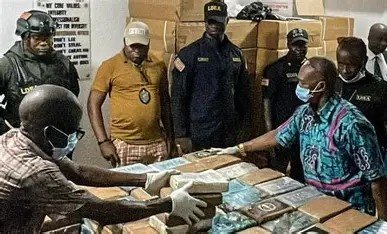
Principally, their role is to provide for and watch over the security of the state, ensuring criminals do not have any haven to forment mayhem. Because they carry overwhelming national backings, they are respected and looked up to when situations strike. They may have done well on many fronts, but when it comes to dealing with drugs importers and dealers, the story dangles. Today, top security officers once relied on or looked up to when criminals hit are banging their heads against jail walls at the Monrovia Central Prison, waiting to face justice. How they got there is no longer the issue, but how they allowed themselves into such menace matters. Because drugs cartels, or other criminals are financially potent, they go extra miles to desuade their enemies. Could it be their reasons? As The New Republic’s Jamesetta Williams reports on how the power of money often desuades people do the undersirable thing.
Liberia is scratching head, seeking for both answers and solutions amid reported connections of ranking security officers at the level of the Liberia National Police, National Security Agency, Liberia Drugs Enforcement Agency and many others to criminals commiting the very crimes they sworn to fight.
What is responsible remains an overwhelming conjecture, but experts believe money might be the protuding reasons security officers put nation and citizens interest at risk.
“I think the love and power of money is the underlining factor in all of this,” remarked a security expert in a chat with this paper at the weekend in Monrovia. Not wanting to be named, he said the situation is not new or strange in the security environment, stating “this is the germ most nations confront with when officers put money first over task resigned to.”
This seems to be the case of Liberia’s drugs crisis which has seen undulating developments relating to a good number of officers of law enforcement agencies being accused of dinning with criminals.
Sweeping investigations into two unprecendented drugs bust at the Roberts International Airport (RIA) and the VOA Community along the Robertsfield Highway uncovered troubling connections between actors in the drugs sector and some security highups.
Liberia is yet to overcome the drugs plague since the end of the civil war largely blamed for the unparalleled influx or importation of narcotic substances into the country. It is now believed the stagnation to getting results is due to the involvement of security officers in abetting and aiding the process.
Recall how two successful administrations failed to dismantle or limit the impact of drugs on the nation and its youthful population. Dozens of young people lost their lives to drugs over the past years, while a dozen more has either gone wayward or into despicable act of stealing and other societal ills.
Most of them overwhelmed by drugs intake roaming streets, feeding on dumpsites have been nicknamed ‘zogoes.’
A resurged LDEA, the country’s leading anti-drug institution, has arrested and charged dozens of drugs dealers and destroyed several kilograms of drugs nationwide. They also destroyed their hideouts or ghettos from where they formented crimes across several communities.
Despite what were seen as substantial gains, the drugs crisis continues to hit ceiling-raising limits, leaving many to wonder if the government was saying one thing and doing another thing behind-the-scenes. At some point in time, many suggested the government had lost the war owing to the growing undetected inflow of cocaine and narcotic substances.
But what would break the camel back unfolded on June 8 when committed officers at the RIA busted a US$19 million cocaine scheme. The cocaine valued at over US$19 Million was bounded for Europe via Brussels Airlines, the country’s longstanding flight service.
As investigations deepened into how, who and when the drugs entered the bailiwick of the country, citizens got the shocks unexpected when investigators identified security agents having connections to those behind the drugs saga.
Amid concerns of alleged attempts by investigators to shield some highups said to be connected to the RIA seizure, the Liberia National Police on July 4 charged several others including Paul J. King and Michael U.S. Browne.
Inspector General Col. Gregory Coleman had indicated seizure of roughly 237.6 kilograms of cocaine was no accident and no clerical slip, but the exposed tip of an organized criminal enterprise routing drugs through the country’s air cargo system.
“This was not a paperwork error. This was not a routine cargo discrepancy. This was not an innocent shipment gone wrong,” Coleman said. “This was a serious transnational cocaine trafficking operation using Liberia’s aviation and logistics system as a channel for organized crime.”
He told the nation how after the cocaine was discovered, members of the network moved to recover it and to compromise the case. The evidence, he said, established “deliberate efforts by operating cells of the cartel to bribe security personnel, retrieve the shipment, and interfere with the seizure.”
The charges did not capture any security officers as expected. But days later, the nation was alerted to another shocking discovery of drugs in the VOA, Robertsfield High Community valued at over US$317.68 million was seized in Duazon.
As investigations into Liberia’s recent multi-million-dollar cocaine seizures continue, citizens are increasingly demanded answers over the growing number of security officers, airport officials, and prison personnel allegedly linked to the cases.
On July 30, 2026, Inspector General of Police Gregory Coleman, alongside Minister of Justice and Attorney General Cllr. N. Oswald Tweh, disclosed that investigations had uncovered evidence leading to criminal prosecution against several senior security officials.
The investigation is being conducted with assistance from the United States Drug Enforcement Administration (DEA) and the Kingdom of Morocco.
Shockingly, those identified and formally charged were principally security agents attached to the LNP, LDEA and others. They include Wadia Quabo – Chief of Highway Patrol, Anthony Blaye, Chief of Financial Crimes. Others include Deputy LDEA Commander at RIA who was identifed as a key suspect.
Several airport security and cargo personnel identified as persons of interest in connection with the US$19.2 million cocaine seizure include Mohammed Gbowrah, RIA Security Director, Philip Yeoh, Security Manager, GLS Menzies, Oscar Browne, RIA Chief of Intelligence, Ruth Gbapaywhea, RIA Scanner Agent, Geraldine Zeon – RIA Scanner Agent, and Festus S. Musa – Cargo Handler, GLS Menzies.
The wider investigation into the US$317.68 million suspected cocaine seizure has also implicated additional security personnel. LNP Officer Johnny Bolar Dean was identified by authorities as having allegedly received a US$10,000 bribe in connection with the suspected cocaine trafficking network.
The allegation forms part of the ongoing criminal investigation, and the matter remains subject to due process before the courts.
On July 30, 2026, President Joseph Boakai dismissed and suspended several government and law enforcement officials.
Their dismissal and suspension followed a review of ongoing investigations into major narcotics trafficking cases.
Those immediately dismissed include Mark Egon Kuiah, Deputy Director for Operations at RIA; Johnny Bolar Dean, Commissioner of Police for Criminal Investigation, Intelligence and INTERPOL; and Patrick Doe, Deputy Director for Administration at the National Security Agency (NSA).
Patrick Komasu (702) was recalled from his assignment at the LDEA and suspended without pay, and ordered that he be investigated.
President Boakai also dismissed Mohammed O. Gbowrah, Director of Security at RIA, and Moses Jallah, Deputy Commander of the LDEA at RIA in connection with the seizure of 198 plates of processed cocaine at RIA and the confiscation of 3,971 plates of cocaine linked to two foreign nationals.
Also dismissed were LNP officers Anthony T. Blaye and Wadell W. Kwarbo, for allegedly using government vehicles to facilitate the transportation of narcotics from Vincent Town along the Bomi Highway to the vicinity of Mega Mart in Thinker Village, Paynesville.
Jammel V. Jallah, Christian L. Nyantee, and Albenigo Janior, all agents of the National Security Agency, along with Caycee Nelson, Procurement Director at the Ministry of Gender, Children and Social Protection were dismissed and referred to the Ministry of Justice for prosecution.
Last week, Jackson K. Kolako, Deputy Superintendent for Operations at the Monrovia Central Prison, was arrested by the National Security Agency (NSA).
It is alleged that Kolako facilitated communication between suspected Colombian drug traffickers and their overseas and local associates using his mobile phone. Investigators also reportedly traced multiple mobile money transactions allegedly linked to the suspected cartel.
The investigation into his alleged role remains ongoing.
These developments regarding the involvement of security officers to drugs-related crimes are said to be troubling and concerning amongst Liberians.
Many are now questioning how individuals entrusted with protecting the nation’s borders, enforcing the law, securing correctional facilities, and safeguarding public safety allegedly became connected to one of the country’s largest narcotics investigations.
They are not only questioning, but calling on the government to ensure that the investigations remain transparent, impartial, and free from political influence.
Many are urging authorities to prosecute anyone found guilty, regardless of rank or position, while strengthening integrity screening, internal oversight, and accountability across the country’s security institutions.
Inspector General Gregory Coleman has maintained that investigations are continuing and that the Joint National Security Task Force remains committed to identifying every individual connected to the alleged transnational drug trafficking syndicate.
As Liberia continues one of the most significant anti-drug investigations in its history, citizens say the country deserves full accountability and justice, insisting that no public official or security officer should be above the law.
This is not the first time security officers have been put on spotlight for partaking in acts that contravene their responsibilities.
It can be recalled that Liberia faced similar situation during the regime of former President Ellen Sirleaf Johnson when police officers were accused of working with armed robbers who terrorized communities, put citizens at gun points and in most case made away with their belongings.
The bottomline is that the situation has the potential to lower public trust and confidence in the country’s security agencies.
About The Author