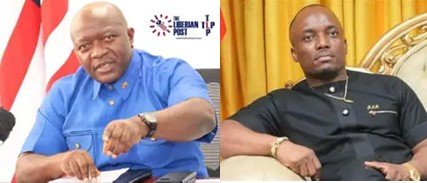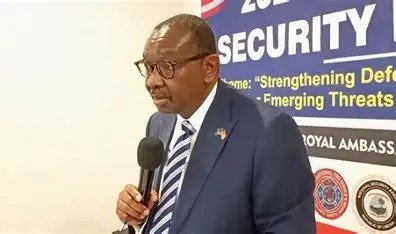
Monrovia-Liberia’s new Acting Minister of National Defense, Cllr. N. Oswald Tweh, has outlined a three-pillar agenda for the Armed Forces of Liberia focused on strategic continuity, soldier welfare and stronger civil-military relations.
President Joseph N. Boakai appointed him acting Minister of Defense recently days after he removed him as Minister of Justice and Attorney General of Liberia in an unexpected cabinet shakeup that affected the justice ministry, defense, and the local government administration.
Tweh set the agenda last Thursday during a formal turnover ceremony at the Barclay Training Center in Monrovia, after taking over from outgoing Defense Minister Brig. Gen. (Rtd) Geraldine J. George.
During the ceremony attended by Minister of State for Presidential Affairs Samuel A. Stevequoah, AFL Chief of Staff Maj. Gen. Dickerson Forleh, senior Defense Ministry officials, officers and enlisted personnel, and members of the diplomatic corps, Tweh said he assumes the role with humility and gratitude to President Joseph Nyuma Boakai for the trust reposed in him.
Tweh, who previously served as Minister of Justice and Attorney General, said his move keeps him within the national security architecture.
He paid tribute to his predecessor, describing her as a trailblazer whose leadership laid a solid foundation. “Your dedication and historic service to the Ministry and the Armed Forces of Liberia have laid a solid foundation upon which we will continue to build,” he said of Gen. George.
The acting defense minister stressed the constitutional role of the Defense Ministry as the civilian anchor for the military.
Citing Article 50 of the Constitution and the Executive Law, he noted that while the President serves as Commander-in-Chief and operational command rests with the Chief of Staff, the Defense Minister must be a civilian providing democratic oversight, policy direction and bureaucratic management.
“Our role is bureaucratic, strategic, and legal. It requires ensuring strict adherence to the rule of law, managing resources with transparency, and insulating our military from partisan politics,” Tweh said. “As a legal professional, my commitment to this democratic principle of civilian oversight is absolute.”
Recalling Liberia’s civil war history and the reform of the AFL, Tweh said he was reminded of a 2007 Liberian National Bar Association program during his tenure as Bar President, when then Defense Minister Brownie Samukai outlined how new soldiers were being trained in Liberian civics, constitutional authority and subjugation of the military to civilian authority.
He also recalled serving as Guest Speaker in 2008 at the graduation of the last Initial Entry Training and activation of the 1st Infantry Battalion – the program that transforms civilians into soldiers.
Now, 18 years later, Tweh said his priorities will be institutional continuity and strategic alignment, aggressively supporting implementation of the newly launched Ministry of National Defense 5-Year Strategic Plan, which expands the national security vision beyond territorial defense to include disaster resilience, humanitarian assistance and engineering contributions to national development.
Soldier welfare and capability is another priority area he said his leadership will pay key attention by improving support, equipment, healthcare and recognition for men and women in uniform.
“The well-being of our men and women in uniform is paramount. Their voices will be heard, and their conditions of service must reflect the honor of the uniform they wear,” he pledged.
He also spoke of civil-military relations, which entails strengthening trust between the AFL, which he described as a “Force for Good,” and communities, anchored on mutual respect, transparency and accountability.
To the AFL leadership and rank-and-file, Tweh pledged to be a fair and transparent advocate, and to work with international partners to protect Liberia’s peace and sovereignty.
The appointment of Tweh, a lawyer and former Justice Minister, is seen as a move to reinforce rule-of-law and legal discipline at the Defense Ministry as the AFL expands its non-combat role in engineering and disaster response.
About The Author