
By Jamesetta D. Williams
MONROVIA–The University of Liberia (UL) is exploring a partnership with German laboratory equipment company PHYWE to modernize its science laboratories in a move aimed at strengthening practical teaching, research, and innovation across the institution.
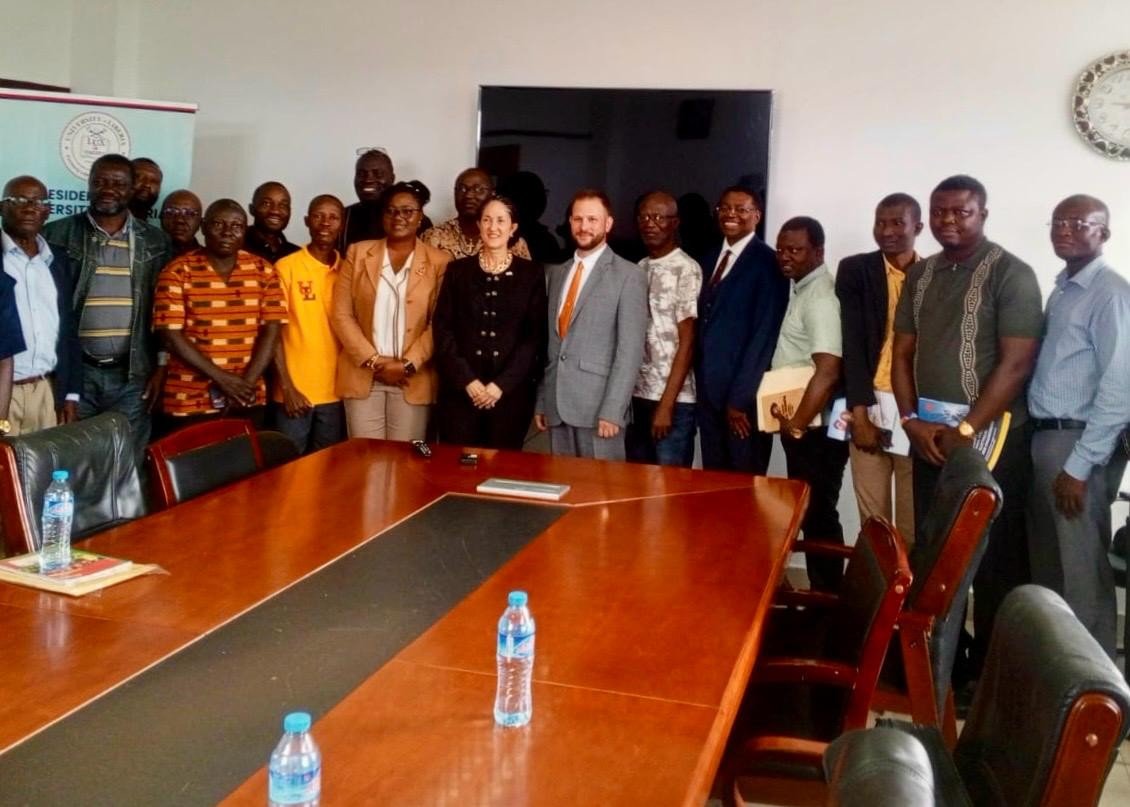
The proposed collaboration was discussed Monday during a meeting between UL officials and representatives of PHYWE, ahead of a three-day assessment visit that begins Tuesday at the university’s Fendall campus and concludes Thursday at the David A. Straz-Sinje Technical and Vocational College in Grand Cape Mount County.
The site assessment is intended to identify priority areas where the German company can provide advanced laboratory equipment, technical expertise, and training to improve science education.
UL President Dr. Layli Maparyan described the modernization of the university’s laboratories as one of the institution’s top strategic priorities, noting that inadequate laboratory facilities have long hindered effective science instruction.
“We’ve suffered with laboratories that don’t meet the needs of our curriculum or our students,” Dr. Maparyan said.
She explained that the university, which currently enrolls approximately 28,000 students, continues to face significant challenges in providing modern laboratory equipment, consumable materials, and other resources needed to support science education.
According to Dr. Maparyan, the university has launched several initiatives to address these challenges, with the discussions with PHYWE forming part of a broader strategy to strengthen laboratory infrastructure.
The PHYWE delegation included Mr. Vladimir Schelakov, who oversees international projects for LN Education Group, and Dr. Michael Flowers. During the meeting, Mr. Schelakov presented the company’s global operations to science deans and department chairpersons, who outlined the challenges facing their respective programs and expressed interest in identifying areas for collaboration.
PHYWE, headquartered in Germany with offices in the United States, China, and Dubai, supplies laboratory equipment and provides technical training in physics, chemistry, biology, and other STEM disciplines through partnerships with institutions in more than 100 countries.
Mr. Schelakov emphasized that modern science education extends beyond laboratory equipment and requires integrated teaching approaches that incorporate digital technologies, including laptops, tablets, artificial intelligence, and online learning platforms.
He said the company offers not only laboratory equipment but also ongoing technical support and professional training to ensure institutions maximize the use of the technologies they receive.
Dr. Michael Flowers encouraged faculty members to clearly document the challenges affecting their departments and align proposed solutions with Liberia’s national education priorities to ensure the partnership delivers broader benefits to the country’s education sector.
If realized, the partnership could significantly improve science teaching and research at the University of Liberia while strengthening the country’s capacity to produce graduates equipped for careers in science, technology, engineering, and mathematics.
About The Author