
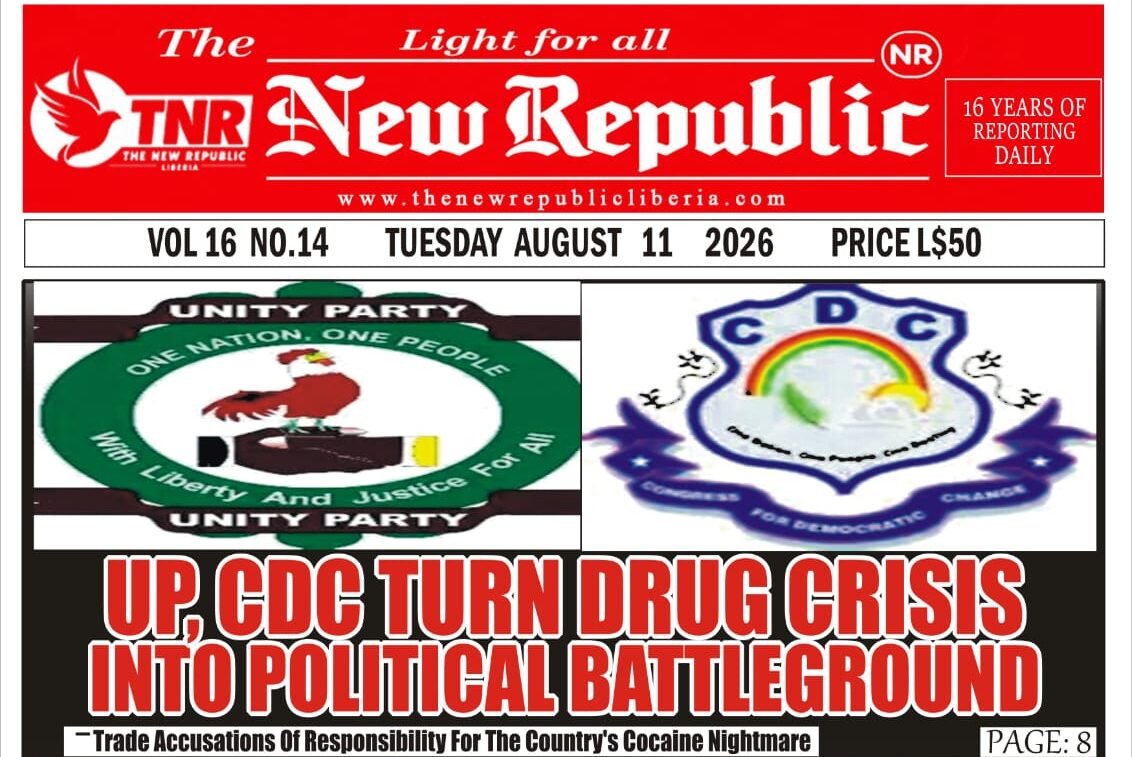
Liberians’ decades-long yearn for multi-party democratic governance did not come on silver plater; it was realized through the blood and sweet of youthful progressive citizens. Their memories are still being cherished and names inked in the annals of history. For them, the objectives were simple: that one-party system will come to an end, and that multi-party system would flourish wherein citizens’ voices would be meaningful, and governments would be held accountable for their deeds. Indeed, that democratic governance is bearing fruits, and citizens are speaking out, challenging their government to transpaency and accountability. Contrarily, the very citizens are attempting to abuse the process, putting the nation in harm’s way in the name of party loyalty. The crescendo of such deportment is seen in the current drugs crisis where partisans of the leading political parties, UP and CDC are trading allegations against each other. The New Republic reports on the troubling development.
Liberia’s escalating drug crisis is increasingly being drawn into the country’s partisan political contest, with the ruling Unity Party (UP) and the opposition Congress for Democratic Change (CDC) accusing one another of responsibility for the spread of illicit drugs and the government’s response to it.
What began as a growing public-health and security concern has become a political flashpoint, as supporters of both parties trade allegations over suspected drug networks, arrests and the identities of people linked to drug-related cases.
Across social media platforms, partisan voices have circulated names and photographs of individuals accused, often without publicly verifiable evidence, of involvement in the trafficking or distribution of narcotics. Many of those accused are also being labeled as supporters, financiers or associates of either the UP or the CDC.
The development has raised concerns among civil society groups, legal practitioners and public-health advocates, who warn that the crisis risks being overshadowed by political blame games.
The UP and the CDC have both presented themselves as concerned about Liberia’s drug problem. But their public statements have increasingly focused on the alleged involvement of members or supporters of the opposing party.
Supporters of the UP have pointed to drug-related arrests and allegations involving individuals they claim are connected to the CDC. CDC supporters, in turn, have accused the governing party of using the crisis to target political opponents while ignoring alleged wrongdoing within its own ranks.
Neither party has accepted responsibility for the broader conditions that have allowed drugs to enter communities, nor has either side publicly acknowledged that the crisis transcends party lines.
The competing narratives have created the impression that the primary political objective is not necessarily to dismantle the networks supplying drugs, but to ensure that people associated with the opposing camp are prosecuted.
Such claims remain allegations unless established in court. An arrest, political affiliation or appearance in a social media post does not, by itself, prove involvement in drug trafficking or possession.
Liberia’s drug problem has been described by government officials, community leaders and health professionals as a national emergency with consequences for public safety, youth development and the country’s already fragile health system.
Communities have reported increased drug use among young people, while residents in parts of Monrovia and other urban centers have raised concerns about the presence of substances such as kush and other narcotics. Families have complained about addiction, violence, homelessness and the lack of affordable treatment and rehabilitation services.
For many citizens, the most immediate issue is not which political party is being blamed, but whether the government can prevent the importation and distribution of drugs, protect vulnerable young people and provide care for those already suffering from addiction.
Public-health specialists have repeatedly emphasized that drug dependence cannot be addressed through arrests alone. Law enforcement may be necessary to target major traffickers and organized networks, but treatment, counseling, prevention programs and community-based support are also essential.
The political dispute has been amplified by social media, where allegations can spread rapidly without independent verification.
Posts identifying suspected drug dealers or users have been shared widely, sometimes accompanied by claims about their political connections. In several cases, online discussions have blurred the distinction between a person accused of a crime, a person arrested for questioning and a person convicted by a court.
The circulation of unverified names has prompted concerns about defamation, vigilante justice and possible political intimidation. It also risks endangering individuals who may have no connection to the allegations or who may ultimately be cleared by investigators or the courts.
Legal observers say the authorities have a responsibility to provide accurate information about arrests and prosecutions while protecting the rights of suspects. They warn that public pressure must not replace evidence-based investigations.
“Political affiliation should not determine who is investigated, prosecuted or protected,” civil society advocates have argued. “The same standard must apply to everyone.”
The controversy has increased pressure on law-enforcement agencies to demonstrate that investigations are being conducted independently and transparently.
Citizens and civil society organizations are calling for authorities to identify the sources and financiers of drug shipments, trace the money behind trafficking operations and investigate allegations of official protection or political influence.
They also want regular public updates on drug-related cases, including the charges filed, the evidence presented and the status of prosecutions. Such transparency, they say, would help reduce speculation and prevent political actors from shaping public perception through selective disclosures.
A credible response would require cooperation among the Liberia National Police, the Liberia Drug Enforcement Agency, customs officials, the judiciary, health authorities and local communities.
It would also require stronger oversight to ensure that arrests do not disproportionately target users and street-level suspects while more powerful actors remain untouched.
The growing partisan dimension of the crisis has raised fears that enforcement could become selective.
“If drug-related arrests are perceived as a tool for punishing political opponents, public confidence in the justice system may decline,” said an observer. “Suspects could claim political persecution, while victims and communities may become less willing to cooperate with investigators.”
At the same time, shielding individuals because of their political connections would further weaken the rule of law and allow criminal networks to exploit Liberia’s political divisions.
The country’s experience with other forms of organized crime has shown that illicit networks often rely on influence, money and protection. That makes it especially important for investigators to follow evidence rather than party labels.
A person linked to the UP or the CDC should neither be presumed guilty nor protected from investigation. The central questions should be whether a crime was committed, what evidence exists and whether the case can withstand independent judicial scrutiny.
The drug crisis also exposes broader institutional challenges, including unemployment, poverty, limited youth opportunities, weak rehabilitation services and gaps in border control.
Many young people affected by drug use require medical and psychological support rather than public humiliation or indefinite detention. Families often lack the resources to seek treatment, while rehabilitation centers remain limited and inaccessible to large sections of the population.
Community leaders have called for education campaigns in schools and neighborhoods, expanded mental-health services and programs that offer employment and skills training to vulnerable youth.
They also want the government to distinguish between users, low-level sellers and major traffickers. Without that distinction, enforcement efforts may fill prisons without disrupting the organizations responsible for importing and financing drugs.
The dispute between the UP and the CDC comes at a time when Liberia’s leaders are being judged on their ability to respond to urgent national problems. The drugs crisis offers an opportunity for cooperation, but so far the dominant political message has been accusation.
Political observers also said both parties have a responsibility to discourage their supporters from spreading unverified allegations and to support impartial investigations, regardless of who may be implicated, adding “They should also make clear that political loyalty cannot provide immunity from prosecution and that opposition status cannot be used as evidence of guilt.”
For the government, the test will be whether it can pursue suspected traffickers without appearing to conduct a partisan purge. For the opposition, the challenge will be to scrutinize the government’s response without minimizing the seriousness of the crisis or defending individuals solely because of political affiliation.
Liberia’s drug problem is unlikely to be solved by competing press statements or online accusations. It will require sustained law enforcement, independent courts, public-health investment, regional cooperation and political will.
Until then, the country’s two dominant political camps risk turning a national emergency into another front in their political struggle, while the communities most affected continue to wait for meaningful action.
About The Author