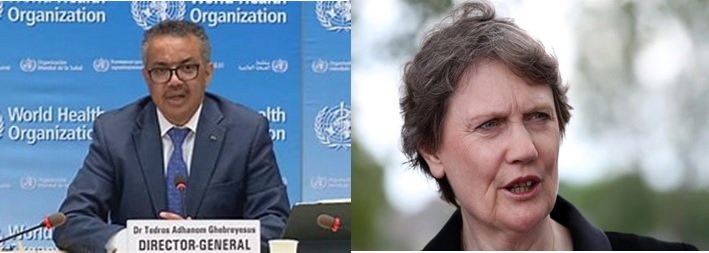
WHO Head. Dr. Tedros Adhanom Ghebreyesus
MONROVIA – Delegates arriving for the World Health Assembly were jolted by news of a large Ebola outbreak centered in Ituri Province, Democratic Republic of the Congo.
The timing and details of the outbreak exposed gaps that experts say prove “progress on outbreak and pandemic prevention, preparedness and response is not enough.”
The outbreaks dominated side events at the Assembly.
At a full-house session organized by The Independent Panel with the Global Health Centre, Geneva Graduate Institute, experts bluntly stated “the world is not yet ready for the next pandemic threat.”
WHO Director-General Dr. Tedros Adhanom Ghebreyesus rapidly declared the outbreak a Public Health Emergency of International Concern, a signal to mobilize immediately. But the declaration came weeks after the outbreak had already begun.
WHO officials say the Bundibugyo Ebola species driving the outbreak has no licensed vaccines, treatments, or field-based testing available.
The situation leaves responders with limited tools as hundreds of millions of dollars are now needed to mount a response.
The Independent Panel, which monitors global pandemic readiness, joined calls for rapid mobilization of funds and for full sharing of tools including point-of-care testing, vaccines, and treatments.
The Ebola alarm came just as the world was responding to a recent multinational outbreak of Andes Hantavirus – another rare virus that “took the world by surprise.”
According to them, back-to-back emergencies underscored how pathogens can still catch the global system off guard, even after COVID-19.
Independent Panel Co-Chair Helen Clark said the moment requires “knowing your risk. What are you looking out for? What are you preparing for? We must be risk-informed,” not just reactive.
Dr. Joanne Liu, Independent Panel member who worked on the two largest Ebola outbreaks to date, provided a frank assessment of the current Bundibugyo outbreak and outlined immediate actions to stop it while filling enduring gaps in the system.
The Assembly discussions focused on turning momentum from the Geneva Pandemic Agreement process into concrete action at the UN High-Level Meeting on Pandemic Prevention, Preparedness and Response set for September in New York.
A 18 May roundtable hosted by the Friends of the High-Level Meeting with Australia and Qatar surfaced several converging themes including “Urgency and solutions mode: The time for aspirational language is over. The UNGA Political Declaration must contain “precise, concrete commitments.”
According to them, finalizing the IHR amendments and Pandemic agreement is critical, as is completing the Pathogen Access and Benefit Sharing, PABS, Annex.
On how much is needed and how to deliver it, some called for bigger contributions to the Pandemic Fund and WHO Contingency Fund, while others pushed innovative approaches that engage the private sector.
On prevention and one health, experts urged deeper investment, especially as climate change, environmental degradation, and urbanization increase risk of spillovers.
“One Health must move beyond rhetoric and become operational reality,” said Desmond Boateng, Chief Director of Ghana’s Ministry of Health.
Experts agreed future monitoring must be flexible, country-driven, avoid duplicate reporting burdens, and integrate financial tracking to direct investments where needed. The IPPS 100-Days Mission scorecard was highlighted as a tool to measure progress on diagnostics, vaccines, and treatments.
Dr. Maria Guevera of MSF recalled Ebola treatment centers being burnt down in 2018 because communities didn’t trust them.
“Once we met that, they allowed us to continue… This happens time and time again.” Community needs like water, malaria treatment, and maternal care must be addressed alongside outbreak response.
For his part, Dr. Hanan Al-Kuwari said COVID-19 vaccine inequity “sits at the PABS negotiating table with every delegation.
With Bundibugyo Ebola spreading without vaccines and hantavirus still fresh, the message from Geneva is that global agreements are important, but readiness also depends on what countries put in place locally.
“There’s a lot that can happen in countries that needs to be in place that doesn’t depend on global agreements. Because each of us here who represent governments, we have a responsibility to our people,” Dr. Mariangela Simão of Brazil said.
For Liberia and other countries with limited fiscal space, the Ebola alarm is a reminder that pandemic preparedness is not just a Geneva issue – it’s a budget, health system, and community trust issue at home.
About The Author