
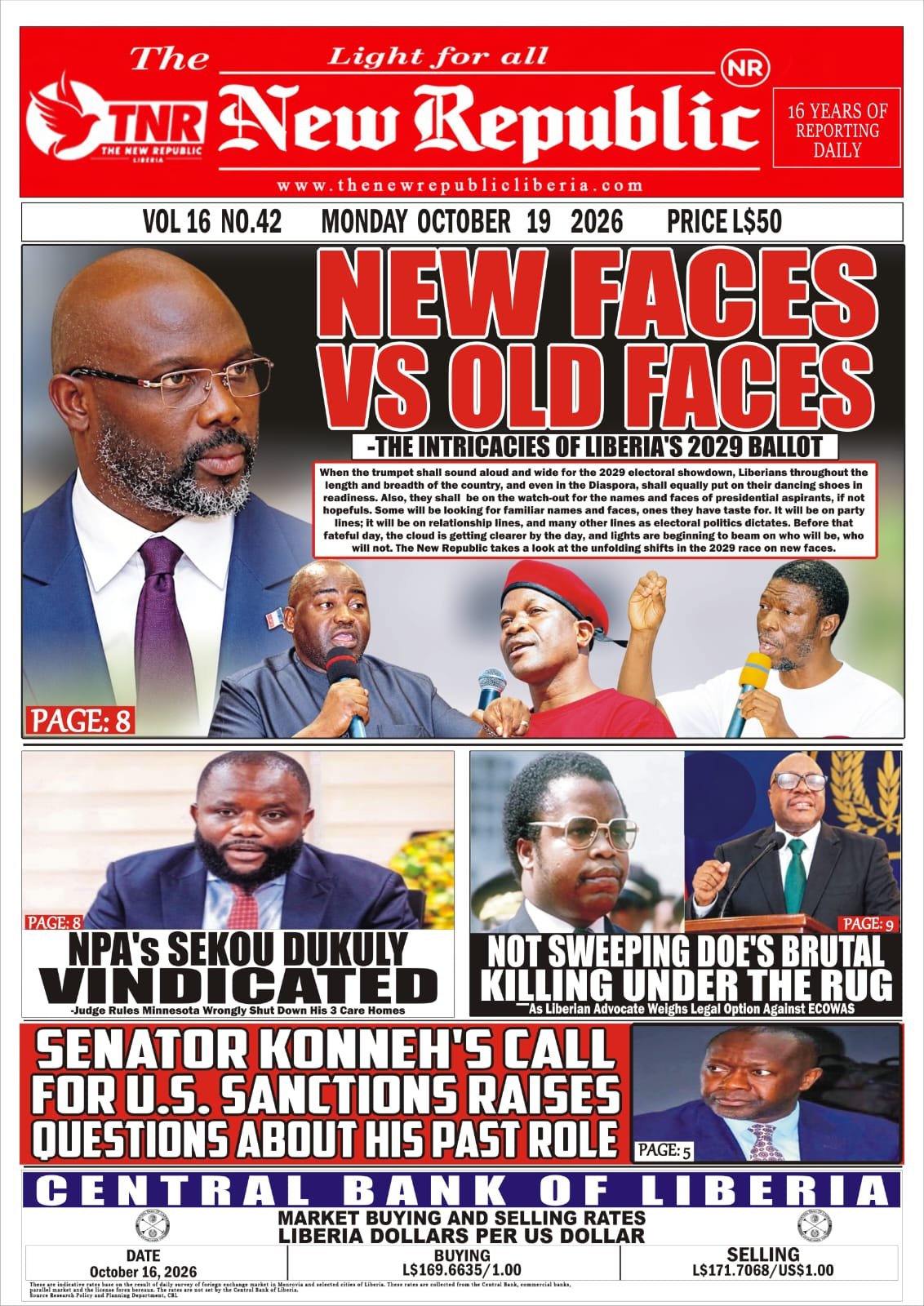
Monrovia-When the trumpet shall sound aloud and wide for the 2029 electoral showdown, Liberians throughout the length and breadth of the country, and even in the Diaspora, shall equally put on their dancing shoes in readiness. Also, they shall be on the watch-out for the names and faces of presidential aspirants, if not hopefuls. Some will be looking for familiar names and faces, ones they have taste for. It will be on party lines; it will be on relationship lines, and many other lines as electoral politics dictates. Before that fateful day, the cloud is getting clearer by the day, and lights are beginning to beam on who will be, who will not. The New Republic takes a look at the unfolding shifts in the 2029 race on new faces.
Potential intricacies for voters in the pending 2029 elections are beginning to emerge with the introduction of new presidential faces going against the old faces.
Several months away, the portending challenges are becoming glaring that there will be a good number of new faces on the ballot against the known old faces, a dynamic that could reshape Liberia’s presidential politics.
First it was former President George Weah who let the cat out of the bag that he would contest in 2029, then followed by former Representative Yekeh Kolubah recently, and now it is Emmanuel Gonquoi of the Economic Freedom Fighters of Liberia (EFFL).
With his declaration that he will be on the ballot in 2029, the list for the presidential election is getting complexly long, and more crowded by the day.
“Almost three years to the polls, more and more Liberians are declaring intentions, and the latest is EFFL leader Emmanuel D. Gonquoi, who says his arrival this time is “much more presidential.”
“The Emmanuel D. Gonquoi you knew two years ago, is not the Emmanuel Gonquoi before you here today. Margibi County will not be used as a scapegoat. My arrival in Margibi years ago is not as compared to my arrival here today,” Gonquoi declared to cheering supporters in Kakata.
“My arrival today is even much more presidential. There is no curse on Margibi that we can’t produce a presidential candidate or vice presidential candidate; 2029 I will be on the ballot.”
Gonquoi made the declaration during a political engagement in Margibi County, where he framed his ambition around breaking what he called the political marginalization of the county.
According to him, Margibi, one of Liberia’s most politically vibrant and economically strategic counties, has for too long been used as a voting bloc without producing national leadership.
Gonquoi rose to national prominence as an outspoken advocate and head of the EFFL, a grassroots movement modeled after radical economic emancipation rhetoric, demanding accountability, jobs for young people, and a re-negotiation of concession agreements he says disadvantage Liberians.
Once known mainly for street protests and fiery press statements in Monrovia, Gonquoi now says he has matured politically.Political observers say his 2029 declaration is not entirely surprising.
The EFFL leader contested in previous legislative elections in Margibi and has built a loyal youth base, particularly among unemployed graduates and motorcyclists.But declaring for president raises the stakes significantly – and places him in an increasingly long queue.
First, it was former President George Manneh Weah, the old face seeking a comeback, who has already signaled to his Coalition for Democratic Change (CDC) partisans that he intends to stage a return in 2029 after his 2023 defeat to President Joseph Nyuma Boakai.
Then came former Montserrado District #10 Representative Yekeh Kolubah, the firebrand opposition figure known for his no-holds-barred criticism of the establishment, a familiar face, but now branding himself as a new alternative.
Now it’s Gonquoi of the EFFL, a quintessential new face, adding a third vocal opposition voice to the list, with many more expected.
Representative Musa Bility of the Citizens Movement for Change (CMC) is another potential new face on Liberia’s 2029 ballot. Though, he is yet to make a clear-cut declaration about his presidential intentions, political analysts have hinted his actions, utterances, and political activities across the country are classically tacit confirmation of how he sees and thinks about 2029.
He is seen as one of the vocal critics of the current administration’s handling of the affairs of state, the stark disparity between what it preaches and the actual realities of life citizens are undergoing.
He recently challenged what he sees as the Congress for Democratic Change’s (CDC) claim to leadership and ownership of the country’s opposition politics, arguing that opposition cooperation cannot be reduced to allegiance to one political organization.
The remarks followed efforts by former President Weah to rally the opposition into a united force against the ruling establishment.
Also, Bility drew a line between opposing the Unity Party government and automatically aligning with the CDC, while making a broader argument about how political alliances should be structured as Liberia moves toward the 2029 elections.
“Being in opposition does not mean supporting the CDC,” Bility declared.
His argument is significant because it comes at a time when opposition parties are again discussing cooperation, but with unresolved questions about who should lead, how decisions should be made and whether a future alliance will be built around a common governing program or simply the objective of defeating the incumbent Unity Party.
Recent developments suggest those questions are already producing friction. In September, opposition leaders including the CDC, ANC, CMC and other political actors agreed to develop a framework for cooperation, while stopping short of announcing a coalition or presidential ticket.
Political analysts say this is where the intricacy lies that voters in 2029 will have to navigate a ballot that pits nostalgia and established political machinery against anger, youth appeal, and radical economic promises, political analysts have said.
According to them, the early declarations reflect both deep discontent within the opposition and a strategic attempt to lock down grassroots support early, especially as President Boakai’s Unity Party grapples with internal wrangling, economic pressures, and mounting corruption allegations in the Legislature.
“2029 looks far, but Liberian politics starts early. Whoever starts early controls the narrative in their county,” one Margibi-based analyst told this paper.
Gonquoi’s message deliberately tapped into Margibi’s local pride and frustration.Despite producing prominent lawmakers, business tycoons, and some of Liberia’s best-educated professionals, Margibi has never produced a President or Vice President since 1847.
Both major parties often pick running mates from vote-rich counties like Nimba, Bong, and Lofa, leaving Margibi as a “kingmaker” but never king.”
There is no curse on Margibi that we can’t produce a presidential candidate or vice presidential candidate,” Gonquoi insisted.
Whether his EFFL, which is not yet a fully certified political party by the National Elections Commission (NEC), can meet the organizational and financial threshold for a presidential run remains to be seen.
But his declaration has already set Kakata talking. As one supporter shouted at the event, “The ballot is long, but Margibi must be on it.”
With more than 36 months to elections, the presidential list is only expected to grow longer, and the battle between new faces and old faces will only get more intense.
About The Author