The national conversation surrounding the Armed Forces of Liberia’s (AFL) ongoing recruitment exercise continues to grow, with prominent Liberians calling for greater empathy toward applicants, urgent reforms in the education sector, and stronger protections for those seeking to serve their country.
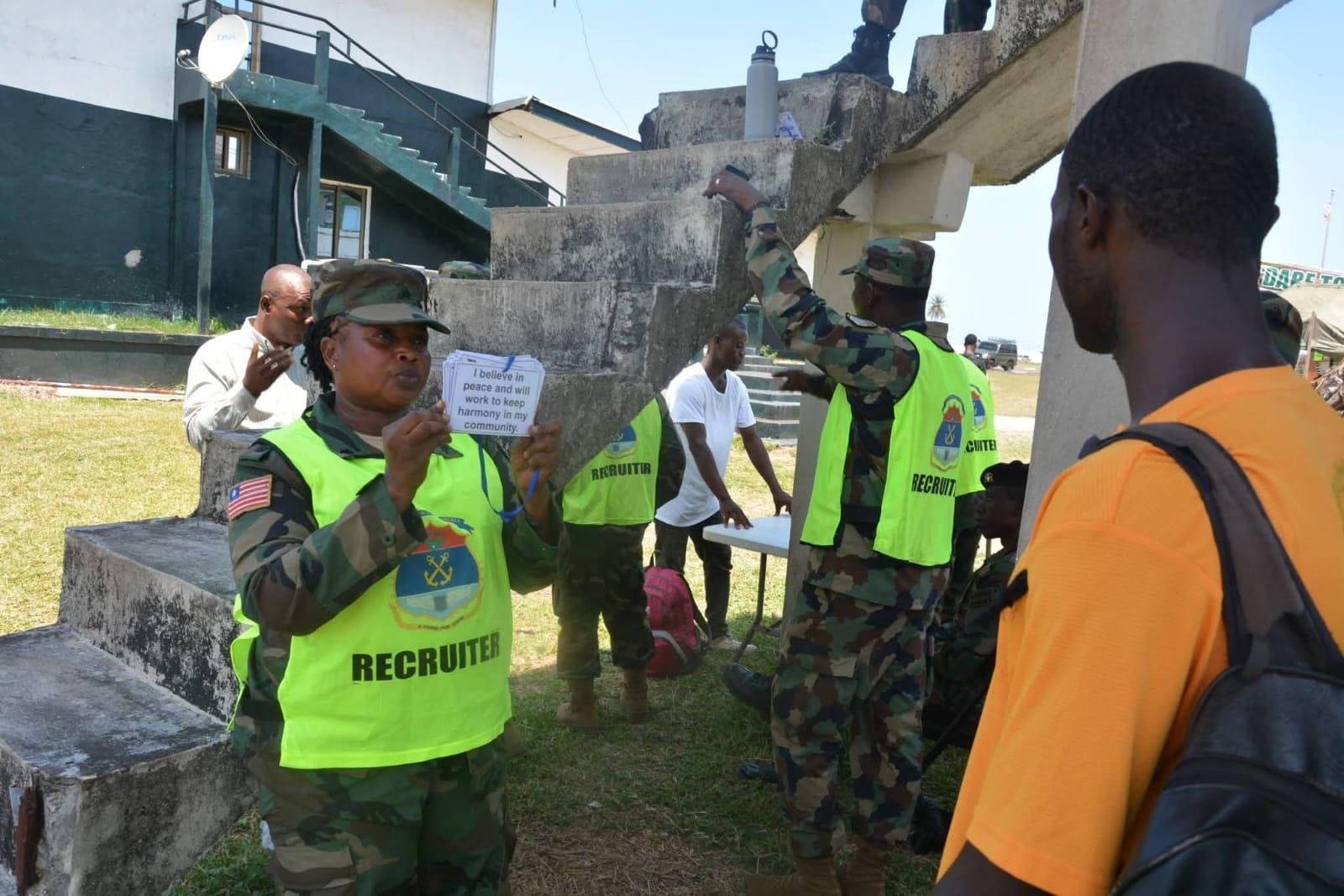
The debate was sparked by a viral video showing applicants participating in the AFL’s “Read What You See” assessment, where some candidates appeared to struggle during the reading exercise.
The footage has generated widespread discussion on social media, with reactions ranging from criticism to concern.
Among those weighing in is the Managing Director of the Liberia Water and Sewer Corporation, Mohammed M. Ali, who stressed that the ultimate goal of military recruitment should be to build a disciplined and capable force.
“I see all these posts about how people can’t read. What we need is a well-trained army, not mere sentence readers,” Ali stated.
His comments have sparked debate, with many agreeing that military service requires discipline, courage, and physical readiness.
Others, however, maintain that literacy remains an essential skill for modern soldiers, who must be able to understand written instructions, interpret operational documents, and effectively use technical equipment.
Activist Martin K. N. Kollie also joined the discussion, linking the issue to broader concerns about public spending and the state of Liberia’s education system.
“Are you still asking why a lot of AFL applicants can’t read?” Kollie wrote. “A few greedy politicians pocket almost everything every year.”
He cited what he described as stark disparities in government spending, noting that schools such as Cape Palmas High School, Sanniquellie Central High School, and Frank Tolbert Public School have received relatively modest funding compared to other government expenditures. His remarks have intensified calls for increased investment in education.
Adding her voice to the national discourse, Hon. Karishma Pelham-Raad urged Liberians to approach the issue with compassion rather than ridicule.
“The current situation with the new applicants for the AFL is not something to be used to bully, throw shade, or make mockery of them,” she stated.
Pelham-Raad emphasized that the struggles displayed by some applicants should be viewed within the broader context of Liberia’s longstanding educational challenges.
“What we should focus on is how to fix the broken system we have had since the war,” she noted, adding that Liberia’s education system has faced significant structural weaknesses for many years.
She further called for renewed efforts to motivate young people to prioritize education, regardless of the hardships or circumstances they may face.
The public airing of the recruitment exercise has also drawn criticism. Pelham-Raad described the broadcasting of applicants’ evaluations on social media as inappropriate and potentially harmful.
“It is completely wrong to carry out a recruitment process on social media,” she said, urging the AFL to remove such activities from Facebook and other digital platforms.
She stressed that individuals seeking to join the military deserve dignity, privacy, and protection throughout the recruitment process.
“People wanting to be recruited or joining the army should be protected in all forms and ways,” she added.
Despite the controversy, Pelham-Raad commended the courage and patriotism of the young men and women who have stepped forward to serve.
“To the young men and women who have shown interest in our Army, I wish all of you the very best,” she said.
As the debate continues, the AFL recruitment exercise has become a focal point for broader discussions about educational reform, youth empowerment, media ethics, and institutional responsibility.
For many Liberians, the moment represents an opportunity to address systemic challenges while reaffirming the dignity of those who aspire to serve the nation.
About The Author