
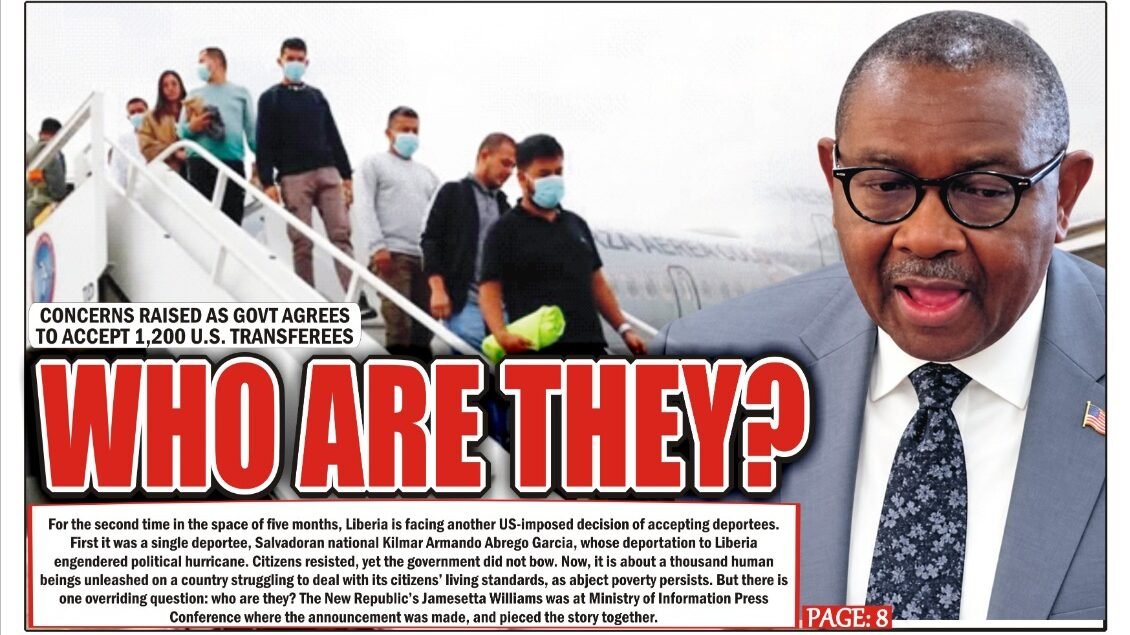
For the second time in the space of five months, Liberia is facing another US-imposed decision of accepting deportees. First it was a single deportee, Salvadoran national Kilmar Armando Abrego Garcia, whose deportation to Liberia engendered political hurricane. Citizens resisted, yet the government did not bow. Now, it is about a thousand human beings unleashed on a country struggling to deal with its citizens’ living standards, as abject poverty persists. But there is one overriding question: who are they? The New Republic’s Jamesetta Williams was at Ministry of Information Press Conference where the announcement was made, and pieced the story together.
Questions have abound over the Government of Liberia’s announced agreement to receive 1,200 individuals being transferred from the United States, with the first group of 20 expected to arrive in the country on Friday.
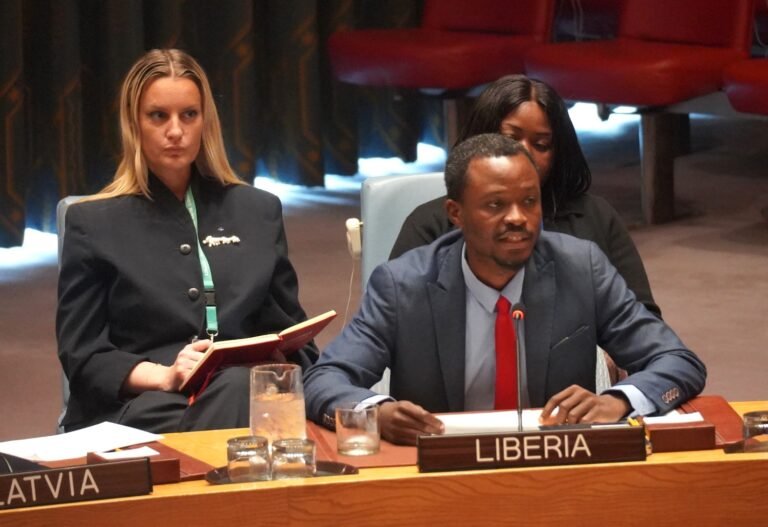
Information Minister Jerolinmek Piah disclosed the arrangement during a press briefing on, saying the decision reflects Liberia’s tradition of hospitality and its willingness to assist people in need.
“Liberia is a country of free people and has agreed to accept these individuals who are asylum seekers in the United States,” Minister Piah said. “This is intended to demonstrate our hospitality and willingness to assist people in need.”
But not many citizens are moved by the announcement and the accompanied justifications, with some wondering if the decision is primarily pillared on pure ‘hospitality or it is for financial reward, or something else only known to the government.’ There are also concerns about the status of the transferees to Liberia, in terms of their nationalities, security records and others.
The concerns come against the backdrop of heightened public suspicion about the government’s handling of the ongoing cocaine busts, where allegations about shielding of some high-ups are ripe. The administration is consistently accused of not being transparent and accountable as far as the cocaine case is concerned.
Those with knowledge of similar situation said it is not the first time Liberia has surrendered to the Unisted States administration request to take in individuals unwanted in the US for clusters of reasons.
They made reference to the case of Salvadoran national Kilmar Armando Abrego Garcia who the Trump admistration to Liberia,agreed to send to Liberia.
The decision was made after a motion filed before a U.S. federal court, the Department of Homeland Security (DHS), urged Paula Xinis to dissolve an existing order blocking Abrego Garcia’s removal.
According to Minister Piah, the 1,200 people are asylum seekers currently in the U.S. immigration system. He did not specify their nationalities, how long they have been in the U.S., or the legal framework under which the transfer is being done.
The Minister said the group will arrive in phases, beginning with 20 people on the first flight this Friday. Subsequent arrivals will be coordinated with relevant government agencies.Government officials said discussions with U.S. authorities have been ongoing for several weeks, and that Liberia agreed to the transfer on humanitarian grounds.
Minister Piah framed the agreement as consistent with Liberia’s historical ties to the United States and its reputation for offering refuge.“Liberia and the United States share a long-standing relationship,” he said. “As a nation founded on principles of freedom, we understand the plight of people seeking safety and opportunity.”
He added that the government is putting measures in place to ensure the arrivals are received, documented, and provided basic support upon landing at Roberts International Airport.
The Minister said the Ministries of Justice, Health, and Internal Affairs, along with immigration authorities and humanitarian partners, will be involved in the reception process.
Key areas of focus, he noted, will include screening and documentation upon arrival, health checks and any needed medical attention, temporary accommodation and orientation for the first group and coordination with international partners for longer-term support.
Minister Piah did not provide details on the cost of the program, where the individuals will be housed, or what legal status they will hold in Liberia. He said a technical team is finalizing those arrangements.
News of the agreement has drawn mixed reactions. Some civil society actors welcomed the humanitarian gesture, while others raised questions about Liberia’s capacity to absorb 1,200 additional people amid existing challenges with housing, jobs, and public services.
There are also questions about whether the transfer is voluntary, what protections will be afforded to the individuals, and what role the UNHCR and other agencies will play.The government has not indicated if there is any financial or logistical assistance from the U.S. as part of the deal.
The announcement comes at a time when the U.S. is conducting a review of its asylum and immigration policies, and several countries have entered into third-country transfer agreements.
Liberia’s decision marks one of the largest such reception commitments in West Africa in recent years. Government officials stressed that the move is not an immigration policy shift, but a specific humanitarian arrangement.
“We are not opening the doors indiscriminately,” Minister Piah said. “This is a specific group, a specific agreement, and we will manage it in an orderly manner.”What Happens Next
The first flight carrying 20 people is scheduled to arrive at RIA on Friday. Government says it will provide updates after the arrival and as subsequent groups are scheduled.
Minister Piah urged Liberians to welcome the arrivals “with the spirit of kindness and solidarity for which our country is known.”
The Ministry of Information said further details on the resettlement plan, partnership arrangements, and support services will be released in the coming days.
Earlier, Justice Minister Cllr. N. Oswald Tweh disclosed that a comprehensive screening and validation process is currently underway for persons expected to be transferred to Liberia.
According to Minister Tweh, the process is intended to ensure that relevant information concerning the individuals is properly reviewed and validated before their transfer and arrival in Liberia.
The screening process, he said, forms part of the Government’s preparations to ensure that the arrangement is implemented in an orderly manner and consistent with Liberian laws and national interests.
The Government says necessary preparations have been made for the reception of the first group of 20 individuals at Roberts International Airport and for their stay in Liberia.
Minister Piah emphasized that the persons arriving under the arrangement will be received as guests of the Republic of Liberia and will be accorded full Liberian hospitality.
He said the approach is consistent with Liberia’s longstanding tradition of providing shelter and protection to people fleeing persecution, wars and other forms of conflict.
According to the Minister, those transferred to Liberia will be free to leave the country if they choose to do so.
However, individuals who wish to remain in Liberia will have the opportunity to apply for asylum in accordance with Liberian laws.
The Government also intends to provide the necessary support to individuals seeking protection in Liberia and to ensure their safety during their stay.
About The Author