By Jamesetta D. Williams
MONROVIA—The Director General of the General Services Agency (GSA), Galakpai W. Kortimai, has outlined a series of ongoing and planned initiatives aimed at rehabilitating government infrastructure, protecting public assets, regulating the use of government license plates, and advancing the decentralization of government activities.
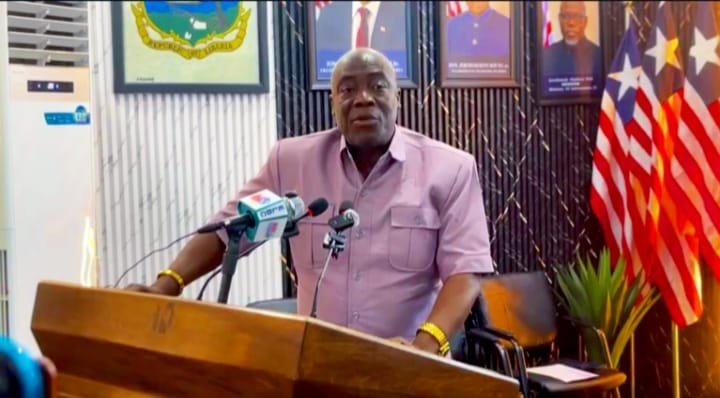
At Ministry of Information press briefing Thursday, Director General Kortimai said the GSA, as the custodian and manager of government assets, has a responsibility to inform the public about the condition and management of government properties across Liberia.
Kortimai said one of the major projects currently being undertaken by the agency is the full renovation of the historic Centennial Pavilion.
He explained that the building, which was constructed in the 1940s, has hosted several major national activities over the years, including Independence Day celebrations and other national events.
According to him, the facility has mostly received partial renovations over the years whenever major occasions were approaching, a practice he said contributed to recurring problems with the structure.
He said the government has now decided to undertake a complete renovation of the compound to give the facility a modern outlook and improve its durability.
Kortimai disclosed that renovation work has already commenced and, based on assessments from the agency’s technical team, the facility is expected to be dedicated by November.
He said the roofing component of the project has been completed at 100 percent, with the entire roof replaced to address longstanding leakage problems.
The GSA Director General said the roofing design has also been changed from the previous gable structure to a more modern design intended to improve the facility.
He said work is also ongoing on the bathrooms, plumbing, and other internal facilities, with the renovation of those areas approximately 50 percent complete.
According to Kortimai, the bathrooms have experienced several challenges over the years, particularly during major national events, prompting the agency to replace and modernize the facilities.
He added that accommodation areas used by high-ranking government officials during major occasions are also being addressed under the renovation project.
On electrical works, Kortimai said the project is currently about 60 percent complete, with wiring and other electrical installations already underway.
He said the renovation also includes painting and finishing works, which are approximately 50 percent complete.
The GSA chief explained that the agency intends to completely transform the appearance of the Centennial Pavilion, including carrying out bodywork before applying new paint to the entire building.
He said work on the front portion of the facility has already been completed, with workers expected to proceed to other sections before the final painting is done.
Kortimai also highlighted masonry and drainage works as important components of the renovation.
He said the drainage system around the facility has deteriorated over the years, with several concrete structures and other obstructions affecting the flow of water.
The GSA, he said, is working to correct the drainage problems and address other structural issues around the compound.
He added that materials and components affected by prolonged leakage and deterioration are being replaced with more durable alternatives.
Beyond the Centennial Pavilion, Kortimai said the GSA has identified several other government-owned facilities that require rehabilitation.
He said the agency intends to address those facilities gradually, depending on available resources and government priorities.
One of the facilities being considered for future rehabilitation, he disclosed, is the police barracks.
According to Kortimai, some of the barracks have not received major rehabilitation since they were constructed, resulting in poor living conditions for members of the security forces.
He expressed hope that the rehabilitation of the police barracks could be included in the next budget period.
The GSA Director General also spoke about efforts to improve the agency’s monitoring and management of government assets in the counties.
He said the GSA has monitors stationed across the country, but noted that some county leadership officials have not fully understood the functions and responsibilities of the agency.
To address the issue, Kortimai said the GSA recently conducted a tour of the southeastern region to engage county authorities and explain the agency’s role in managing government properties.
During the exercise, the GSA team visited five counties and held discussions with superintendents and local government officials.
He said the purpose of the tour was to identify and account for government assets located in the counties and ensure that ministries, agencies, and commissions have proper records of their properties and equipment.
Kortimai said the engagement has resulted in stronger collaboration between county authorities and GSA monitors.
He disclosed that the monitors are now receiving greater cooperation in tracking, identifying, and coding government properties and equipment, including laptops and other government-purchased materials.
He said the exercise is also helping to address longstanding gaps in the records of government assets located outside Monrovia.
Kortimai also raised concerns about the unauthorized use of government license plates.
He described the issue as a serious concern, saying the GSA has identified private individuals who are using government plates despite not being entitled to them.
According to him, the practice was inherited from previous administrations, but the current GSA leadership has taken steps to restrict unauthorized use.
He disclosed that a task force headed by the GSA Deputy Director General for Operations has been conducting operations to retrieve government plates being used by private vehicle owners.
Kortimai said the task force has retrieved more than 100 government license plates from private car owners in recent weeks.
He warned that the GSA will continue conducting enforcement operations without prior public announcement.
He said the agency intends to periodically go into the field to identify and retrieve government plates that are being used without authorization.
Kortimai thanked the Liberia National Police for its support during the enforcement exercise.
He also commended the Chief Justice of Liberia for issuing a memorandum directing judicial institutions to account for government license plates in their possession.
According to him, the memorandum will help the GSA address the use of old government plates, including some plates that were printed many years ago and are still being used on vehicles.
He said the GSA must approach the retrieval of plates from members of the judiciary carefully, but expressed confidence that the Chief Justice’s directive would help facilitate the process.
The GSA Director General also disclosed that the agency has been working with the Legislature on the production and replacement of official license plates for lawmakers.
He said discussions were held with legislative leadership after concerns emerged over the previous plate design.
As part of the process, Kortimai said the GSA produced new plates for members of the Legislature, including REP and HOR plates.
He explained that members of the House of Representatives and other lawmakers are expected to use the plates assigned to their respective offices.
However, he said the GSA has observed situations in which some lawmakers place one official plate on a vehicle while keeping another plate and using it on another vehicle.
Kortimai said the agency intends to meet with legislative authorities again to ensure that the plates issued to lawmakers are properly accounted for and used only on authorized vehicles.
He said the GSA will continue its field operations to retrieve old and unauthorized government plates that remain in circulation.
Turning to government infrastructure and decentralization, Kortimai provided an update on plans for the construction of a National Convention Center.
He recalled that President Joseph Nyuma Boakai had made a commitment to decentralize major national activities and reduce the concentration of large government programs in Monrovia.
According to Kortimai, the government currently relies heavily on facilities in Monrovia, including the Ministerial Complex, to host major national and international programs.
He said the GSA has therefore begun working with relevant government institutions to advance plans for the proposed National Convention Center.
Kortimai said several ministries and agencies are involved in the planning process, including the Ministry of Public Works, the GSA, the Environmental Protection Agency, and other relevant government institutions.
He disclosed that the government has acquired 50 acres of land for the construction of the proposed National Convention Center.
He expressed appreciation to those involved in making the land available for the project.
According to Kortimai, the first phase of work on the property, including clearing of the land, has already been completed.
He said the next phase will involve fencing the entire property to prevent encroachment before construction begins.
The GSA Director General said technical preparations are also underway, including architectural planning and geotechnical assessments to determine the condition of the soil and other requirements for the construction.
He disclosed that a preliminary architectural design for the proposed facility has already been prepared.
According to Kortimai, the planned National Convention Center is expected to accommodate at least 5,000 people during major national and international programs.
He said the proposed compound will also include a hotel and villas representing all 15 counties.
Kortimai explained that the next phase of the project will include landscaping, further technical assessments, and additional architectural work before the final construction plan and cost are determined.
He said the GSA will provide the public with the overall estimated cost of the project after the necessary technical and architectural assessments have been completed.
The Director General said the broader objective is to decentralize major national activities from Monrovia and create opportunities for citizens in rural counties to participate in major national programs.
He said the government is also considering the development of additional facilities in other parts of the country to support national and regional programs.
Kortimai further disclosed that the GSA is reviewing its policies and procedures governing government vehicles and license plates.
He said a new policy is being developed to clearly define which government officials are entitled to specific categories of government vehicles and official plates.
According to him, the policy will cover senior government officials, including the President, Vice President, Chief Justice, ministers, deputy speakers, and other government officials.
He said the objective is to ensure that government vehicles and other public assets are properly managed and that officials comply with established regulations.
The GSA Director General also announced plans for a new resource-mobilization policy aimed at strengthening the management and protection of government assets and services.
He said the agency is preparing documents for consideration by the Cabinet, with additional policies expected to be presented for endorsement.
Kortimai said once the policies are approved, the GSA will return to the public to explain their implementation.
He emphasized that the agency remains committed to protecting government property, improving asset management, and ensuring that public resources are properly accounted for.
He said the GSA is also preparing its budget and planning for future projects, including the decentralization of renovation and rehabilitation works on government properties across the country.
Kortimai concluded by reiterating the GSA’s commitment to strengthening the management of government assets, improving coordination with county authorities, and ensuring that public infrastructure is protected, rehabilitated, and developed to support Liberia’s national development goals
About The Author