
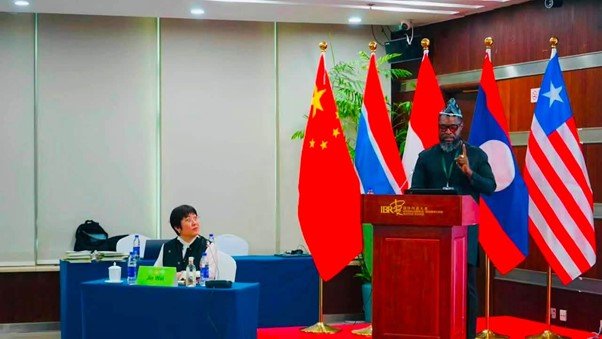
Liberia has showcased its vision for sustainable economic transformation through bamboo innovation at the ongoing international seminar on the Development of Industries Related to the “Bamboo as a Substitute for Plastic” Initiative, with Varmah Bobby Gray leading the country’s delegation and presenting a roadmap for green industrial development.
Gray, who serves as Chief of Office Staff in the Office of Senator Nathaniel F. McGill, Chairman of the Liberian Senate Committee on Education and Public Administration, delivered Liberia’s official presentation before senior Chinese government officials, international experts, and delegates from eight participating countries.
Speaking on the theme, “From China’s Experience to Liberia’s Transformation: Building a Green Economy Through Bamboo Innovation,” Gray outlined how Liberia intends to harness its abundant bamboo resources to drive sustainable industrialization, environmental protection, job creation, and inclusive economic growth.
He pointed to China’s remarkable development journey as a model for developing nations, highlighting the country’s strategic planning, policy consistency, investment in human capital, scientific innovation, and modern infrastructure as key factors behind its emergence as a global leader in sustainable development.
According to Gray, China’s ability to balance ecological conservation with industrial growth provides valuable lessons that Liberia can adapt as it pursues a greener and more resilient economy.
Drawing on Liberia’s favorable climate and vast natural resources suitable for bamboo cultivation, Gray proposed a comprehensive framework for implementing the “Bamboo as a Substitute for Plastic” Initiative. The proposal calls for the formulation of a National Bamboo Development Strategy, stronger public-private partnerships, increased investment in research and innovation, capacity building for farmers and entrepreneurs, and the expansion of domestic and international markets for bamboo products.
He identified several sectors where bamboo could significantly contribute to Liberia’s economic diversification, including construction materials, furniture manufacturing, eco-friendly packaging, paper production, handicrafts, renewable bioenergy, and other value-added industries capable of creating employment opportunities while reducing dependence on plastic products.
Gray also underscored the importance of strengthening Liberia-China cooperation through technology transfer, technical training, joint research, investment partnerships, demonstration projects, and institutional exchanges. He said such collaboration would accelerate Liberia’s transition to a green economy while contributing to the achievement of the United Nations Sustainable Development Goals (SDGs).
“The experience shared by China demonstrates that sustainable development is driven by innovation, long-term planning, and strategic partnerships,” Gray said. “For Liberia, the Bamboo Initiative is not merely an environmental intervention; it is a transformative opportunity to diversify our economy, create green jobs, empower rural communities, and build a more resilient and sustainable future.”»
The Liberian presentation received positive attention from participants for its practical recommendations, forward-looking vision, and emphasis on adapting international best practices to Liberia’s national development priorities. It also reaffirmed Liberia’s commitment to environmental sustainability and strengthened prospects for expanded cooperation with China in green industrial development.
The international seminar has brought together government officials, policymakers, researchers, and industry leaders from across the world to exchange experiences and explore innovative approaches to reducing plastic pollution through the sustainable development of bamboo and rattan industries.
Liberia’s participation reflects the country’s growing commitment to green industrialization, environmental sustainability, and international cooperation while creating new opportunities for investment, technology transfer, and knowledge exchange between Liberia, China, and the wider international community.
About The Author