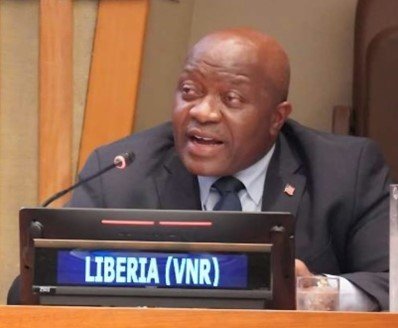
Finance and Development Planning Minister Augustine Kpehe Ngafuan has told the United Nations High-Level Political Forum (HLPF) on Sustainable Development that Liberia is making significant progress in achieving its development agenda and the Sustainable Development Goals (SDGs), despite facing global economic challenges.
Minister Ngafuan made the statement on Friday, July 10, 2026, while presenting Liberia’s Third Voluntary National Review (VNR) at the 2026 HLPF in New York, United States.
Liberia was among 36 countries that presented their voluntary national reviews under this year’s HLPF theme, “Transformative, Equitable, Innovative and Coordinated Actions for the 2030 Agenda.”
In his presentation, Minister Ngafuan highlighted the government’s ARREST Agenda for Inclusive Development (2025–2029) as the country’s framework for achieving the SDGs, noting that the National Development Plan contains 375 development interventions, with about 83 percent directly linked to specific SDG targets.
He said the government remains committed to implementing measurable development programs aimed at improving the lives of Liberians while ensuring accountability and sustainability.
According to the Finance Minister, Liberia has recorded progress in several key areas, including poverty reduction, economic growth, healthcare, education, infrastructure, energy, and financial inclusion.
He reported that the country’s Human Development Index has increased to 0.510, while the national poverty rate has declined from 34 percent in 2020 to 29.6 percent in 2024.
Minister Ngafuan also said Liberia’s economy has remained resilient amid global economic pressures, with economic growth projected at 5.5 percent in 2026 and inflation reduced to 5.3 percent, compared to the double-digit inflation recorded in 2023.
On social development, the Minister said Liberia continues to improve maternal healthcare, strengthen disease surveillance systems, expand school enrollment, and increase access to Technical and Vocational Education and Training (TVET) programs to prepare young people for employment opportunities.
He added that financial inclusion has expanded significantly, with mobile money accounts increasing from 1.5 million in 2020 to more than 3.5 million currently, especially benefiting rural communities.
The Finance Minister further reported improvements in access to basic services, including safe drinking water, sanitation, electricity, and telecommunications.
He said access to safe drinking water has increased to 78.8 percent of the population, while sanitation coverage has grown from 18 percent to 28 percent. Electricity access has also expanded from 32.7 percent to 38 percent, supported by increased generation capacity of 146 megawatts, largely through renewable energy investments.
On infrastructure, Minister Ngafuan said paved roads have increased from about 1,300 kilometers in 2023 to approximately 1,450 kilometers by the end of 2025, with government targeting 2,000 kilometers by 2029.
He also disclosed that 4G telecommunications coverage now reaches 80 percent of Liberia, construction has started on the country’s first Special Agro-Industrial Processing Zone, and domestic revenue has increased from US$606.3 million in 2023 to more than US$840 million in 2025.
However, Minister Ngafuan acknowledged that Liberia continues to face major challenges, including the withdrawal of support from a major development partner in 2025, rising global fuel and food prices linked to international crises, and increasing debt obligations.
Despite these challenges, he assured the international community that Liberia remains committed to pursuing sustainable, inclusive, and climate-resilient development.
“Liberia is not retreating. We are taking ownership. We are modernizing tax administration, accelerating digital transformation, strengthening climate resilience, and mobilizing more domestic resources to finance our own development priorities,” Minister Ngafuan said.
He emphasized that ensuring no Liberian is left behind remains central to the government’s development agenda.
The Minister also noted that Liberia’s Third Voluntary National Review was developed through a broad consultation process involving civil society organizations, women, youth, and persons with disabilities, with more than 40 percent of consultations led by these groups.
He concluded by calling for stronger international partnerships, increased private sector investment, innovative financing solutions, technology transfer, and enhanced global cooperation to help Liberia accelerate progress toward achieving the SDGs by 2030.
Members of Liberia’s delegation included Mines and Energy Minister Hon. R. Matenokay Tingban and Labor Minister Hon. Cooper Kruah.
About The Author