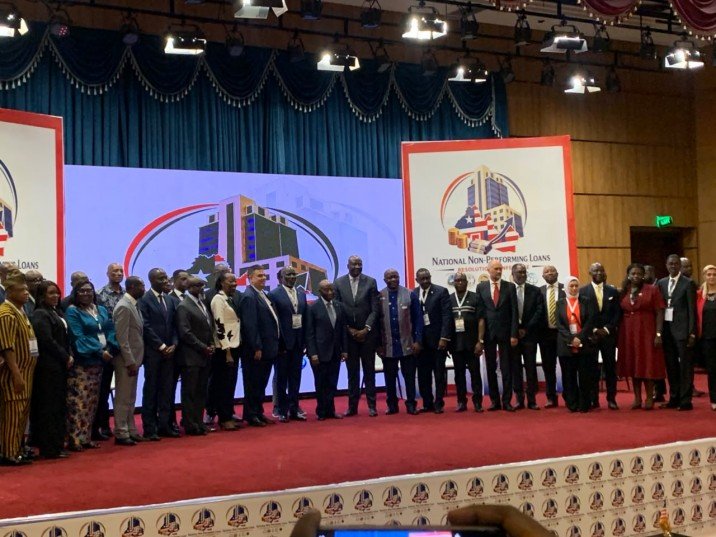
MONROVIA–The three-day National Non-Performing Loans Resolution Conference (NPLs) being held under the auspices of the Central Bank of Liberia (CBL) comes to an end today with stakeholders expected to draw out a resolution that would proffer suggestions on the way forward for the NPLs situation facing Liberia, which Governor Henry F. Saamoi, providing his perspectives, described as a national development imperative.
Under the theme, “Promoting Access to Finance to Support Private Sector Growth and Job Creation,” the NPLs conference, which got underway Wednesday, seeks to address issues of high levels of bad debt in the banking sector and unlocking credit for private sector growth and job creation.
Several representatives are in attendance, including from the World Bank, IMF, IFC, African Development Bank, Afreximbank, and delegates from Nigeria, Ghana, Egypt, Kenya, and the United States.
Also attending the conference are leaders of the Liberia Bankers Association, Liberia Business Association, Liberia Chamber of Commerce, and Liberia Marketing Association also participated.
In his insight, Governor Saamoi sounded gloomy about the fact that the conference comes at a critical time as Liberia’s NPL ratio remains well above international benchmarks, constraining lending to farmers, businesses, and entrepreneurs.
Governor Saamoi disclosed that Liberia’s banking sector ended 2024 with an NPL ratio of 19.1 percent, nearly double the prudential benchmark. The figure he said declined to 12.9 percent in 2025, but he noted that much of the improvement came from restructurings and write-offs rather than sustainable recoveries.
“Across our nation, entrepreneurs seek capital to expand, farmers need financing to increase production, manufacturers require investment to grow industry, and women and the youth aspire to transform innovation into enterprise. Yet, access to credit remains constrained, and at the heart of this challenge lies the persistence of NPLs,” he said.
According to him, healthy banking systems globally maintain NPL ratios of 5% or below while highlighting regional statistics that show that Ghana recorded 21.8% in 2024, Nigeria 8.1%, Guinea 6.7%, and The Gambia 4.6%.
The CBL Governor said no country has resolved a systemic NPL problem through isolated action, stressing “Governments must play their part. Regulators must play their part. Banks must play their part. The judiciary must play its part. Borrowers must play their part. Development partners must play their part.”
According to him, the question before Liberia is not whether the NPL challenge can be overcome, but “whether we possess the collective resolve to act decisively and collaboratively.”
Over September 9-11, participants will focus on 5 objectives, including building a shared understanding of the causes and scope of NPLs in Liberia, assessing existing regulatory, legal and judicial frameworks for NPL prevention and resolution, identify reforms to strengthen credit risk management, debt recovery, and collateral enforcement, and learning from regional and international best practices.
He also stressed the need to develop a National NPL Resolution Roadmap with clear responsibilities and timelines.
According to him, the conference aligns with government’s broader goals on private sector development, financial sector modernization, economic diversification and job creation.
“The ultimate measure of success will not simply be lower NPL ratios,” he stated. “Success will be reflected in greater access to credit, better repayment terms, stronger businesses, expanded investment, increased employment opportunities, and improved livelihoods for our people.”
“Resolving non-performing loans is not only a banking sector objective, it is a national development imperative. It is about creating jobs, expanding opportunities, and building a more prosperous and inclusive Liberia,” he concluded.
Expected outcomes include a conference communiqué, an NPL Resolution Policy Roadmap, and a Reform Action Plan.
President Joseph Nyuma Boakai who addressed the opening session of the conference, called for collective action among government, commercial banks, regulators, borrowers, the judiciary and development partners to resolve Liberia’s non-performing loan (NPL) crisis and unlock financing for private-sector growth and job creation.
The President said NPLs should not be viewed merely as a technical banking matter, arguing that the issue has direct consequences for businesses, employment and economic opportunities.
“At first glance, non-performing loans, or NPLs, may sound like a technical banking issue, something for bankers, accountants, regulators and economists to worry about. But NPLs are not just about banks. They are about businesses. They are about jobs,” President Boakai said.
According to him, the challenge affects farmers seeking financing to expand production, entrepreneurs trying to access capital, businesses seeking to expand and young Liberians hoping to turn innovative ideas into viable enterprises.
“When loans are not repaid, money that should circulate through the economy becomes tied up, making banks more cautious about lending and making credit more difficult and expensive to obtain,” he said.
President emphasized that Liberia’s development agenda cannot be achieved without a strong and healthy financial system capable of financing productive economic activity, while stressing the responsibility for resolving the NPL problem must be shared.
“Banks must lend responsibly and conduct proper assessment of those to whom they lend. Borrowers must also understand that the loans are obligations that must be repaid,” he said.
He added that contracts and collateral must have meaning, while legal and judicial institutions must be capable of resolving financial disputes fairly and efficiently.
The President acknowledged weaknesses in Liberia’s credit assessment and risk-management systems, credit information, collateral enforcement, legal and judicial processes, financial discipline and repayment culture.
He called for improvements in credit reporting, land administration and collateral registration, greater use of technology, responsible digital financial services and an improved insolvency framework.
“Resolving today non-performing loans is important, but preventing tomorrow bad loans is equally important,” President Boakai said.
The President also emphasized the role of government in Liberia’s credit ecosystem, particularly its responsibility to pay contractors and suppliers on time.
Governor Saamoi thanked President Boakai for his leadership on economic reforms and acknowledged support from development partners including the US Embassy and European Union.
About The Author