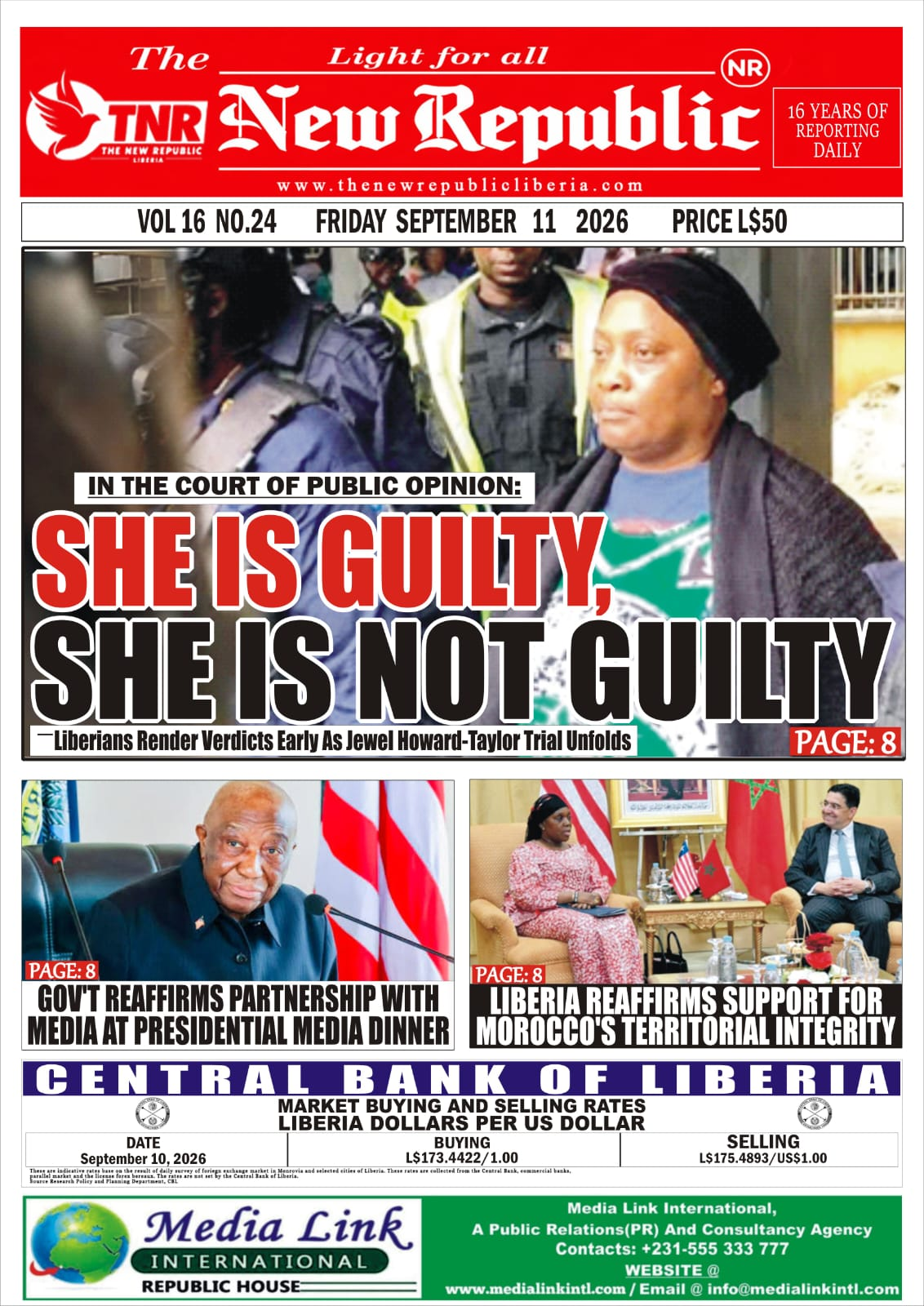
MONROVIA–While lawyers for the prosecution and defense remain locked in legal arguments over procedure i n the trial of former Vice President Jewel Howard-Taylor, many Liberians have already made up their minds.
On talk shows, in marketplaces, and across social media, the “court of public opinion” is in full session.
Before the court has ruled on admissibility of evidence or heard full arguments, citizens are declaring the former VP either guilty or not guilty, often along political, party, or personal lines.
Liberian law prohibits judgement on a case before the courts, as doing so could prejudice the matter.
Madam Howard-Taylor, who served as Vice President from 2018 to 2024, is facing multiple charges including money laundering and other financial crimes.
The case marks one of the most high-profile prosecutions in Liberia’s recent history, but as the legal teams debate technicalities and admissibility, public debate has moved far ahead.
On Facebook, TikTok, and WhatsApp, posts dissect every filing, with some users arguing the government has a “preponderance of evidence” and that the former VP should consider a plea bargain.
Others claim the evidence being presented is “immaterial” or “politically motivated” and should not be admitted in court.
“The courtroom is in session on radio and on social media before it even opens,” a Monrovia-based analyst said. “People are not waiting for judges. They are waiting to confirm what they already believe.”
Political commentator Henry Costa recently took to social media, urging the former VP to consider a plea bargain, indicating that the prosecution has substantial evidence in connection to the drug-cartel trial.
Costa alleged that the evidence includes recordings and money transfers that prosecutors may present in court. According to him, if the allegations are proven and the evidence is admitted, the charges could carry serious consequences.
But legal experts believe the early judgments appear tied to several factors including party loyalty, with some opposition supporters framing the case as persecution, pledging to and rally around the former VP.
Also, critics of the former administration in which the former vice president served, said the trial is long overdue accountability.
As the first female vice president and a long-time public figure, Howard-Taylor’s case carries symbolic weight, making opinions more passionate.
Distrust in institutions: Years of high-profile cases that stalled in court have left many Liberians skeptical that the legal process alone will deliver justice, pushing them to pronounce verdicts publicly.
At bus parks and in offices, the conversation is the same that “She’s innocent, it’s a witch-hunt” vs. “No one is above the law, let the court decide.”
Legal experts warn that trying the case in the media can complicate the judicial process. Judges, jurors, and witnesses can all be influenced by the noise outside the courtroom.
But civil society actors also note that the intensity of public debate reflects something deeper, a demand for accountability after decades of impunity for public officials.
“The people feel this case is about more than one person,” said a governance advocate. “It’s about whether the law applies to everyone, including those who once held the second highest office.”
The court has just concluded hearing preliminary arguments from both prosecution and defense on the legal path forward, with key issues being about the admissibility of evidence and the scope of charges.
Until the court makes substantive rulings, the public debate is likely to intensify. Analysts say the government will be under pressure to show the case is based on law, not politics.
The defense will be under equal pressure to prove the charges lack merit.
According to legal experts, the country appears to be running two trials at once, one inside the courtroom, governed by law and evidence, and one outside, governed by opinion, emotion, and politics.
And in that second court, they contend, verdicts are already being delivered daily on guilty, not guilty long before the gavel falls in the first. Information minister weighs In
Early this week, Information Minister Jerolinmek Matthew Piah shared perspectives on the growing public insinuations on the matter, cautioning against what he described as attempts to use the court of public opinion to influence matters currently before the courts.
Piah said he was concerned about inaccurate information being circulated publicly about the court proceedings, adding the government had remained conscious that the matter is before the court and should therefore be handled with caution.
“We are also conscious and guarded by the fact that there are cases before the court,” Piah said, stressing that parties should not attempt to shift the matter from the courtroom to the court of public opinion.
The Minister said the government decided to clarify the situation after a fresh press release was issued following a scheduled hearing, which he said contained information that could mislead the public.
At the same time, Piah went on to explain the purpose of a preliminary examination under Liberia’s Criminal Procedure Law, provoking reaction from legal experts and Jewel defense team.
He quoted Section 12.2 of the Criminal Procedure Law which he said provides for a preliminary examination after a defendant’s first appearance before a magistrate or justice of the peace when the defendant requests one.
“The former Vice President requested a preliminary examination and that the court granted the request,” he averred, and emphasized “preliminary examination is a court proceeding designed to determine whether sufficient evidence exists to establish probable cause and move a criminal case forward to trial.”
Piah said the clarification was necessary to ensure that the public was not misled by competing accounts of the proceedings.
About The Author