By Jamesetta D Williams
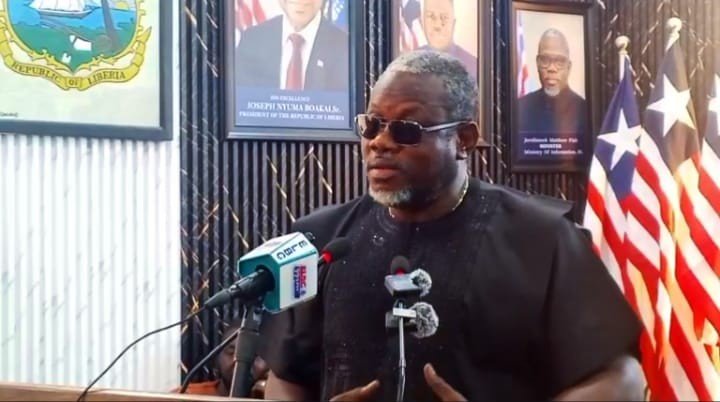
MONROVIA-Information Minister Jerolinmek Matthew Piah has warned public officials against making what he described as reckless and irresponsible statements that could inflame tensions or encourage violence in connection with the ongoing legal case involving former Vice President Jewel Howard-Taylor.
Minister Piah said public officials have a responsibility to promote peace and stability and should refrain from statements that could be interpreted as inciting people or communities against one another.
Speaking during a government press engagement, Piah criticized comments by an unnamed public official who, according to the Minister, suggested that the prosecution of Howard-Taylor was connected to her being a “Bomi woman” and portrayed the legal proceedings as an attack on the people of Bomi County.
Piah rejected the characterization, stressing that Howard-Taylor’s case is a legal matter being handled through the country’s judicial system and should not be presented as an attack on a particular county or group of people.
He said public officials, including lawmakers, must exercise greater responsibility when speaking publicly about sensitive legal matters.
We have to at all times keep away from being reckless because that is not what public officials do. We should also work around the clock to ensure that the country is peaceful,” Piah said.
The information minister argued that individuals facing legal proceedings are subjected to the same judicial processes regardless of their county, background, or political affiliation.
He pointed to the case of a former Chief Justice from Maryland County, who, according to him, previously went through a legal process without the proceedings being interpreted as an attack on the people of Maryland.
Piah said a similar principle should apply to the current case involving Howard-Taylor.
It is only a legal process as a former Vice President. It has nothing to do with our county. It has nothing to do with our tribe,” he said.
The Minister warned that attempts to link criminal or judicial proceedings to tribal or county identity could have serious consequences in a country with a history of conflict.
He recalled Liberia’s civil wars, saying the country suffered decades of violence in which an estimated 250,000 people were killed, with tribalism contributing to the division and destruction.
Piah said Liberia cannot afford to return to a situation where legal or political disputes are framed as attacks against entire communities.
He therefore urged public officials to stop making statements that could create ethnic or tribal tensions and instead allow the courts to handle matters before them.
According to the Minister, people appearing before the courts are not there because they belong to a particular county or ethnic group, but because authorities have alleged that they are in conflict with the law.
Former Vice President Jewel Howard-Taylor is currently detained at the Monrovia Central Prison in connection with an ongoing drug-trafficking investigation.
She faces allegations including importation and unlicensed exportation of controlled drugs, illicit trafficking, criminal conspiracy, facilitation, solicitation, money laundering, and aiding the consummation of crime.
Howard-Taylor has not been convicted of the allegations and remains presumed innocent unless and until proven guilty in court.
Her legal team has denied the allegations and said it intends to vigorously defend her.
Piah’s comments come amid growing public discussion surrounding Howard-Taylor’s arrest, detention, health condition, and pending preliminary examination.
The Minister maintained that while citizens and public officials have the right to express opinions, such expressions should not undermine Liberia’s peace or interfere with the judicial process.
He called for greater responsibility from political leaders, lawmakers, and other public figures when commenting on sensitive national issues.
Piah said the government remains committed to protecting peace and ensuring that legal matters are resolved through the appropriate institutions rather than through public confrontation or inflammatory rhetoric.
About The Author