
By Jamesetta D. Williams
Monrovia-Liberia’s Technical and Vocational Education and Training (TVET) sector is expected to undergo renewed assessment and institutional reforms following discussions between the Minister of Youth and Sports, Atty. Cornelia W. Kruah, and European development partners aimed at improving skills training, accountability, and youth employment.
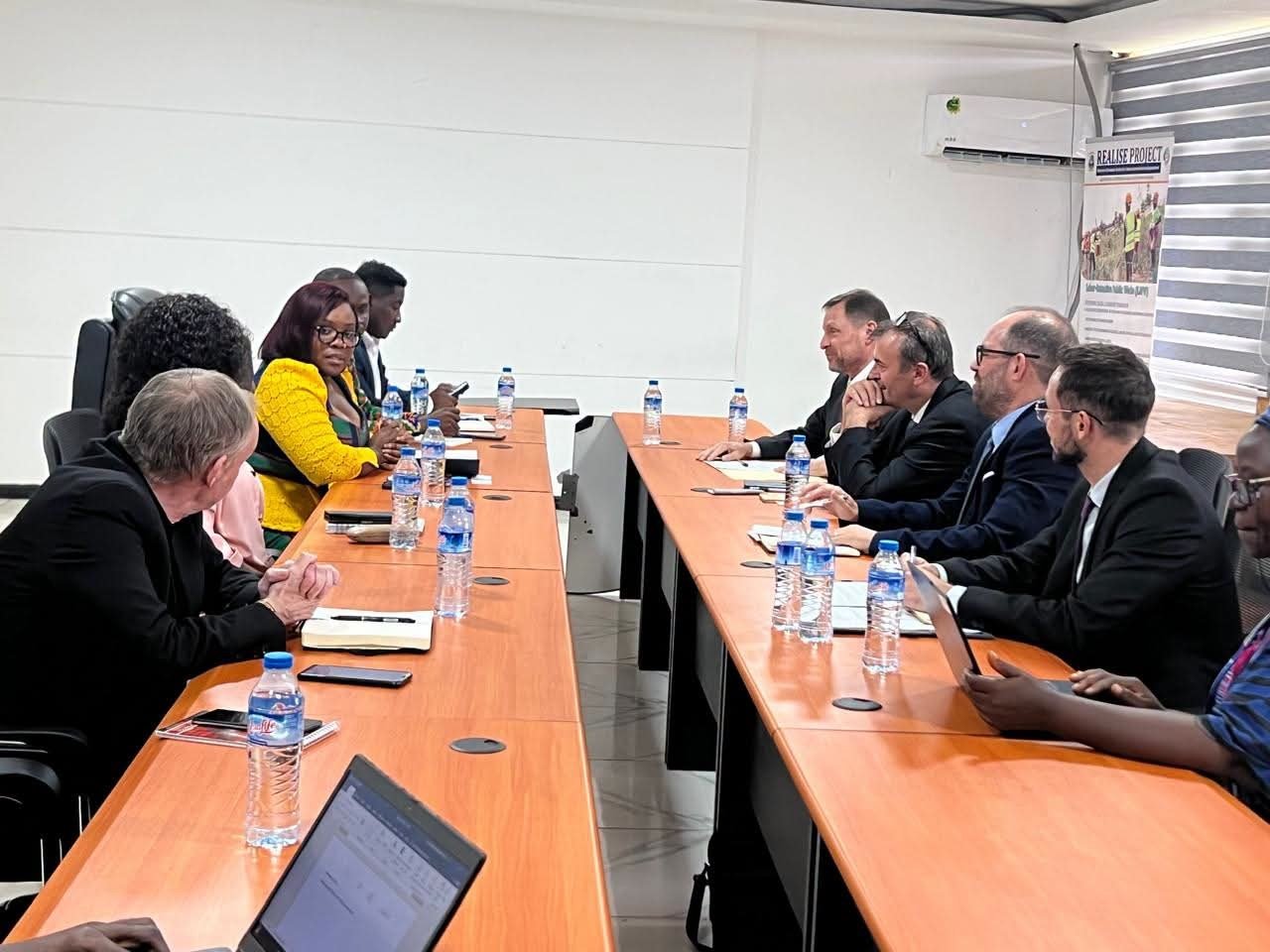
The discussions took place on Tuesday, November 17, 2026, when Minister Kruah received a high-level delegation comprising French Ambassador Dominique Delpuech, German Ambassador Carsten Hölscher, and Giles Matayron, Head of Partnership at the Delegation of the European Union to Liberia, at her office at the Samuel Kanyon Doe Sports Complex in Paynesville.
The meeting focused on reviewing ongoing Technical and Vocational Education and Training interventions, assessing institutional challenges, strengthening accountability mechanisms, and exploring ways to sustain development investments in Liberia’s vocational education sector.
Among the issues discussed were infrastructure, institutional governance, legislative reforms, the sustainability of training programs, and the need to ensure that vocational education equips young people with practical skills that can lead to employment.
Speaking during the meeting, Minister Kruah expressed appreciation to the Governments of France and Germany and the European Union for their continued support to Liberia’s TVET sector, particularly through the Skills for Technical and Vocational Education and Training (STRIVE) Project.
She said the STRIVE Project was among the first initiatives brought to her attention upon taking office, adding that she received several reports concerning projects nearing completion.
Although she expressed regret over the project’s conclusion, the Minister stressed that its achievements, experiences, and lessons learned should be preserved and extended to other areas of the country’s TVET system.
Kruah described the engagement as important to promoting transparency, strengthening institutional checks and balances, and ensuring accountability among stakeholders, reaffirming that technical and vocational education remains a priority because of its role in youth empowerment and employment.
She disclosed that one of her first actions upon assuming office was to visit the Monrovia Vocational Training Center (MVTC) to assess its operations and identify areas requiring urgent attention.
The Minister acknowledged that the country’s TVET system faces institutional weaknesses, noting that addressing the challenges would require time, commitment, and a systematic approach.
Addressing concerns about the shortage of raw materials needed for practical training at MVTC, Kruah said she was concerned about the situation, particularly because the Government had reportedly spent more than US$300,000 this year on tools and raw materials for the institution.
She said she would instruct the Ministry’s Internal Audit team to investigate the matter to determine how the resources provided were managed, given the amount of money already invested in the center.
The Minister also raised concerns about student enrollment, overcrowding, and weaknesses in the institution’s administrative and registration systems.
According to her, an initial assessment indicated that MVTC had a capacity of approximately 3,000 students, while the institution had earlier reported an enrollment of about 1,000 students.
However, subsequent assessments reportedly uncovered weaknesses in student registration and recordkeeping, including cases involving individuals claiming student status without proper registration records or supporting documentation.
Kruah further disclosed that an internal audit had identified financial management concerns, including difficulties accounting for student fees and the practice of depositing MVTC revenues into the Ministry’s operational accounts, where the funds were reportedly used for other purposes.
To address the situation, she said the Ministry had established a dedicated bank account for MVTC to ensure that student fees and other payments are properly received, managed, and accounted for.
She added that a team had been assigned to improve the institution’s operations, while efforts were underway to audit student records and verify enrollment documentation.
French Ambassador Dominique Delpuech emphasized the need to strengthen governance, coordination, and institutional arrangements within Liberia’s TVET system.
He said sustained collaboration between the Government and its development partners was essential to improving the effectiveness and long-term sustainability of vocational training interventions.
The French Ambassador also highlighted operational challenges at MVTC, including the availability of raw materials, training equipment, workshop facilities, and the overall capacity of the institution.
He recommended a comprehensive assessment of the center to establish accurate information on student enrollment, the number of trainers, training programs, workshop facilities, practical training hours, and available equipment.
According to Delpuech, such an assessment would improve reporting, accountability, and institutional management, particularly in view of the significant investments made by the French Development Agency (AFD) and the European Union through the STRIVE Project and other EU-supported initiatives.
German Ambassador Carsten Hölscher called for accelerated efforts to make Liberia’s TVET sector more functional, effective, and responsive to the country’s development needs.
He stressed that vocational training should be closely linked to employment opportunities, noting that equipping young people with technical skills must translate into their successful entry into the labor market.
Hölscher also informed the Ministry about ongoing discussions on European Union technical assistance aimed at identifying skills gaps in key economic sectors, mapping relevant stakeholders, and strengthening partnerships between private-sector actors and vocational training institutions.
Meanwhile, European Union Head of Partnership Giles Matayron reaffirmed the EU’s commitment to supporting Liberia’s vocational education sector, describing the meeting as an opportunity to review ongoing cooperation, identify implementation challenges, and develop practical solutions.
He disclosed that the European Union had invested more than €16 million in Liberia’s TVET sector over the past five to six years through various initiatives.
Matayron said the EU’s support extends beyond financial assistance to include institutional strengthening, expanding economic opportunities, and ensuring that development investments produce sustainable results.
He reaffirmed the EU’s readiness to continue working with the Ministry while emphasizing the need for open dialogue, stronger coordination, and collective action to address challenges within the sector.
The meeting ended with a shared commitment among the Ministry and its European partners to deepen cooperation, strengthen institutional accountability, and advance reforms aimed at making Liberia’s TVET system more effective and sustainable.
The parties also underscored the importance of ensuring that vocational training responds to the skills demands of young people, employers, and the country’s evolving labor market.
About The Author