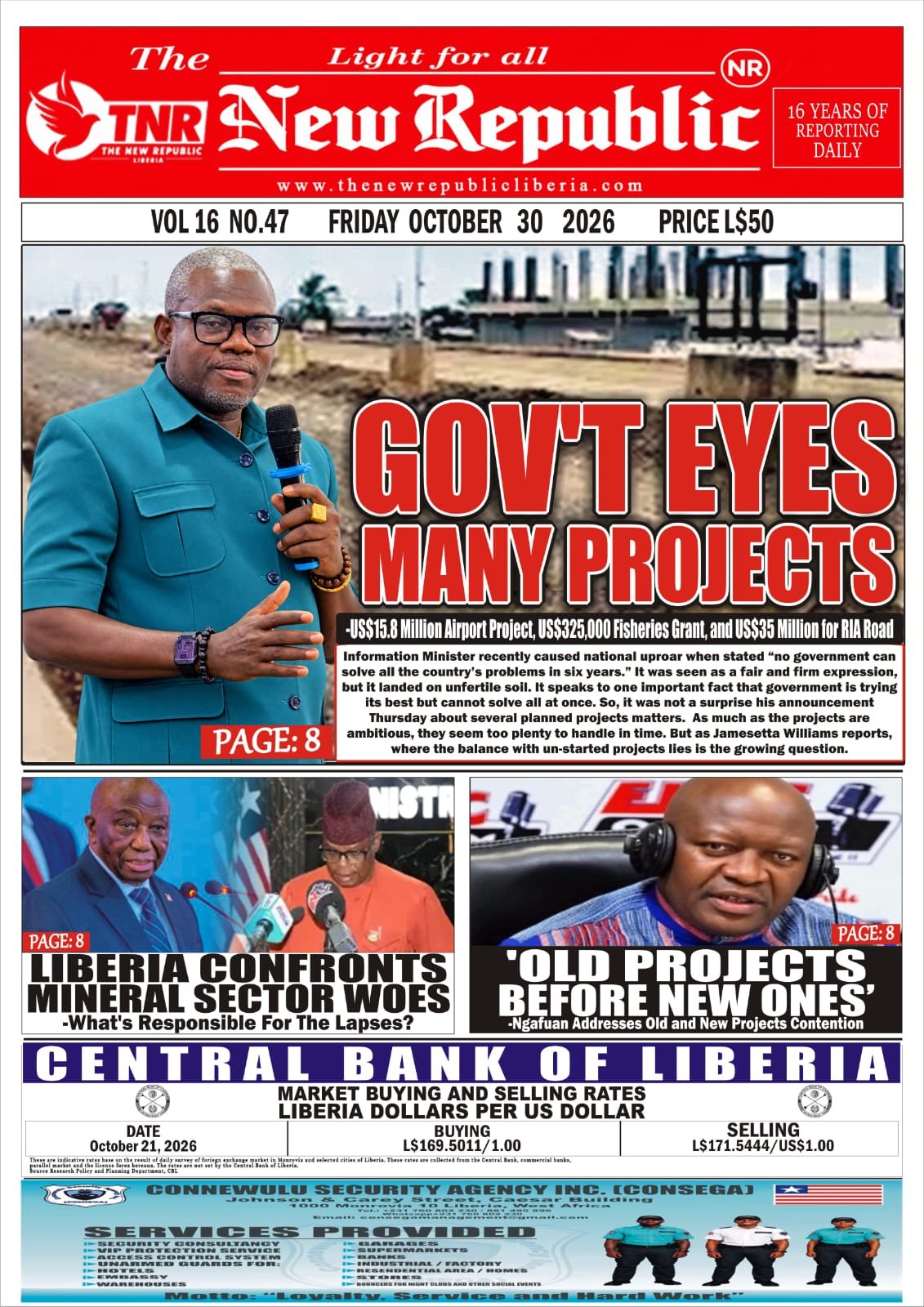
Monrovia-Information Minister recently caused national uproar when stated “no government can solve all the country’s problems in six years.” It was seen as a fair and firm expression, but it landed on unfertile soil. It speaks to one important fact that government is trying its best but cannot solve all at once. So, it was not a surprise his announcement Thursday about several planned projects matters. As much as the projects are ambitious, they seem too plenty to handle in time. But as Jamesetta Williams reports, where the balance with un-started projects lies is the growing question.

The Boakai administration says it is thinking big about fulfilling its agenda of giving the country a better infrastructural outlook.
The ARREST Agenda for Inclusive Development (AAID) unlocks the government’s plan for national transformation, but whether that is accomplishable under the current term arrangement remains to be seen.
From a projected US$3 billion in mining and energy investments, to a US$15.8 million airport safety upgrade, to a US$325,000 grant to keep fish fresh in Congo Town, Information Minister Jerolinmek Piah on Tuesday unveiled a catalog of ambitious new initiatives.
But the fanfare for the new projects has reopened an uncomfortable question for the government, with many wondering about what happened to the old projects it already broke ground for.
For many Liberians watching the groundbreakings, sod-cuttings and press conferences pile up, the line between announcement and actual delivery is getting blurry.
Briefing the press Thursday on the sidelines of the Liberia International Mining and Energy Conference (LIMEC 2026) at Farmington Hotel, Minister Piah laid out four major headlines, including US$3 Billion mining & energy ambition.
Minister Piah said Liberia is targeting US$3 billion in new investments as iron ore production is expected to jump from under 5 million tonnes to between 25 and 30 million tonnes, with new interest in cobalt, lithium, gold and diamonds.
Discussions, he said, also cover railway expansion, cross-border corridors, hydropower, solar, mini-grids and local content.
The two-day conference, organized by the Ministry of Mines and Energy, Liberia Chamber of Mines and AME Trade Ltd, opened October 28.
He also highlighted a US$15.8 Million airport safety project.
Titled “Enhancing Safe and Secure Air Connectivity,” the three-year project for Roberts International Airport (RIA) will be funded by the European Union (US$7.8m) and Germany’s Federal Ministry for Economic Cooperation and Development (US$8m).
It promises new air traffic control communications, emergency response, firefighting and rescue equipment, perimeter fencing, access control and passenger screening, plus training for LAA and LCAA personnel.
Also is US$325,000 fisheries grant secured by the National Fisheries and Aquaculture Authority (NaFAA) from FAO under its Technical Cooperation Programme to upgrade the fish sales hub in Congo Town. The centerpiece is a 20-tonne cooling room to reduce post-harvest losses.
Besides these ambitious undertakings, there is a plan US$35 Million for the RIA Road stalled project.
Piah defended continuing the RIA road, saying the administration inherited it with about US$101 million already invested or committed, but only about 10 percent physically complete at transition.
According to him, the government will now inject an additional US$35 million from its own resources while continuing to repay loans from EBID and Afreximbank.
His message echoed Finance Minister Augustine Ngafuan’s earlier defense, saying “Is the road cursed because another government started it? No!”
But amid the new announcements, citizens are pointing to a growing list of projects that were celebrated with ceremonies but are yet to move beyond the foundation stone.
Two stand out are the US$4 Million security complex broken ground for to house the Ministry of Justice, Liberia Immigration Service, Liberia Fire Service, and Liberia Drug Enforcement Agency in one complex.
Almost a year later, no contractor is on site, no structure has risen, and no timeline has been published.
The other is the US$500,000 Disabled Home in Brewerville announced in 2024 as a flagship social protection project for persons with disabilities remains unstarted, even as disabled Liberians continue to live in deplorable conditions.
Analysts say these are not isolated, but they feed a narrative that the government is better at breaking ground than laying blocks.
The tension defines the central development dilemma of the Boakai administration about continuity versus credibility.
Analysts say continuing inherited projects like the RIA road is fiscally responsible, and abandoning a US$101 million corridor for political reasons would be wasteful.
As Piah argued, “National development projects should benefit Liberia rather than be treated as the property of political parties.”
But announcing new, grander projects while old groundbreakings gather dust raises three critical accountability questions.
“If a US$500,000 disabled home cannot be started in two years, how will the government manage US$15.8 million in aviation upgrades and a US$3 billion mining portfolio,” asked a development expert.
But according to them, the figures presented need verification, stressing the US$101 million for RIA road must be broken down, to include how much was actually disbursed vs. committed; what physical work constitutes “10 percent”, and how was the new US$35 million calculated and will it be enough?
For the airport and fisheries projects, another expert quipped, “when will work begin, who will procure, and how will success be measured?”
It is understood that the US$3 billion is a target, not cash in hand.
For ordinary Liberians, the question is not how much investors promise at Farmington, but how many Liberians will be hired, how much revenue will reach the national budget, what mining communities will receive, and whether fish sellers in Congo Town can actually afford the cooling room.
“No one disputes Liberia needs more investment, safer airports, cold storage for fisheries, and a completed RIA highway,” remarked a critic when asked for his views.
He said iron ore rising to 30 million tonnes and a gold refinery would transform revenue, which already rose from US$699 million in 2024 to a projected US$1.1 billion this year largely on mining receipts.
“But the government’s development scorecard cannot be measured in press briefings alone,” he added.
For now, Liberians are left balancing two images that a government eyeing plenty of new projects on a whiteboard at Farmington, and a disabled home in Brewerville and a security complex in Monrovia where the grass is growing over the groundbreaking sites.
The ultimate value will not be determined by the size of the announced figures, but by whether the old projects are finally completed and the new ones actually start, and both deliver tangible benefits to the people.
About The Author