
Monrovia-As a candidate vying to become President, one of Joseph Nyuma Boakai’s signature promises was that Liberia would no longer experience the horrible ordeal of vehicles getting stuck in mud on major national road corridors.
The promise that “no vehicle will get stuck” resonated deeply with citizens. For years, plying major highways during the rainy season had been a nightmare, travelers sleeping on the road for days, market women watching their goods rot in stalled trucks, and sick patients dying because ambulances could not pass.
At high financial cost, the first few weeks of the Boakai administration saw a higher concentration of heavy machinery on major road corridors, with the aim of ensuring the President’s pledge was actualized.
The much-touted yellow machines were paraded, deployed, and celebrated on social media as a new dawn for road connectivity.
The Ministry of Public Works told the National Legislature it had expended over “US $22 million” to meet the “no vehicle gets stuck” commitment, although the extent of work done as well as the quality allegedly did not commensurate with the figures.
However, this rainy season, the promise has become another “empty talk” as dozens of vehicles and thousands of travelers endured difficulties reaching their destinations due to “extremely bad road conditions.”
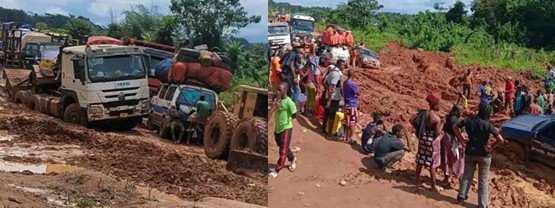
Reports and videos from different parts of the country speak of and show damaged road situations, with vehicles getting stuck for days before being pulled out by other trucks or manually offloaded by passengers.
Along the Nimba-Grand Gedeh, Sinoe-Grand Kru, and Lofa corridors, bad road conditions are glaringly visible.
On the Ganta-Zwedru highway, trucks loaded with cement and rice have been stuck for over a week are seen lope-sided.
On the Greenville-Barclayville stretch, travelers posted videos of cars submerged in muddy waters up to their doors, and on the Voinjama-Foya road, pregnant women have had to be carried on hammocks to clinics.
“For three days I was in the bush between Tappita and Zwedru. My business spoiled. This is the same suffering we have been going through for 20 years,” said Mamie Kollie, a trader who spoke to Spoon TV.
According to recent reports, more than 200 vehicles got stuck in the mud due to poor road conditions in Duogee Town, along the Toe Town–Zwedru route in Grand Gedeh County, thus disrupting government, civilian, and humanitarian movements.
Those said to be affected were Unity Party Executive Officer Mo Ali, Deputy Education Minister Amos Fulay, and several United Nations vehicles.
Travelers from Maryland County were also reportedly unable to reach Zwedru or their destinations for days.
In Lofa, commercial drivers have increased fares by more than 200 percent, citing the cost of repairs and the risk of getting stuck.
The situation unfolds at a time the Liberian government’s overly celebrated yellow machines are in country and distributed amongst the various political sub-divisions.
Over 300 pieces of earth-moving equipment – graders, excavators, bulldozers and compactors – were procured under the administration’s much-heralded road equipment program.
Why are the machines not being utilized in reconditioning the bad road conditions remains the most troubling concern.
In many counties, residents say the machines are parked at administrative compounds, or are used only to grade short stretches in front of superintendents’ residences or to work on private farms of local officials. In some places, there is no fuel to operate them.
In others, there are no trained operators or spare parts.
“The machines are there for photos. When the President is coming, they grade the road. After he passes, they park them again,” a youth leader in Grand Gedeh alleged.
The Ministry of Public Works’ disclosure that it spent over US $22 million to deliver on the “no car gets stuck” promise has raised more questions than answers.
Lawmakers in the House have demanded a full breakdown, including which roads were done, at what unit cost, who were the contractors, and what is the quality assurance?
Civil society groups say a physical inspection of the corridors shows spot patching, laterite dumping without proper compaction, and no drainage, works that wash away after two heavy rains.
“US $22 million is enough to fully pave at least 40 kilometers of road with proper culverts. What we are seeing is not commensurate with that amount,” an engineer with the Association of Liberian Construction Engineers said.
President Boakai, who campaigned as the “rescue” leader who would fix the roads, now faces a credibility test.
His government says the challenges are inherited and that climate change has made rains heavier, but for travelers stuck for days in the mud with no food and no network, such explanations ring hollow.
Some Liberians spoken to expressed disappointment that the age-old issue of cars getting stuck along the various highways remains the same despite President Boakai’s vows to address the problem head-on.
“The old man promised us that no car will get stuck. But our cars are still getting stuck. So where lies the promise?” asked driver Alieu Sheriff in Gbarnga.
As the rains intensify, the yellow machines sit idle in many counties, the roads get worse by the day, and the promise that was supposed to keep Liberia moving remains stuck in the mud, along with the vehicles it was meant to save.
About The Author