
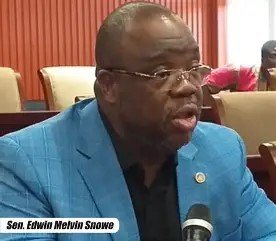
Monrovia-Bomi County Senator Edwin Melvin Snowe has disclosed that Liberia owes the Economic Community of West African States (ECOWAS) a staggering US $17.5 million in outstanding arrears, warning that the debt is undermining the country’s influence and credibility within the regional bloc.
Briefing the Liberian Senate on Tuesday, Senator Snowe, who is Liberia’s longest-serving member of the ECOWAS Parliament and former Speaker of that regional parliament, urged the Liberian Government to urgently settle the debt to strengthen Liberia’s standing and protect its future opportunities in the sub-regional organization.
According to Snowe, Liberia’s failure to meet its financial obligations to ECOWAS has placed it in the category of delinquent member states, weakening its moral authority to participate fully in decision-making, to bid for key leadership positions, and to benefit from regional programs.
ECOWAS is funded by Community Levy contributions from member states. Those funds finance the ECOWAS Commission, Parliament, Court of Justice, peacekeeping operations, infrastructure projects, and youth and trade programs.
When a country defaults, it risks suspension of some benefits, loss of voting rights, and disqualification from holding statutory positions.”Liberia is a founding member of ECOWAS.
Senator Snowe argued that “We cannot continue to be in arrears to this extent and expect to command respect at the regional table.”
Sources at the Ministry of Finance indicate that the arrears accumulated over several administrations, including the Ellen Johnson Sirleaf and George Weah governments, as successive budgets prioritized domestic spending over regional obligations.
The current Boakai administration inherited the bulk of the debt, this paper learned.
Snowe also dropped a major revelation that Liberia could be in line to head the ECOWAS Commission, the executive arm and most powerful institution of the regional bloc around 2030, if it meets the required criteria.
The ECOWAS Commission presidency is rotated among member states based on alphabetical order, fulfillment of financial obligations, and political standing.
Liberia has never held the Commission presidency since the body was restructured from a Secretariat to a Commission in 2007.
“If we settle our arrears and get our house in order, Liberia is well-positioned to produce the next President of the ECOWAS Commission in the 2030 cycle,” Snowe said.
“That is a position of enormous continental influence, with control over a multi-million dollar budget and the power to shape regional policy on trade, security, and integration.”
He noted that such a position would not only elevate Liberia’s diplomatic profile but also create jobs for Liberians at the Commission headquarters in Abuja, Nigeria, and bring strategic benefits.
Several senators who spoke after Snowe’s briefing expressed shock at the size of the debt and supported his call for urgent action. They argued that while Liberia is struggling with domestic challenges, road construction, power theft, civil service salaries, it cannot afford to be isolated regionally.
Senators are now expected to engage the Ministry of Finance and Development Planning and the Ministry of Foreign Affairs to craft a payment plan.
Options include staggered payments over three fiscal years or negotiating a debt offset against ECOWAS-funded projects in Liberia.
Snowe’s disclosure comes at a time when ECOWAS itself is under strain, having recently lost three member states, Mali, Burkina Faso, and Niger, to the Alliance of Sahel States.
It is in that context that loyal members like Liberia are expected to demonstrate commitment.
For a country that still depends on ECOWAS for trade protocols, free movement of persons, regional security support, and the ECOWAS Brown Card insurance scheme, defaulting is not just a diplomatic embarrassment, it is an economic risk.
As Senator Snowe put it: “You cannot beg ECOWAS to intervene when you have a security crisis, to fund your programs, and to give you leadership, if you are not paying your dues. It is time for Liberia to pay what we owe.”
The Senate is expected to formally write to President Joseph Boakai to prioritize the settlement of the US $17.5 million in the next budget cycle.
About The Author