By Stephanie M. Duncan
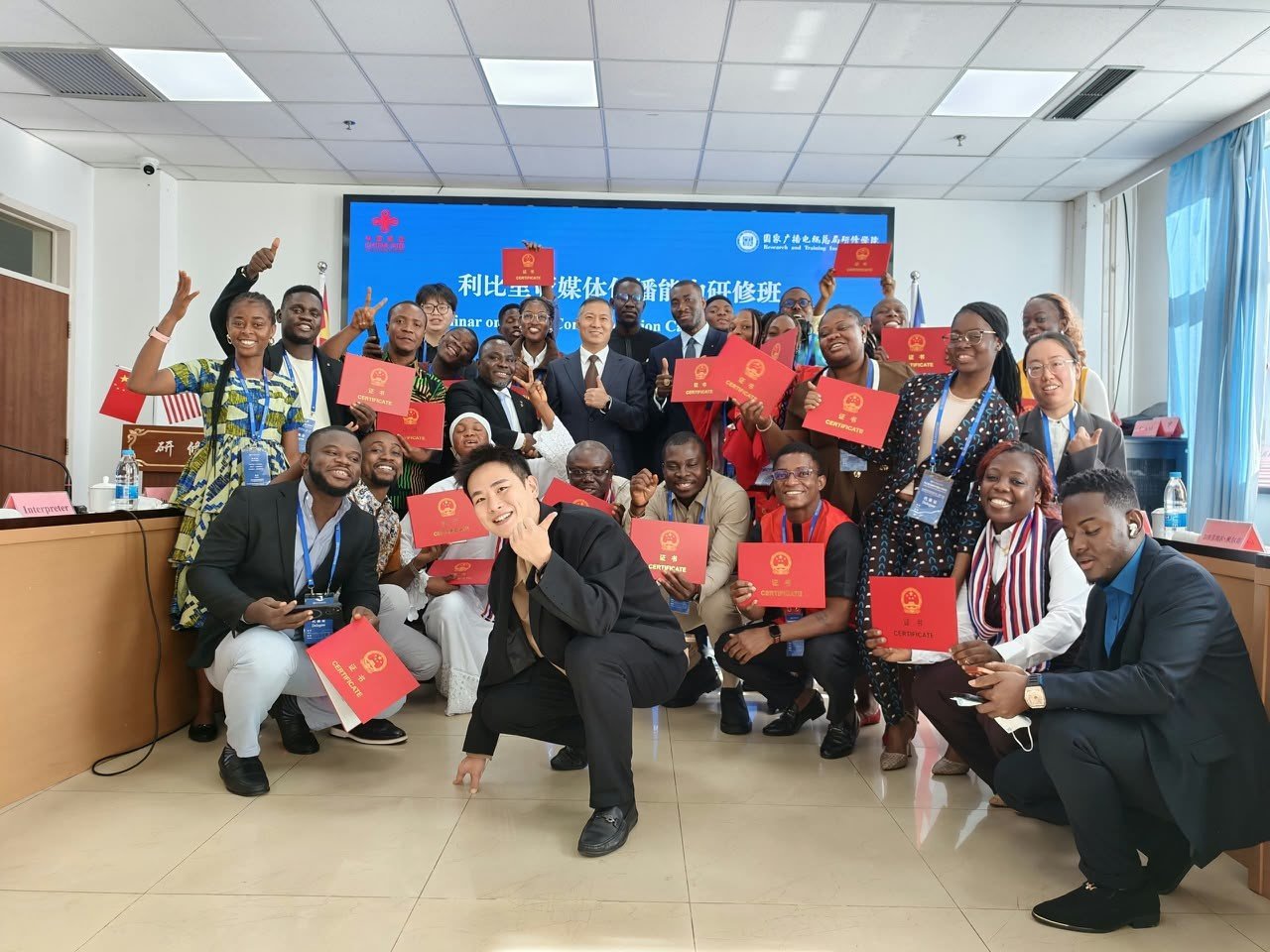
Monrovia-Liberian journalists who participated in a two-week media communication capacity-building seminar in China have been challenged to apply the knowledge and experiences gained to improve journalism, strengthen their newsrooms and contribute to national development upon their return home.
Bai S. G. Best, leader of the Liberian media delegation, delivered the challenge during remarks at the closing ceremony of the Seminar on Media Communication Capability for Liberia, hosted by the Research and Training Institute of China’s National Radio and Television Administration (NRTA) in Beijing.
Best said the seminar provided participants with an opportunity to reflect on the role of journalism in governance, national development and the well-being of citizens, while encouraging stronger professional relationships among journalists from different media institutions in Liberia.
He urged his colleagues to embrace constructive journalism that goes beyond identifying societal problems to helping the public understand them and explore possible solutions.
“I hope we return to our respective newsrooms with renewed determination to practice constructive journalism — journalism that does not merely identify problems, but helps society understand them and explore solutions,” Best said.
He also stressed the importance of holding public officials accountable, challenging dominant narratives and ensuring that the concerns of marginalized communities receive adequate attention in media coverage.
According to him, the real test of the seminar’s impact will begin when participants return to Liberia and attempt to translate their experiences into meaningful changes in their respective newsrooms and communities.
Best acknowledged that introducing new ideas and professional practices could encounter skepticism and resistance but maintained that meaningful change requires commitment and perseverance.
Drawing on a development philosophy associated with Chinese President Xi Jinping, he reminded the journalists that even a single individual or idea could make a difference in a wider community.
He challenged the participants to become agents of change in Liberia’s media landscape, asking whether the knowledge and relationships established during the seminar would produce tangible results at home.
“Our Chinese hosts have planted seeds of knowledge, friendship and possibility in each of us. The question now is what we will do with them,” he said.
“Will we grow? Will our newsrooms grow? Will our communities and our country benefit from what we have learned? The answer rests with us.”
Best described the two-week program as more than an opportunity for Liberians to learn from China, saying it also created space for participants from both countries to exchange perspectives on journalism, culture, national development and their respective ways of life.
He expressed gratitude to the Chinese government, the Research and Training Institute of the NRTA, facilitators and support staff for organizing the seminar. He also acknowledged the families, employers and colleagues of the participating journalists in Liberia for accommodating their absence during the training.
The delegation leader said the experience strengthened relationships among Liberian journalists who came from different institutions and professional backgrounds, leaving them with deeper friendships, mutual respect and a stronger sense of shared purpose.
For his part, Liu Linhai, Vice President of the Research and Training Institute of the NRTA, described the seminar as an important platform for deepening media cooperation and promoting mutual understanding between China and Liberia.
Liu congratulated the participants on completing the program and commended them for their active engagement throughout the training.
He said the 14-day seminar exposed the Liberian journalists to discussions on international communication, cultural exchange, media convergence and innovation, and strategies for combating fake news.
According to Liu, experts and scholars from several Chinese institutions, including the NRTA, China Media Group, the Chinese Academy of Social Sciences, Communication University of China and China Foreign Affairs University, shared their knowledge and engaged participants in discussions on contemporary media issues.
He noted that the exchange provided opportunities for participants to compare perspectives, broaden their professional understanding and establish relationships that could support future cooperation between the two countries.
A major component of the program was a week-long field visit to Anji County in Zhejiang Province, where the journalists observed China’s approaches to ecological development, local governance and the use of media to support social and economic progress.
Liu highlighted Anji as the birthplace of the Chinese development philosophy commonly translated as “lucid waters and lush mountains are invaluable assets.”
During the visit, the journalists toured Yucun Village, where they learned about the origins and implementation of the philosophy, which emphasizes the relationship between environmental protection and economic development.
The delegation also visited the Bamboo as a Substitute for Plastic Center and the White Tea Cultural and Creative Complex, where participants observed local initiatives promoting green development and cultural industries.
Additional visits to Anji’s county-level governance center and public creative platform provided insights into how integrated media platforms can support public administration, community engagement and local development.
Liu said the experience was particularly relevant to Liberia, which possesses abundant natural resources and environmental assets that could support sustainable development.
He encouraged the journalists to share the lessons gained from Anji with their colleagues and communities in Liberia, particularly the experiences of using media to promote social development and communicate environmental sustainability initiatives.
The Chinese official also expressed hope that the seminar would serve as a foundation for stronger practical cooperation between the two countries in media and culture.
He urged the participants to continue serving as cultural ambassadors by sharing their experiences and helping strengthen understanding between the Chinese and Liberian peoples.
Liu said the friendships developed during the seminar demonstrated the importance of direct engagement in strengthening relations between countries, beyond formal agreements and institutional exchanges.
The Seminar on Media Communication Capability for Liberia brought together Liberian media professionals for an intensive program of lectures, discussions, institutional visits and cultural exchanges designed to strengthen their understanding of contemporary media practices and international communication.
The closing ceremony marked the end of the training program, but both speakers expressed hope that the relationships and knowledge developed during the seminar would contribute to lasting cooperation between Liberia and China.
For the Liberian journalists, the next phase will be to translate the experience into professional practice and share the knowledge gained with their colleagues and the wider public back home
About The Author