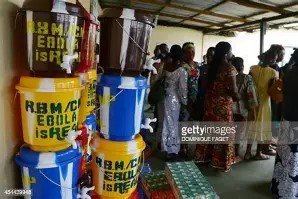
Monrovia-There is no confirmed Ebola case in Liberia to date but no single citizen is brushing aside the reality of the virus. This is why, according to our observation across Monrovia, the rubber buckets are back at the entrance of ministries, banks, supermarkets and churches across Monrovia.
They have reappeared almost overnight, blue and yellow buckets filled with chlorinated water, a bar of soap floating inside, few days after the Health Ministry issued its latest surveillance alert.
Beside the buckets and others, security guards are seeing with thermometer gun in hand, nose mask hanging loosely under his chin, urging in-bound visitors and employees alike to make use of them. There are strict rules that no single persons goes in without “washing of hands.”
Our reporter who visited the Central Bank of Liberia (CBL) explained how security guards on duty are not allowing entrance without hand wash.
“There is a bucket placed at the gate of the building where visitors and employees are asked to wash their hands before entering the fence,” he said.
On Broad Street, traders who yesterday sold phone chargers are today selling hand sanitizers, nose masks and Clorox. On the buses, people who sneezed without fear last week now cover their mouths and look around nervously.
This is a sign that Liberia is once more grappling with the trepidation of the return of the Ebola virus, 12 years after it struck a deadly blow, killing over 4,800 Liberians, most of whom were buried in mass graves, in plastic bags, without a final goodbye.
The nightmare that Liberians thought was buried in 2016 is knocking again.
Few days ago, the Government of Liberia through the Ministry of Health urged Liberians to begin taking precaution, announcing the enforcement of health screening measures and infection prevention and control protocols following reports of a confirmed Ebola Virus Disease case in Nigeria, the first since the DR Congo outbreak early this year.
According to a public health report dated Wednesday, October 21, 2026, Nigeria confirmed an Ebola case involving a woman who reportedly arrived in the country on a flight from Uganda. She developed symptoms, was admitted, and laboratory testing confirmed Ebola. She was placed in isolation on October 11 and is receiving care.
Nigerian health authorities, led by Coordinating Minister of Health Professor Muhammad Ali Pate, have traced about 44 contacts, passengers on the same flight and health workers who may have been exposed, and are monitoring them.
The current development has place the entire West Africa on edge as a grim reminder that in a region connected by flights, buses and porous borders, one case is enough.
Though there is not a reported case of Ebola in Liberia, no one is taking any chance and the government is emphatic about that, as the measures say otherwise.
In a recent briefing, Dr. Camanor of the National Public Health Institute of Liberia, NPHIL, said Liberia is closely monitoring the regional situation and taking precautionary measures to protect the population.
“Vigilance is required, particularly at airports, land borders and seaports,” he said. As part of the vigilance, the government requires all travelers to complete a health surveillance form upon arrival, giving accurate information about health status, recent travel history, and possible contact with sick or dead persons suspected of Ebola.
She said travelers arriving from or transiting through the Democratic Republic of Congo will be required to undergo 21 days of self-isolation and daily monitoring by health professionals.
Travelers from Uganda, Kenya and Nigeria will also be monitored for 21 days. Health screening, including temperature checks, at all points of entry – Roberts International Airport, Bo Waterside, Ganta, Loguatuo, seaports. Anyone suspected of showing symptoms will be managed under established public health procedures.
The hotlines are back in public memory, including 4455 for NPHIL, 5888 for ambulance.
NPHIL says it is increasing infection prevention materials, procuring lab reagents, refreshing training for health workers, and working with the Liberia National Tourism Authority to monitor large gatherings, including the ongoing African Scrabble Championship bringing participants from across Africa.
It is also working with the Liberia Pharmacy Board, because many Liberians go to pharmacies before hospitals, and a pharmacist may be the first to see a suspect case.
In a small sign of progress, Dr. Camanor disclosed that the National Reference Laboratory, whose access road had been cut by rains, now has improved access thanks to Public Works, and after more than 35 years, was finally connected to the national electricity grid on Monday, October 19, 2026, with support from LEC and the World Bank.
But the public notice from the Ministry of Health did not say where exactly screening is happening, what precise measures, or whether any suspected cases have been identified.
That silence leaves room for rumor, the same rumor that fueled panic in 2014.
As revealed, the symptoms for Ebola are fever, severe headache, weakness, fatigue, muscle and body pain, vomiting, diarrhea, stomach pain, skin rash, others.
Health experts say Ebola does not spread through air like influenza or measles, but through direct contact with blood and body fluids of a sick person, or contaminated materials.
That is why handwashing, no touching, safe burial, and early isolation worked before, and why they are back.
Recall the Ebola ghost of 2014, the horror in Congo and many more, such as the mass graves in Johnsonville, crematorium in Boy’s Town, ETUs where families dropped loved ones and never saw them again.
World Health Organization (WHO) recorded over 11,000 dead across Liberia, Sierra Leone and Guinea.
Though the epicenter is far, experts say the horror is familiar.
In north-eastern DR Congo, where the outbreak began in May, a nurse has just been killed and a second health worker seriously injured after youths attacked them as they responded to an Ebola alert.
According to UN-backed Radio Okapi, the attackers accused health workers of contaminating water sources and deliberately spreading Ebola.
WHO Director-General Tedros Adhanom Ghebreyesus condemned the assault, and said health workers “must be able to carry out their duties in safety and dignity.”
The Congo outbreak has claimed more than 4,800 lives, with nearly 10,000 infections since it was declared.
In response, neighboring Uganda has banned all non-essential travel to and from DR Congo while citizens returning face 21-day quarantine.
At Duala market, Ma Mary, who sells slippers, has placed a bucket in front of her stall.
“In 2014, I lost my sister. We cannot play with this thing. I told my children, no shaking hands,” she said.
Also at a private school in Sinkor, the principal ordered all students to come with nose masks Monday.
But there is also fatigue. “Every year they say Ebola coming. We have been washing hands since COVID. We are tired,” a keh keh driver said.
The government is urging calm, vigilance, and verified information.
“Rely on information from the Ministry of Health and NPHIL, not unconfirmed reports on social media,” Dr. Camanor said.
In 2014, panic killed almost as many as the virus, markets closed, health facilities shut, pregnant women left to die because nurses feared touching them.
Liberia learned hard lessons that early detection, isolation, contact tracing, community engagement, and trust save lives.
With the buckets, thermometer guns, and nose masks are back, Liberians are praying they are just precaution, and not a dress rehearsal for another nightmare.
As one health worker at Redemption Hospital said quietly “We survived Ebola before. But we never forgot how it felt. The moment you see that bucket at the gate, your heart starts beating fast again.”
About The Author