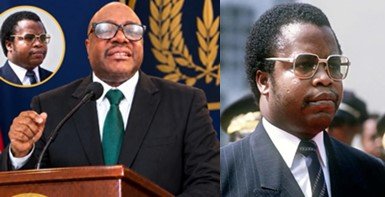
Monrovia-The recent formal and official reburial of former slain President Samuel Kanyon Doe may have marked the close of his chapter, but happened he was brutally killed on September 9, 1990 that does not go away.
Thirty-five years after one of the most gruesome political assassinations in African history was caught on camera, the brutal death of the former head of state is again in the spotlight.
Many complexities have enveloped how and why the then sitting president was snatched by rebels in the heart of Monrovia, before the very eyes of the troops assembled from several West African countries to not just monitor the horrors, but to protect citizens, including Doe.
Liberian advocate Solomon Weahwea, based in the United States, has reaffirmed his intention to pursue legal action against the Economic Community of West African States (ECOWAS) over the circumstances surrounding Doe’s death on September 9, 1990, and the role played by the ECOWAS Monitoring Group (ECOMOG) which was present in Liberia at the time.
Weahwea says he intends to take the matter before the ECOWAS Court of Justice in Abuja, Nigeria, in an effort to seek accountability and legal redress, insisting that Doe’s killing should not be swept under the rug of history.
According to historical records and testimonies, President Doe, who had been trapped in the Executive Mansion as Charles Taylor’s NPFL and Prince Johnson’s breakaway INPFL rebels encircled Monrovia, made a fatal decision to leave the Mansion to visit the newly established ECOMOG headquarters at the Free Port of Monrovia.
He was accompanied by more than 60-80 elite guards of the Special Anti-Terrorist Unit (SATU) and top officials, including Logistics Minister Joseph Kannah and Brig. Gen. Washington Barlee.
Upon arrival at the Free Port, ECOMOG peacekeepers under Ghanaian Commander Lt. Gen. Arnold Quainoo reportedly instructed Doe’s men to surrender their weapons at the gate to respect the neutrality of the compound. Doe complied and his men were disarmed.
Moments later, trucks loaded with heavily armed INPFL fighters loyal to Prince Yormie Johnson entered the same compound without being disarmed. Witness accounts say a change of guard was ongoing, from the better-armed Nigerian contingent to the weaker Gambian contingent, creating a security vacuum.
Johnson’s men opened fire. In what survivors described not as a battle but a massacre, over 64-80 of Doe’s men were executed in corridors and courtyards while ECOMOG commanders reportedly took cover and later fled to a Ghanaian warship docked nearby. No ECOMOG soldier was shot.
Doe himself was shot in both legs, dragged down bloodstained stairs, thrown into an open truck and taken to Johnson’s Caldwell base. There, he was brutally tortured for 12 hours, his ears, fingers and toes cut off, while Johnson was filmed sipping a Budweiser beer and being fanned by an assistant. The entire ordeal was videotaped and distributed worldwide, making Doe the first sitting world leader to be tortured on camera.
His corpse was later displayed naked, dismembered, burned and ashes thrown into a river.
Weahwea’s core question is one that has haunted many Liberians, especially from Grand Gedeh County, for 35 years, how could a sitting Head of State, invited to a peacekeepers’ headquarters for safety, be disarmed, then slaughtered before those same peacekeepers without any intervention.
The advocate argues on breach of duty to protect that ECOMOG had a mandate to restore order and protect lives. By disarming only Doe’s side and allowing an armed rebel faction free entry, it failed its neutrality and protection duty.
He also sees violation of international humanitarian law whereas Doe had surrendered and was a person under protection, arguing that his handover, even by inaction, to a non-state armed group that tortured him violates Geneva Conventions.
He is also concerned about the right to remedy whereas families of Doe and the 64+ soldiers and officials killed with him, many of whom were never officially buried or acknowledged, have never received an official investigation report from ECOWAS.
The state reburial of Doe and former First Lady Nancy B. Doe in 2024-2025, presided over by President Joseph Boakai, reopened the wound. At that ceremony, former Grand Gedeh Superintendent Chris Bailey (now reappointed superintendent) reminded the nation that “not just Doe , 64 others died defending Liberia.”
Weahwea says his planned suit at the ECOWAS Court will not seek to exonerate Doe’s own controversial 10-year rule, marked by the 1980 coup, execution of 13 Tolbert ministers, and ethnic favoritism toward his Krahn group, but to establish institutional accountability.
“ECOWAS cannot claim to be a peacekeeping body and yet have no answers for what happened under its roof on September 9, 1990,” Weahwea has maintained.
Legal experts note the case faces steep challenges: ECOWAS enjoys immunity in many instances, the ECOWAS Court primarily hears human rights cases against member states, not against ECOWAS itself, and the 35-year delay raises statute of limitations questions.
However, under ECOWAS Revised Treaty Articles 15 and 76, and the Court’s human rights jurisdiction expanded in 2005, advocates can bring cases for human rights violations if domestic remedies have been exhausted.
Weahwea argues Liberia’s Truth and Reconciliation Commission (TRC) recommended reparations but never addressed ECOWAS complicity.
Whether the court accepts jurisdiction or not, the move has reignited a national debate: Was Doe’s death an inevitable consequence of war, or a preventable extrajudicial killing that occurred under the watch of those sent to keep peace?
For many in Monrovia and Zwedru, Weahwea’s action is not just about Doe, it is about setting a precedent that peacekeepers must be held accountable when protection turns into betrayal.
The case, if truly pursued, could occur at the ECOWAS Court of Justice which is being taken over by a new college of judges headed by a Liberian female legal luminary, Cllr. Charlyne Brumskine, having recently elected by her peers as president of the Court.
Since the end of the civil war in which the former head of state lost his life, Liberia is still locked in processes geared toward finding justice and accountability, not for Doe and others, but for all Liberians affected by it.
About The Author