

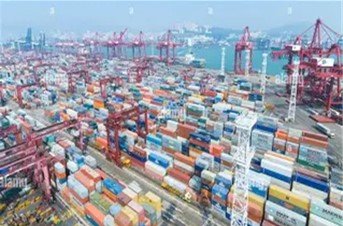
Monrovia-China said Monday its economy expanded 4.5% in the July-September quarter from a year earlier, driven by strong exports, a record that moves the country closer to its annual growth target just as trading partners press harder to narrow their deficits with Beijing.
The official figure beat expectations and picked up from 4.3% in April-June, the slowest pace in more than three years.
Chinese leaders have set a 2026 target of 4.5%-5%, down from last year’s 5% expansion. Earlier this month, the International Monetary Fund (IMF) cut its forecast for China’s growth this year to 4.5%, the bottom of Beijing’s range.
Exports lift growth, but domestic demand stays weak
Exports remain one of the few bright spots. After a 36% jump in exports last month and a $938 billion surplus for January-September, China is on course to top last year’s record $1.2 trillion trade surplus.
Higher US tariffs have dented bilateral trade, pushing Chinese exporters toward Southeast Asia, Latin America and Europe. High-tech goods, including semiconductors and hybrid and electric vehicles, are leading the growth.
In pursuing self-sufficiency to guard against Western export controls, China has built vast, heavily subsidised manufacturing capacity in sectors such as solar and EVs. But there have also been issues.
Output expanded quickly while consumption lagged, so much of it is sold abroad at competitive prices. Ecaterina Bigos, senior market strategist at BNP Paribas Asset Management, said this tech-driven, export-reliant model has produced limited job creation and income gains, while the risk of AI-driven job losses is growing.
As such, the headline official growth figure is becoming “an increasingly poor indicator of how the broader economy is performing,” according to Max Zenglein, Asia Pacific senior economist at The Conference Board.
Zenglein believes, despite the impressive number, it hides “widening disparities across industries, regions, and households”, and that managing domestic imbalances may prove harder for Beijing than handling outside pressures.
Domestic demand has softened, weighed down by a years-long property slump that has eroded household wealth and pushed up savings.
EU presses China to rebalance trade
China shipped about 919,000 passenger vehicles overseas in September, driven by strong foreign demand for plug-in hybrids and all-electric models, according to data from the China Association of Automobile Manufacturers.
For the first nine months of 2026, exports topped 7.1 million passenger cars, a jump of more than 70% from the same period a year earlier.
However, fear that cheaper Chinese imports threaten their own domestic industries and trade balance continues to remain among Beijing’s partners.
The 27-nation European Union bloc runs a deficit with China of more than $1.1 billion (€981.2 million) a day, and Chinese exports to the EU rose 16% in the first nine months of the year.
Some member states want further curbs, even after an agreement this month to roughly halve Chinese hybrid vehicle imports over the next few years.
That agreement saw the EU cap Chinese hybrid vehicle imports at 350,000 a year.
Analysts say China, however, can keep working with other countries on disputes while protecting its market access.
The hybrid deal, for instance, may let it keep selling more in the longer run while avoiding a broad tariff hike. Still, Lynn Song, chief economist for Greater China at ING, said trade imbalances “will be difficult to resolve quickly.”
Policymakers also argue that an undervalued yuan against the dollar and euro has fed the surplus, a claim China’s central bank has rejected.
Beijing has said it does not seek a large trade surplus. Last Friday, central bank governor Pan Gongsheng said deficit and surplus countries should cooperate and that China is committed to expanding domestic demand.
China’s economy grew slightly more than expected in the third quarter, but Monday’s figures still came in at the lower end of the government’s full-year target, as the global energy shock and weak domestic demand counter surging exports.
The world’s second-largest economy has charted a diverging path in recent years, with an AI-fuelled export boom masking the impact of a persistent real estate crisis and gloomy consumer sentiment.
Gross domestic product expanded 4.5 percent in June-September, according to the National Bureau of Statistics.
The reading was an improvement on the previous quarter’s 4.3 percent expansion and just ahead of the 4.4 percent predicted in an AFP poll of economists.
Beijing is hoping for annual growth this year of 4.5-5.0 percent, its lowest goal in decades. “Exports seem to be the only outperformer,” Guo Shan of Hutong Research told AFP ahead of the data release.
She said China risked missing its official target for the year, spurring a recent roll-out of mortgage subsidies for certain home purchases and support for infrastructure investment.
Beijing “will need to work faster to deploy the funds so as to hit the growth target”, she added.
While consumer activity has been a drag this year, separate data Monday showed retail rose 1.1 percent last month, the fastest pace since March.
The Chinese economy is also under pressure from the high cost of energy caused by the Iran war, which has stymied shipping from the oil-rich Gulf.
China is the world’s largest importer of crude.
Higher energy prices and “protracted uncertainty and structural headwinds” led the International Monetary Fund to last week slightly downgrade its projection for China’s annual growth this year to 4.5 percent.
IMF officials gathering in Bangkok for its meetings with the World Bank described Beijing’s recent support measures as “limited”.
Economists say China’s economy must shift towards a more sustainable growth model powered more by domestic consumption than traditional drivers like construction, property development and exports.
That long-awaited “rebalancing” of the Chinese economy has yet to materialise, IMF Asia and Pacific department director Krishna Srinivasan said.
Exports, for decades the engine of China’s economy, remain a bright spot.
Figures released last week showed a surge in overseas shipments put the country on course for another record trade surplus that would top last year’s $1.2 trillion.
That export boom has been underpinned in large part by insatiable global demand for AI-related products including computers, semiconductors and data centre equipment.
But elsewhere, China’s soaring surpluses are stoking tensions with key trading partners, including the European Union and the United States.
Talks this month between EU trade chief Maros Sefcovic and Chinese counterpart Wang Wentao ended with an agreement to limit exports of Chinese hybrid vehicles to Europe.
Many critics contend that Beijing’s extensive subsidies doled out in recent years to domestic industries have given them an unfair advantage in foreign markets.
Domestic demand woes have also exacerbated the problem, as manufacturers increasingly look overseas for new growth.
About The Author