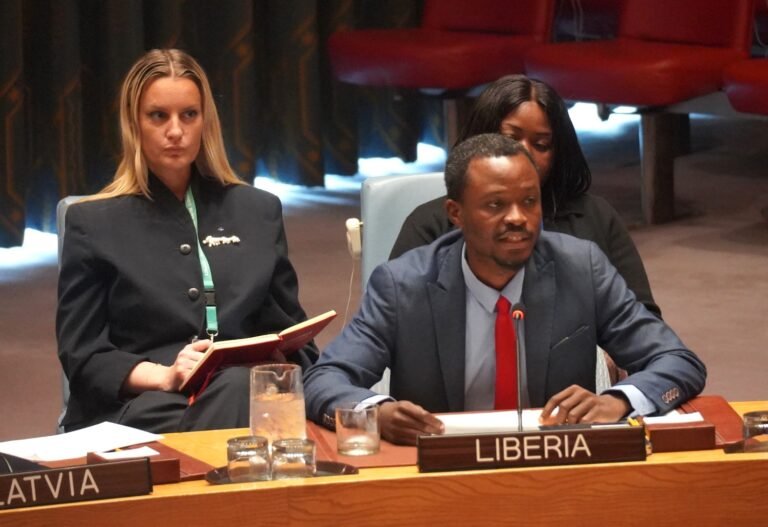

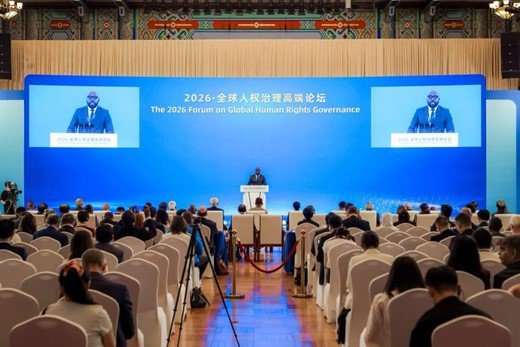
MONROVIA – Liberia’s Deputy Minister for Legal Affairs, Cllr. Jeddi Armah, has called for urgent reforms to strengthen the global institutional framework supporting the Right to Development, warning that despite decades of international recognition, its practical implementation remains uneven, particularly for post-conflict and developing countries.
Cllr. Armah made the statement while addressing the 2026 Forum on Global Human Rights Governance in Beijing, where policymakers, experts, and international partners gathered to discuss the future of global development and human rights systems.
The Right to Development, first declared by the United Nations in 1986, has been reaffirmed in several global agreements. However, the Liberian official stressed that many developing nations continue to face structural barriers that limit their ability to fully realize this principle.
Reflecting on Liberia’s post-conflict recovery journey, Cllr. Armah said development in practice has not been straightforward or without constraints.
He noted that since 2003, Liberia’s reconstruction has been shaped by both international support, including debt relief initiatives, and external policy conditions that have influenced national decision-making space.
He further highlighted the country’s exposure to global shocks, including the 2014 Ebola outbreak and the international commodity downturn, which exposed the vulnerabilities of low-income and post-conflict economies.
Cllr. Armah acknowledged the growing role of South-South cooperation in development, pointing in particular to China’s contributions in promoting partnerships based on mutual respect and national ownership.
He said such initiatives reflect important aspects of the Right to Development, but warned that deeper challenges remain within global financial governance systems, trade regimes, and sovereign debt structures.
To advance what he described as an unfinished global agenda, the Deputy Minister outlined five key proposals aimed at strengthening the Right to Development framework:
He called for stronger institutional systems with monitoring and accountability mechanisms, greater integration of human rights into global financial governance, more transparent sovereign debt restructuring processes, reforms in trade and investment systems to expand policy space for developing countries, and increased inclusion of post-conflict states in global decision-making processes.
According to him, development must not remain a privilege for a few countries but a universal right supported by a fair and functional international system.
The two-day forum brought together more than 400 participants from nearly 100 countries, along with representatives of the United Nations and other international organizations, under the theme “Joint Development, Shared Human Rights: The 40th Anniversary of the Adoption of the Declaration of the Right to Development and a New Vision for Global Human Rights Governance.”
Liberia’s intervention was described as a strong contribution highlighting both the opportunities and ongoing challenges faced by post-conflict nations in participating equitably in global development systems.
About The Author