

MONROVIA – Though the Liberian Government has been bragging improvement in the national economy, with a projected economic growth of about 4% in addition to World Bank projected global economic growth, the impact is not being felt by citizens who crowd streets, market places and other hustle grounds, selling auction goods and doing banjo, to make ends meet.
Banjo, in the Liberian business context, is when sellers waste goods and sell at minimally affordable prices. It is a process intended to encourage and enable middle-income earners to buy with little amount.
It is being observed that even when the clouds burst over Red Light Market at noon or when the midday sun turns Central Monrovia’s pavement into an oven, most people run for cover.
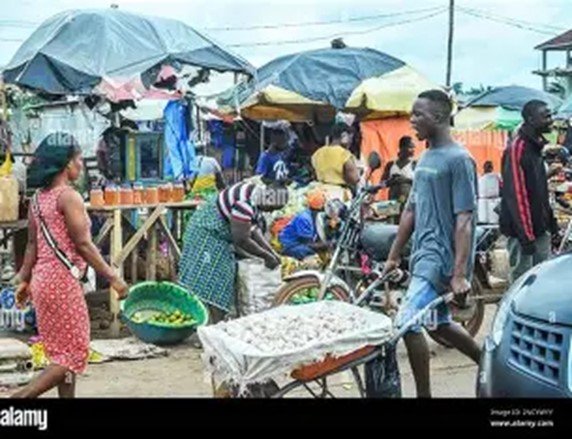
Yet, Ma Konah who sellers auction goods, and Joseph Cane who also sells children clothes in wheelbarrow are out in defiance, trying to make ends meet at all cost.
For them, rain and sun mean nothing because they have to pay school fees, pay LEC bills to pay, as well as rent at month-end, along with hungry mouths at home.
Not the dozens of others lining the streets from Bushrod Island to Paynesville, they stay under umbrellas patched with tape, under plastic sheets and under the sun until their skin burns.
One of them told our reporter “we have no choice because we are living on “banjo” to survive, to send kids to school and even put food in the house.” According to him, “Banjo” is not just street vending, it is a survival economy built on trust.
It is a process where a store owner gives goods on credit — Chinese fashion clothes, secondhand shoes, pure water, biscuits, phone cards, anything that moves. The seller takes the goods to the street, market, or bus stop. At day’s end, they return the capital to the store owner. Whatever is left after that is “small profit” — 50 LD, 100 LD, maybe 300 LD on a good day.
According to them, sometimes store owners sell goods at wholesale price instead of credit, and the seller adds their margin and hustles for the difference. “it has no salary, no benefits, and no guaranteed income, rather a just margin and movement,” remarked an auction seller in Duala Market, a famous business terrain on the Bushrod Island.
“It’s how we beat back hardship,” says 47-year-old Ma Konah, who sells children’s clothes near Waterside. “The rain can fall, but my children must still eat. The sun can burn, but rent won’t wait.”
From Red Light through ELWA Junction, down Tubman Boulevard, into Central Monrovia, and across to Duala on Bushrod Island, the picture is the same as citizens of all ages jammed everywhere, and engaged into auction goods or banjo business.
Young people in their 20s with coolers of cold water and snacks, weaving through traffic, while mother with babies strapped to their backs, balancing trays of bread and groundnuts.
Elderly men and women selling socks, belts, or phone chargers from mats spread on the sidewalk.
It is a venture in which age doesn’t exempt anyone, this paper learned.
For many, formal jobs are scarce and wages don’t cover basic costs, so
“banjo” becomes the default. It’s been part of Liberian life for years, but vendors and economists say the present economic conditions have pushed more people into it than before.
High inflation, rising rent, unstable electricity, and pressure on household budgets mean families that once had one breadwinner now need two or three. It is a condition which puts pressure on the family to the extent where “If a father drives a kekeh, the mother sells on the street. If both parents are struggling, older children join in after school.”
On a daily basis, sellers battle Liberia Marketing Association (LMA) task forces clearing sidewalks, and even seizing their goods, while also battling rain that soaks goods, and sun that causes heat exhaustion.
“We also battle theft and harassment, and do same with thin margins, which is to say to one bad day can mean no profit at all,” said one seller.
Despite these conditions, the streets stay full because “banjo” is not a choice, it is a response.
“Store owner gives me 20 pieces of t-shirt,” says Francis Gmah, 23, who hustles around Duala Junction. “If I sell all 20, I give him his money and keep my small change. That small change buys rice, pays my sister’s school fee. If I don’t sell, we eat dry bread.”
The bigger picture is that “Banjo” reveals two truths about Liberia in 2026, about how the economic pressure is real.
Experts say when more citizens flood informal trade, it signals stress in the formal economy, and as jobs aren’t matching population growth, wages also aren’t matching cost of living.
According to business analysts, the situation is a show of community resilience, adding that the “banjo” system runs on trust between store owners and street sellers.
It is an informal arrangement that requires o contracts, no banks, but relies on reputation and daily accountability. Some called it “microfinance without paperwork.”
It is also seen as paradox as government and development partners often talk about “financial inclusion” and “SME support.”
For thousands of Liberians, that support already exists on the street, under the sun, one sale at a time.
But the hovering question is whether policy can meet them there with better market sheds, access to low-interest capital, protection from harassment, and pathways to graduate from “banjo” to registered business.
At 6 p.m., yesterday, our reporter said she watched Ma Konah packs her unsold clothes into a sack and covers her head with a plastic bag in other to avoid the rain falling again.
“The hardship is biting,” she says, smiling through tired eyes. “But we won’t die. We’ll sell. We’ll survive. That’s banjo.”
From Red Light to Dualla, that’s the story Monrovia tells every day, with people defying weather, defying odds, living on banjo or auction goods to keep Liberia going.
About The Author